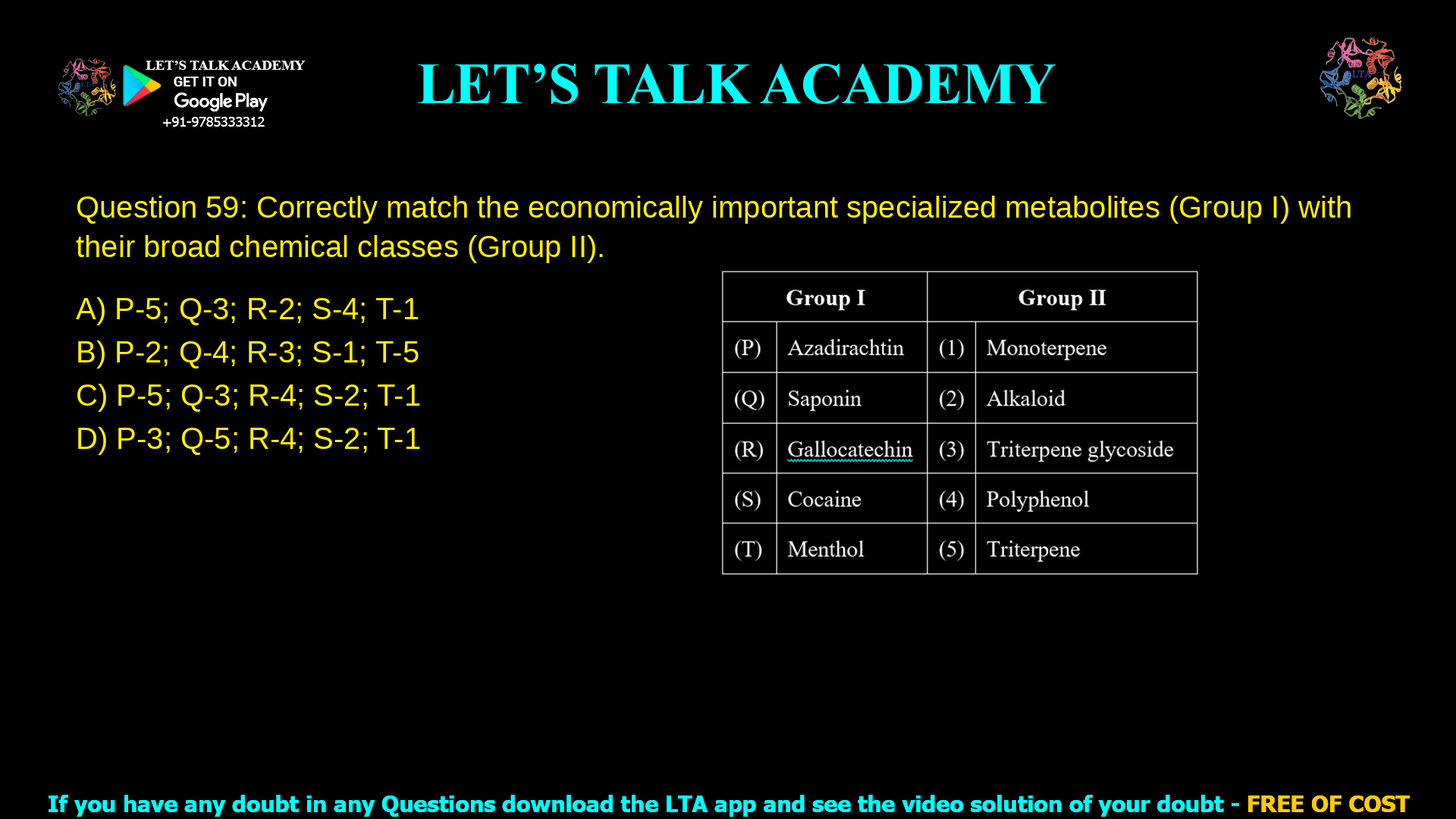
Q.59 Correctly match the economically important specialized metabolites (Group I) with their broad chemical classes (Group II).
Group I Group II
(P) Azadirachtin (1) Monoterpene
(Q) Saponin (2) Alkaloid
(R) Gallocatechin (3) Triterpene glycoside
(S) Cocaine (4) Polyphenol
(T) Menthol (5) Triterpene
(A) P-5; Q-3; R-2; S-4; T-1
(B) P-2; Q-4; R-3; S-1; T-5
(C) P-5; Q-3; R-4; S-2; T-1
(D) P-3; Q-5; R-4; S-2; T-1
Correct matching is:
P–5, Q–3, R–4, S–2, T–1, so the correct option is (A).
Question overview
The question asks to match economically important specialized metabolites (Group I) with their broad chemical classes (Group II). Terms like triterpene, monoterpene, alkaloid and polyphenol refer to major groups of plant secondary metabolites that often determine biological activity and commercial use.
Detailed matching of Group I with Group II
-
P. Azadirachtin – (5) Triterpene
-
Azadirachtin from neem (Azadirachta indica) is described as a limonoid, and limonoids are oxygenated triterpenoids derived from squalene.
-
Therefore, its correct broad class is triterpene rather than monoterpene or glycoside.
-
-
Q. Saponin – (3) Triterpene glycoside
-
Saponins are defined as glycosidic compounds whose major class is triterpenoid glycosides, meaning a triterpene aglycone (sapogenin) linked to sugar residues.
-
Hence, the most accurate broad class given among the options is triterpene glycoside.
-
-
R. Gallocatechin – (4) Polyphenol
-
Gallocatechin is a flavan‑3‑ol, a type of flavonoid with multiple phenolic hydroxyl groups, belonging to the polyphenol family widely found in tea and other plants.
-
Thus its chemical class is polyphenol, not alkaloid or terpene.
-
-
S. Cocaine – (2) Alkaloid
-
Cocaine is a tropane-type coca alkaloid, a nitrogen-containing basic compound isolated from Erythroxylum coca leaves.
-
Therefore its broad chemical class is alkaloid.
-
-
T. Menthol – (1) Monoterpene
-
Menthol is described as a cyclic monoterpene alcohol and a menthane monoterpenoid present in mint essential oils.
-
Hence, it correctly matches with the class monoterpene.
-
Why other options are incorrect
-
Option (B): P–2, Q–4, R–3, S–1, T–5
-
Assigns azadirachtin to alkaloids and menthol to triterpenes, both wrong because azadirachtin is a limonoid triterpenoid and menthol is a C10 monoterpene.
-
It also mislabels cocaine as monoterpene rather than an alkaloid.
-
-
Option (C): P–5, Q–3, R–4, S–2, T–1
-
This matches every metabolite with its correct chemical class, so this is the only fully correct option.
-
-
Option (D): P–3, Q–5, R–4, S–2, T–1
-
Swaps the classes of azadirachtin and saponin, treating azadirachtin as a glycoside and saponin as a simple triterpene, whereas saponins are explicitly triterpene glycosides and azadirachtin is not primarily classified as a glycoside.
-
Introduction
Economically important specialized metabolites such as azadirachtin, saponin, gallocatechin, cocaine and menthol play key roles in plant defense, pharmaceuticals, and agrochemicals, so understanding their chemical classes is crucial for exams and industry applications. By mastering how to match these metabolites with categories like triterpene, triterpene glycoside, polyphenol, alkaloid, and monoterpene, students can strengthen conceptual clarity in secondary metabolism and phytochemistry.
Explanation of each metabolite and its class
-
Azadirachtin – triterpene (limonoid)
-
Azadirachtin is a neem-derived insecticidal compound belonging to the limonoid group, which consists of highly oxygenated triterpenoids formed from squalene via 2,3‑oxidosqualene.
-
Limonoid triterpenes like azadirachtin are valued in biopesticides because they disrupt insect growth while being relatively safe to vertebrates.
-
-
Saponin – triterpene glycoside
-
Saponins are surface‑active glycosides widely distributed in plants, characterized by a triterpenoid aglycone (sapogenin) attached to one or more sugar chains, classifying them as triterpenoid glycosides.
-
Their ability to form foam and lyse cell membranes underlies their use in detergents, adjuvants, and pharmacological formulations.
-
-
Gallocatechin – polyphenol (flavan‑3‑ol)
-
Gallocatechin is a flavan‑3‑ol with three adjacent hydroxyl groups on the B‑ring, making it a typical tea polyphenol with strong antioxidant properties.
-
As a polyphenolic metabolite, it contributes to health benefits such as radical scavenging, anticancer activity, and cardiovascular protection.
-
-
Cocaine – alkaloid (tropane type)
-
Cocaine is a tropane alkaloid from Erythroxylum coca, classed among coca alkaloids that contain a bicyclic nitrogenous tropane ring.
-
In medicine, this alkaloid has been used as a local anesthetic, though its psychoactive and addictive properties also make it a regulated substance.
-
-
Menthol – monoterpene
-
Menthol is a cyclic monoterpene alcohol belonging to menthane monoterpenoids, a subgroup of monoterpenes with a C10 backbone derived from isoprene units.
-
This monoterpene is the cooling principle of mint oils and is widely used in flavorings, cosmetics, and topical analgesic formulations.
-
Quick reference table
| Metabolite (Group I) | Correct class (Group II) | Key points |
|---|---|---|
| Azadirachtin (P) | Triterpene (5) | Neem limonoid, complex triterpenoid insecticide. |
| Saponin (Q) | Triterpene glycoside (3) | Triterpenoid sapogenin + sugar chains, foaming agents. |
| Gallocatechin (R) | Polyphenol (4) | Flavan‑3‑ol antioxidant from tea and other plants. |
| Cocaine (S) | Alkaloid (2) | Tropane coca alkaloid, local anesthetic and drug. |
| Menthol (T) | Monoterpene (1) | Cyclic monoterpene alcohol from mint oils. |
This mapping explains why the correct option for the question is P–5, Q–3, R–4, S–2, T–1 (Option A).


