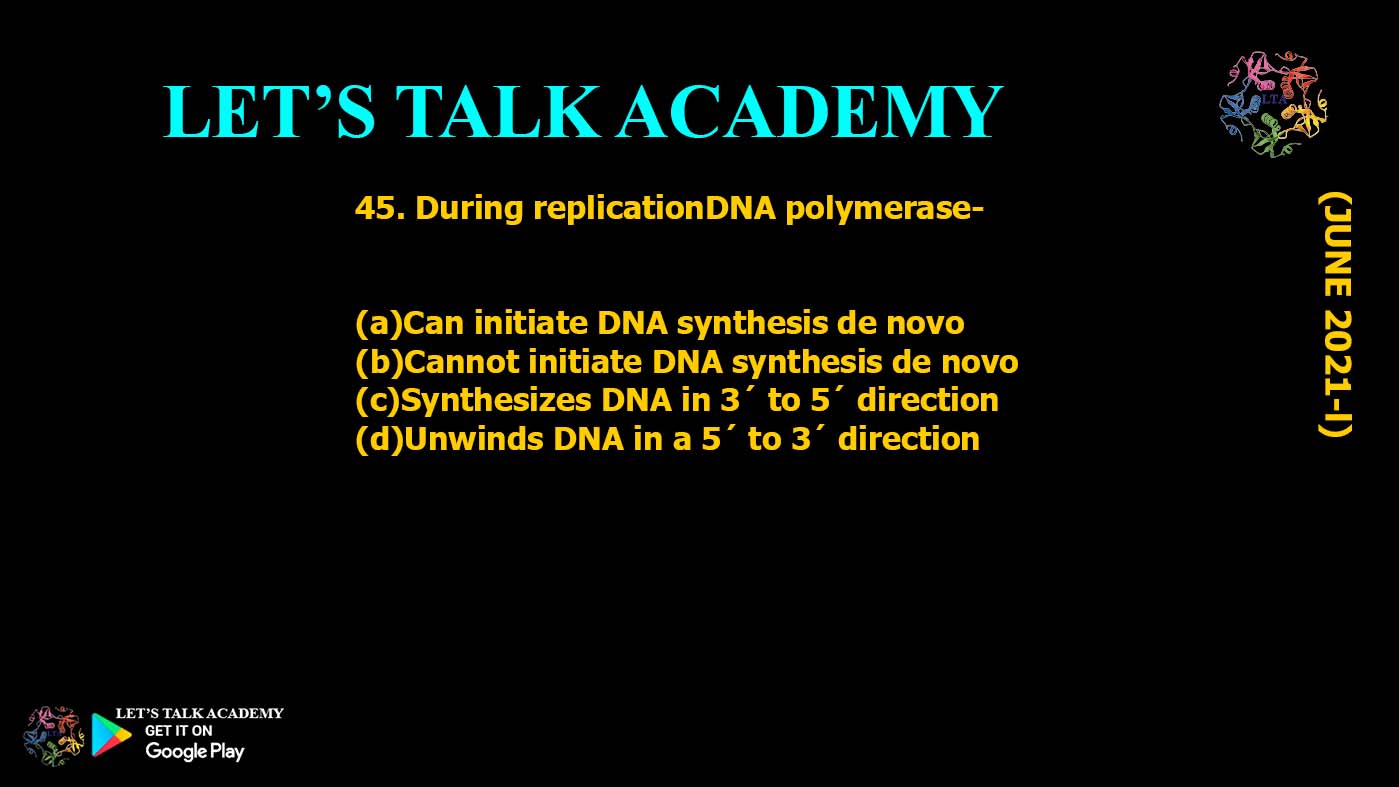
45. During replicationDNA polymerase-
(a)Can initiate DNA synthesis de novo
(b)Cannot initiate DNA synthesis de novo
(c)Synthesizes DNA in 3´ to 5´ direction
(d)Unwinds DNA in a 5´ to 3´ direction
DNA replication is a fundamental process essential for cell division and genetic inheritance. The enzyme DNA polymerase plays a central role in copying the genetic material by synthesizing new DNA strands. However, DNA polymerase has specific functional characteristics that make it indispensable to replication but also limit its activity in certain areas. One such limitation is its inability to initiate DNA synthesis de novo.
Let’s explore how DNA polymerase works during replication, and why the correct answer to this question is (b) “Cannot initiate DNA synthesis de novo.”
What Does DNA Polymerase Do During Replication?
During DNA replication, DNA polymerase works to synthesize a new strand of DNA complementary to the original strand. The process occurs in a 5′ to 3′ direction, and DNA polymerase adds nucleotides one by one to extend the growing strand.
Correct Answer: (b) Cannot initiate DNA synthesis de novo
DNA polymerase cannot initiate DNA synthesis by itself. It requires a primer, which is a short RNA strand, to begin the process. The primer provides the necessary 3′ hydroxyl group (OH) for DNA polymerase to start adding nucleotides. The primer is synthesized by an enzyme called primase, which lays down the RNA primer before DNA polymerase can take over.
DNA Polymerase Can Only Add Nucleotides to an Existing Strand
Unlike some other enzymes, such as RNA polymerase, which can initiate synthesis de novo (without the need for a primer), DNA polymerase requires a starting point. This is why the process of primer synthesis is so crucial for initiating DNA replication.
How Does DNA Polymerase Work?
-
DNA Strand Unwinding: The enzyme helicase unwinds the DNA double helix ahead of the replication fork, creating two single-stranded DNA templates.
-
Primer Binding: Primase synthesizes short RNA primers on both the leading and lagging strands.
-
DNA Synthesis: Once the primer is in place, DNA polymerase binds to the template strand and begins adding complementary nucleotides in the 5′ to 3′ direction.
-
Leading and Lagging Strands:
-
On the leading strand, DNA polymerase synthesizes a continuous strand.
-
On the lagging strand, DNA polymerase synthesizes short fragments known as Okazaki fragments, which are later joined together by DNA ligase.
-
Why DNA Polymerase Cannot Synthesize in the 3′ to 5′ Direction
DNA polymerase synthesizes DNA in the 5′ to 3′ direction. This is due to the inherent structure of nucleotides and the need for a 3′ hydroxyl group (OH) to attach the incoming nucleotide.
The 3′ to 5′ direction is impossible for DNA polymerase because:
-
The nucleotides have to be added to the 3′ end of the growing strand.
-
Adding nucleotides in the opposite direction would be energetically unfavorable and require an entirely different mechanism.
Thus, DNA polymerase operates in a 5′ to 3′ direction when synthesizing new DNA strands, making it the key enzyme in copying genetic material.
DNA Polymerase Does Not Unwind DNA
While DNA polymerase is crucial for adding nucleotides, it does not unwind the DNA strands. This task is carried out by the helicase enzyme. Helicase unwinds the DNA helix ahead of the replication fork, allowing the single strands to serve as templates for the polymerase enzyme to work.
Conclusion
To summarize:
-
DNA polymerase cannot initiate DNA synthesis de novo; it requires a primer to begin the process.
-
DNA polymerase synthesizes DNA in the 5′ to 3′ direction and works by adding nucleotides to an existing strand, not by creating new strands on its own.
✅ Correct Answer: (b) Cannot initiate DNA synthesis de novo
Understanding the specific functions and limitations of DNA polymerase is key to comprehending how genetic information is faithfully copied during DNA replication.


6 Comments
Pallavi gautam
April 22, 2025Yes sir✅
Vikram
April 22, 2025🪷🏻
Akshay mahawar
April 24, 2025Done 👍
Vaidehi Sharma
May 1, 2025✅Done
yogesh sharma
May 8, 2025Done sir
Khushi Vaishnav
July 31, 2025DNA polymerase cannot initiate DNA synthesis de novo; it requires a primer to begin the process.