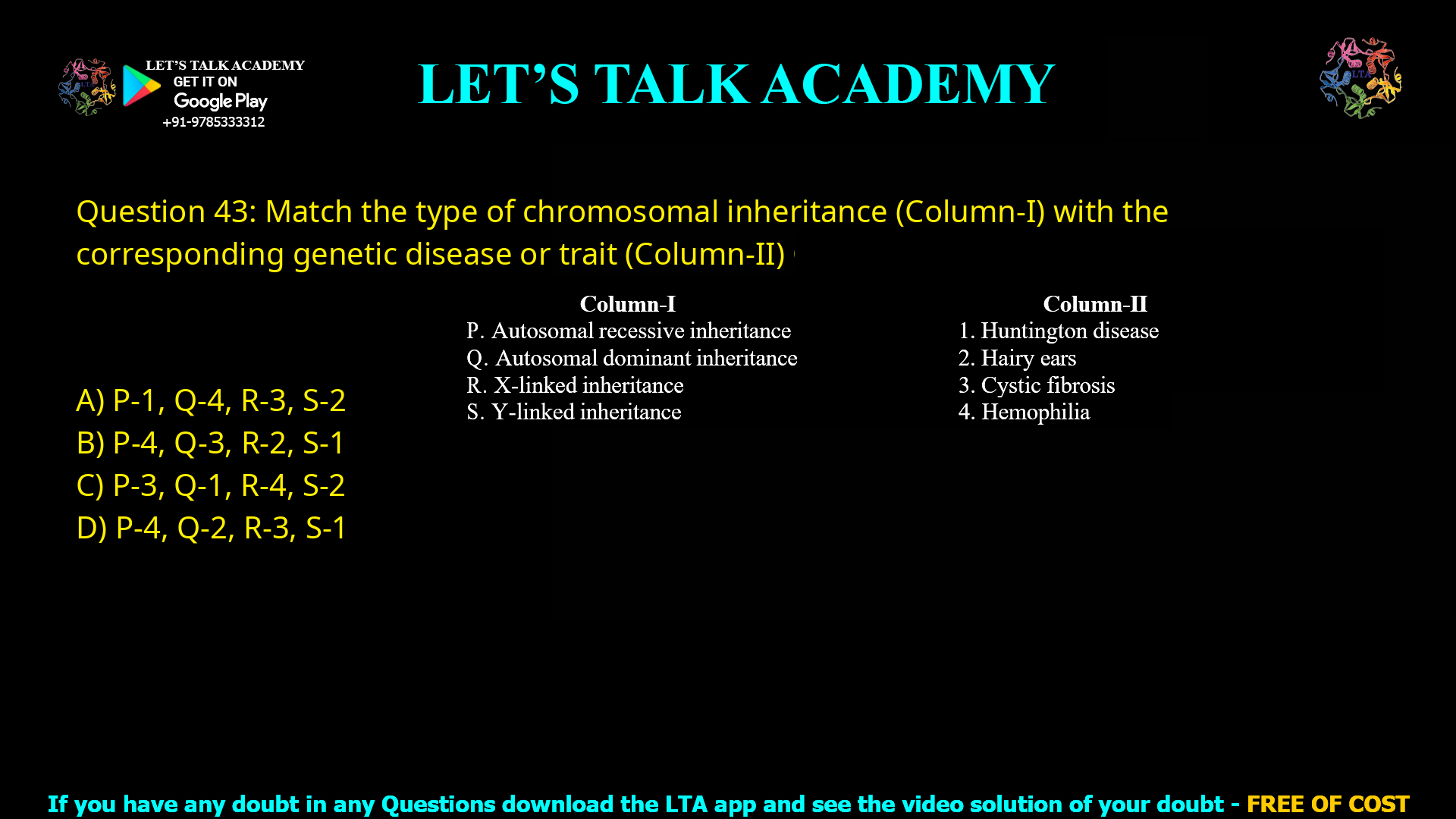
Q.43 Match the type of chromosomal inheritance (Column-I) with the corresponding genetic disease or
trait (Column-II).
Column-I Column-II
P. Autosomal recessive inheritance 1. Huntington disease
Q. Autosomal dominant inheritance 2. Hairy ears
R. X-linked inheritance 3. Cystic fibrosis
S. Y-linked inheritance 4. Hemophilia
(A) P-1, Q-4, R-3, S-2 (B) P-4, Q-3, R-2, S-1
(C) P-3, Q-1, R-4, S-2 (D) P-4, Q-2, R-3, S-1
Chromosomal Inheritance Patterns Matching Genetic Diseases: MCQ Solution for Q.43
Chromosomal inheritance patterns determine how genetic diseases manifest across generations, with autosomal recessive requiring two mutant alleles, dominant needing one, X-linked affecting males disproportionately, and Y-linked being father-to-son traits. The correct matching aligns classic examples for medical genetics exams.
Correct Pairings
-
P. Autosomal recessive inheritance → 3. Cystic fibrosis: Requires biallelic CFTR mutations; 1/2500 Caucasians affected, carrier frequency 1/25.
-
Q. Autosomal dominant inheritance → 1. Huntington disease: HTT CAG repeat (>36) on one allele causes late-onset neurodegeneration; 50% transmission risk.
-
R. X-linked inheritance → 4. Hemophilia: F8/F9 mutations; males hemizygous, females carriers; classic pedigree skips generations via females.
-
S. Y-linked inheritance → 2. Hairy ears: Hypertrichosis of pinna; holandric trait passed exclusively male line (rare, debated penetrance).
Option Evaluation
| Option | P (Recessive) | Q (Dominant) | R (X-linked) | S (Y-linked) | Correct? |
|---|---|---|---|---|---|
| (A) | 1 (Huntington) | 4 (Hemophilia) | 3 (CF) | 2 (Hairy ears) | ❌ All wrong |
| (B) | 4 (Hemophilia) | 3 (CF) | 2 (Hairy ears) | 1 (Huntington) | ❌ All wrong |
| (C) | 3 (Cystic fibrosis) | 1 (Huntington) | 4 (Hemophilia) | 2 (Hairy ears) | ✅ Perfect match |
| (D) | 4 (Hemophilia) | 2 (Hairy ears) | 3 (CF) | 1 (Huntington) | ❌ Wrong |
Correct Answer
(C) P-3, Q-1, R-4, S-2. Standard medical genetics associations confirmed across pedigrees and OMIM database.
Chromosomal inheritance genetic disease matching reveals how pedigree patterns predict disease risk across generations. Autosomal recessive diseases like cystic fibrosis require carrier parents; dominant ones like Huntington manifest in heterozygotes; X-linked hemophilia spares female carriers; Y-linked hairy ears transmit father-to-son exclusively—essential for genetic counseling and exam pedigrees.
Inheritance Pattern Characteristics
-
Autosomal recessive (P-3, Cystic fibrosis): CFTR ΔF508 mutation; salty skin, lung infections, pancreatic insufficiency; 25% risk if both parents carriers.
-
Autosomal dominant (Q-1, Huntington): Chromosome 4p16.3 CAG expansion; chorea, dementia onset 30-50y; anticipation via trinucleotide repeat.
-
X-linked recessive (R-4, Hemophilia A/B): Factor VIII/IX deficiency; prolonged bleeding; males 1/5000, females rarely symptomatic.
-
Y-linked/holandric (S-2, Hairy ears): ABCC9 or related; terminal pinna hypertrichosis; 100% male transmission, no recombination.
Exam Strategy & Mnemonics
Pedigree clues: Recessive=horizontal (siblings), Dominant=vertical (generations), X-linked=no male-to-male, Y-linked=only males. C-H-H-H: CF (recessive), Huntington (dominant), Hemophilia (X), Hairy ears (Y). Option (C) fits all loci: CFTR(7), HTT(4), F8(Xq), Yp11.
CRISPR applications target triplet repeats (Huntington) and CFTR correction, with 15+ trials by 2026, transforming inheritance-based medicine.


