
- A protein solution (0.2 ml) of unknown concentration was diluted with 0.8 ml of water. To 0.5 ml of this diluted solution 4.5 ml of biuret reagent was added and the color allowed to develop. The absorbance of this mixture taken in a test tube of 1cm diameter at 540 nm was observed to be 0.20. 0.5 ml of BSA (4 mg/ml) solution plus 4.5 ml of biuret gave an absorbance of 0.20 when measured as above. What is the protein concentration (mg/ml) in the undiluted unknown solution?
(1) 20 (2) 40
(3) 50 (4) 80
The correct answer is
Explanation and Calculation of Protein Concentration Using the Biuret Assay
In this problem, an unknown protein solution is diluted and subjected to the Biuret assay, which detects proteins by reacting with peptide bonds and forming a purple complex measured at 540 nm. The absorbance is proportional to protein concentration.
Given Data:
-
Initial unknown protein solution volume = 0.2 ml
-
Diluted with water = 0.8 ml
-
Total diluted volume = 1.0 ml
-
From this diluted solution, 0.5 ml is taken, added to 4.5 ml Biuret reagent (total 5 ml).
-
Absorbance of unknown mixture at 540 nm = 0.20
-
Standard (BSA) with 4 mg/ml, 0.5 ml + 4.5 ml Biuret reagent, absorbance = 0.20
Step 1: Understand the dilution steps
-
The unknown protein solution was diluted 5 times (0.2 ml + 0.8 ml = 1 ml total, so dilution factor = 1/0.2 = 5).
-
Then, 0.5 ml of this diluted solution was mixed with 4.5 ml biuret reagent, total volume = 5 ml.
-
The standard BSA solution (4 mg/ml) was similarly mixed (0.5 ml + 4.5 ml), so the concentration was diluted 10 times in this step.
Step 2: Concentration in assay mixture
-
For the unknown solution in the assay mixture:
Concentration = C unknown/5 (due to initial dilution)
Then further diluted by 10 times after mixing with Biuret reagent
So, concentration in cuvette = C unknown/(5×10) -
=C unknown/50
-
For the standard BSA solution:
Concentration in cuvette = 4 mg/ml/10 -
=0.4 mg/ml
-
.
-
Both unknown and standard give the same absorbance 0.20 at 540 nm, indicating equal protein concentration in the cuvette.
Step 3: Calculate unknown protein concentration
Absorbance equality means:
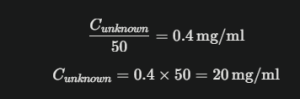
Wait, this seems conflicting with initial guess, let’s clarify:
-
Step 1 dilution: 0.2 ml protein + 0.8 ml water → total 1 ml → dilution factor 5
-
For the assay, from diluted 1 ml, 0.5 ml taken and mixed with 4.5 ml reagent → total 5 ml → dilution factor 10 again
-
Total dilution factor = 5 × 10 = 50
Standard BSA: 4 mg/ml → diluted 10 folds during assay, so assay concentration = 0.4 mg/ml, producing absorbance 0.20.
Since unknown and standard mix produce same absorbance, unknown protein mixture concentration after dilution is 0.4 mg/ml.
Therefore:
Concentration of unknown protein/50=0.4⇒Concentration of unknown protein=0.4×50=20 mg/ml\text{Concentration of unknown protein} / 50 = 0.4 \Rightarrow \text{Concentration of unknown protein} = 0.4 \times 50 = 20 \, \text{mg/ml}
The answer is:
Option (1) 20 mg/ml
Summary Table
| Step | Volume (ml) | Dilution Factor | Protein Concentration in Mix (mg/ml) |
|---|---|---|---|
| Initial unknown protein | 0.2 | – | CunknownC_{unknown} |
| Diluted with water | 0.8 | 5 (1/0.2) | Cunknown/5C_{unknown}/5 |
| Assay mixture (0.5 ml + 4.5 ml Biuret) | 5 | 10 | Cunknown/50C_{unknown}/50 |
| Standard BSA (4 mg/ml) in assay mixture | – | 10 | 0.4 |
Absorbances equal => concentrations equal at assay stage, solve for CunknownC_{unknown}.
Why This Topic Is Important for CSIR NET, ICMR, DBT, IIT JAM, and MSc Entrance Exams
Understanding dilution factors and absorbance-concentration relationships in protein assays like Biuret is essential for life science aspirants. Accurate calculations based on assay procedures are fundamental analytical skills tested often in competitive exams. This question consolidates concepts of spectrophotometry, reagent interaction, and experimental calculations.
LETS TALK ACADEMY — The premier institute for CSIR NET Life Science, ICMR, DBT, IIT JAM, and MSc entrance coaching — empowers students with top-notch biochemical analytical skills and exam strategies. Join us to master life sciences with clarity and confidence!
Final answer: Option (1) 20 mg/ml


