8. A group of 3 cells, the P6p, P5p and the anchor cell are clustered together in the C.elegans hypodermis. Normally the P6p cell gives divides 3 times and forms […]

8. A group of 3 cells, the P6p, P5p and the anchor cell are clustered together in the C.elegans hypodermis. Normally the P6p cell gives divides 3 times and forms […]

7. A genetic cross was set between two heterozygous mice with agouti coat colour. Agouti is dominant over normal coat colour. The F1 phenotypic ratio with regards to coat colour […]

6. Biologist Lynn Margulis is a proponent of the theory of endosymbiosis, which suggests that the mitochondria of modern eukaryotic cells evolved from bacteria living symbiotically within early eukaryotic cells. […]

5. A human cell passes through 4 phases called A, B, C and D, each phase lasting for different lengths of time. At the end of D the cell returns […]

4. Which of the following amino acids to you expect to find in higher proportion within histones compared to a cytoskeletal protein? a. K and R b. L and A […]

3. At which mitotic stage can standard karyotyping be performed using photomicroscopy of cells? a. Interphase b. Prophase c. Metaphase d. Anaphase Introduction Standard karyotyping is a cytogenetic technique that […]
2. The 2020 Nobel prize in Chemistry was awarded to Jennifer Doudna and Emmanuel Charpentier for their work on developing CRISPR-Cas system for gene editing. This system is naturally: a. […]
1. Making a protein from a gene in eukaryotic cells involves: a. first, transport of mRNA, then its processing, then transcription, then translation b. first, transcription of the RNA, then […]
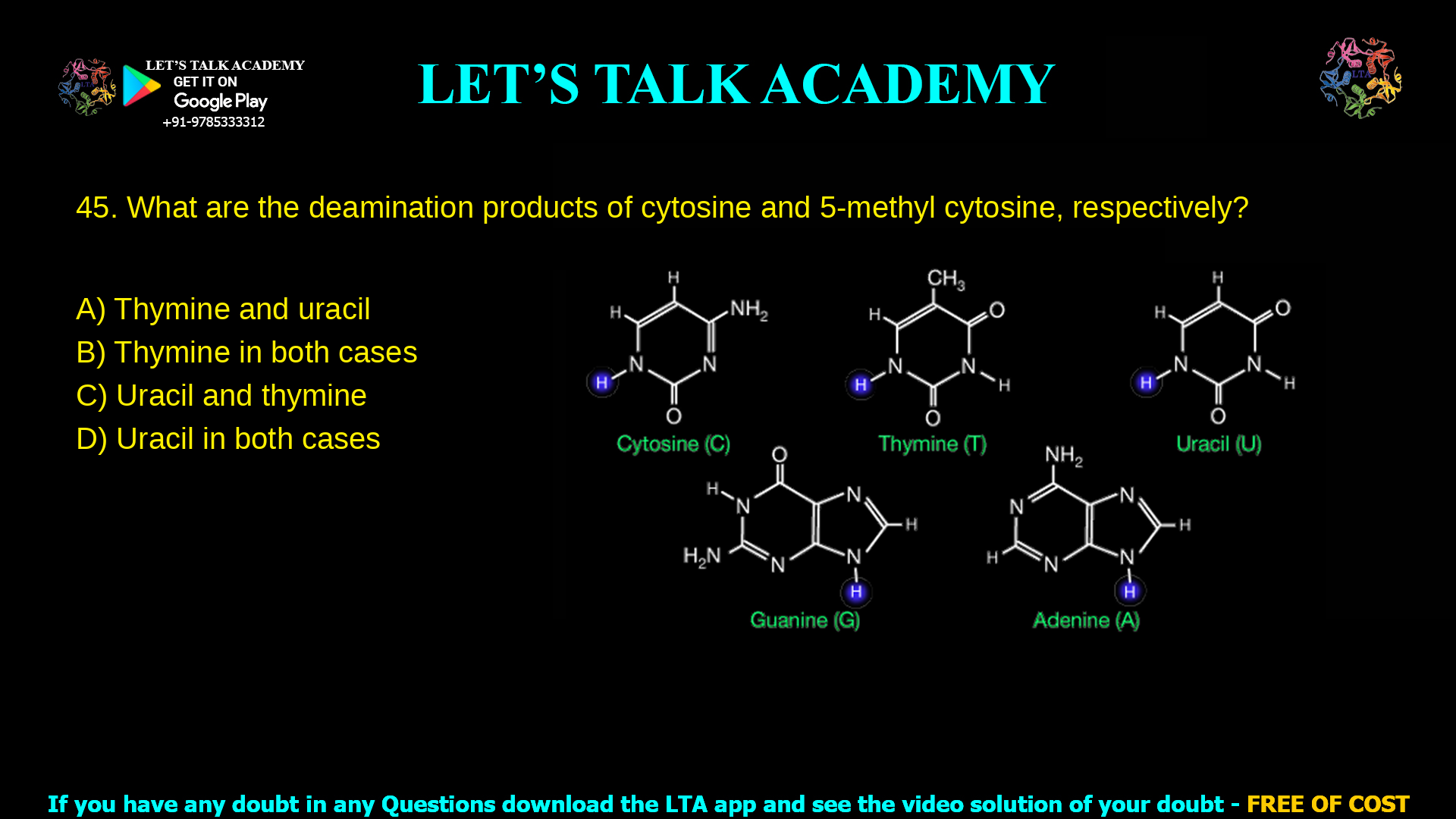
15. What are the deamination products of cytosine and 5-methyl cytosine, respectively? a. Thymine and uracil b. Thymine in both cases c. Uracil and thymine d. Uracil in both cases […]
14. You find that a compound with the formula C5H10O has 4 peaks in its 1H-NMR spectrum. What is the chemical? a. 3-methylbutan-2-one b. pentanal c. pentan-2-one d. pentan-3-one The […]


