Q.9
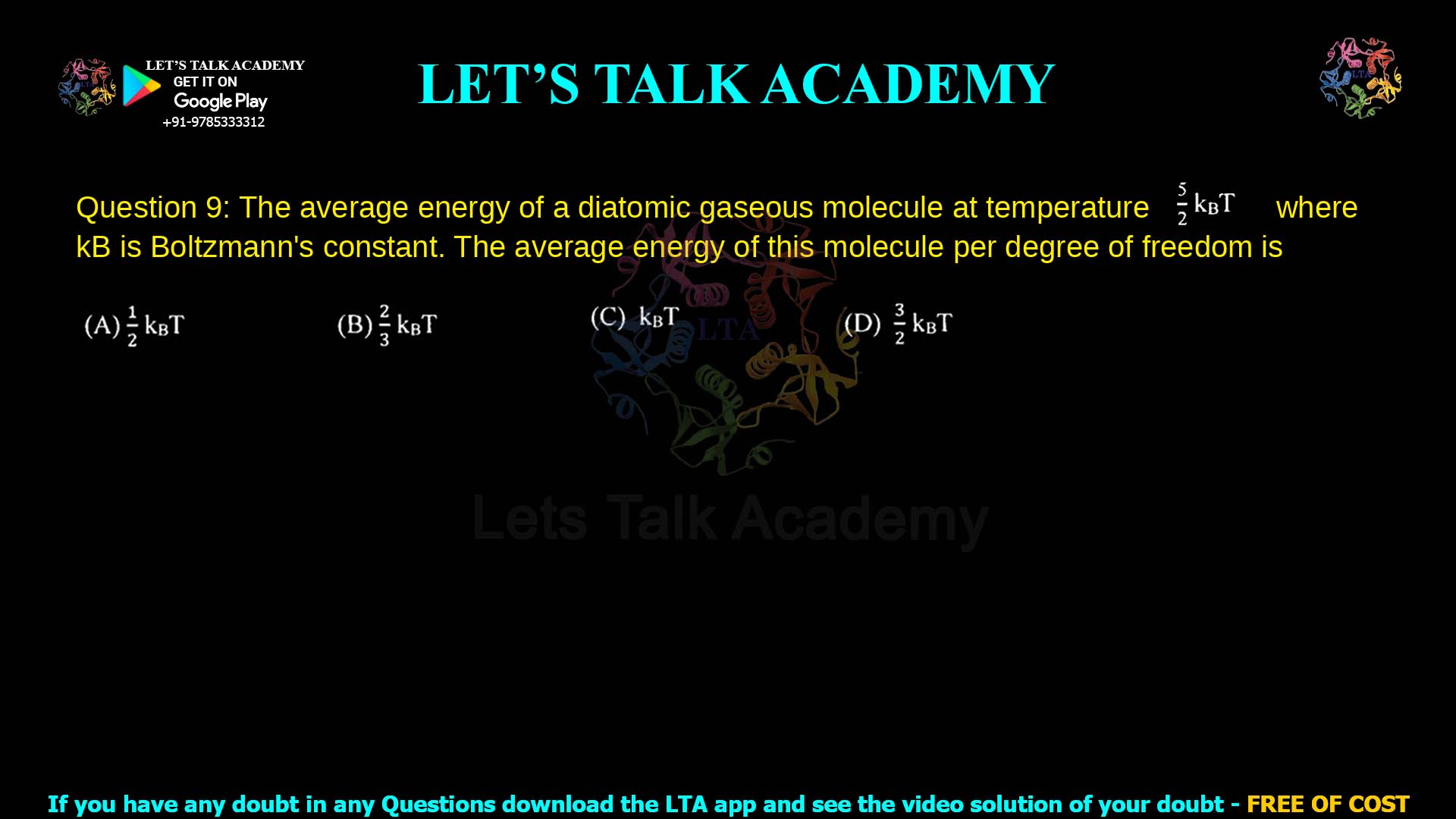
The average energy of a diatomic gaseous molecule at temperature T is kBT where kB is Boltzmann’s constant. The average energy of this molecule per degree of freedom is
(A) ½ kBT
(B) 2⁄3 kBT
(C) kBT
(D) 2⁄5 kBT
The correct answer is (A) ½ kBT.
According to the equipartition theorem, each degree of freedom contributes an average energy of ½ kBT to a molecule in thermal equilibrium, where kB is Boltzmann’s constant and T is temperature. The question states the total average energy of the diatomic molecule is kBT, but standard physics shows it as (5/2) kBT at room temperature (3 translational + 2 rotational degrees of freedom). The query directly asks for energy per degree of freedom, which remains ½ kBT regardless of total degrees or the given total energy value.
Option Analysis
-
(A) ½ kBT: Correct. Equipartition theorem assigns ½ kBT per quadratic degree of freedom (translational, rotational, or vibrational).
-
(B) 2/3 kBT: Incorrect. This equals total translational energy divided by 3 translational degrees ( (3/2 kBT)/3 ), but ignores equal contribution per degree.
-
(C) kBT: Incorrect. Matches neither per-degree energy nor typical diatomic total (which is 5/2 kBT); possibly confuses with vibrational mode (kinetic + potential).
-
(D) 2/5 kBT: Incorrect. Reverses logic; if total were 2 kBT over 5 degrees, per-degree would still be ½ kBT (2 kBT / 5 = 2/5 kBT), but theorem fixes it at ½ kBT.
Degrees of Freedom
Diatomic molecules (e.g., N2, O2) have 5 degrees at room temperature: 3 translational (x, y, z motion) and 2 rotational (about axes perpendicular to bond). Total energy = 5 × (½ kBT) = (5/2) kBT. Vibrational modes (2 more degrees) activate at high T (>1000 K), raising total to 7/2 kBT.
The average energy of a diatomic gaseous molecule per degree of freedom is a core concept in kinetic theory of gases, vital for CSIR NET Life Sciences and physics exams. At temperature T, this energy equals ½ kBT, where kB is Boltzmann’s constant, per the equipartition theorem. This holds for translational, rotational, and (at high T) vibrational modes, ensuring equal energy sharing across degrees of freedom.
Equipartition Theorem Basics
The theorem states each quadratic term in energy (e.g., ½ mv² for translation) contributes ½ kBT on average. For diatomic gases like O2 or N2, room-temperature degrees of freedom total 5, yielding molecule total energy of (5/2) kBT—not kBT as some questions state, possibly testing per-degree focus.
Diatomic vs Monatomic Comparison
| Gas Type | Degrees of Freedom | Total Energy per Molecule | Energy per Degree of Freedom |
|---|---|---|---|
| Monatomic (e.g., He) | 3 (translational) | (3/2) kBT | ½ kBT |
| Diatomic (room T) | 5 (3 trans + 2 rot) | (5/2) kBT | ½ kBT |
| Diatomic (high T) | 7 (adds 2 vib) | (7/2) kBT | ½ kBT |
CSIR NET Exam Insights
Questions often twist totals (e.g., stating kBT) to check per-degree recall: always ½ kBT. Practice: If total energy = f × (½ kBT), solve for f or verify options. Vibrations freeze at low T, keeping f=5 for N2/O2.


