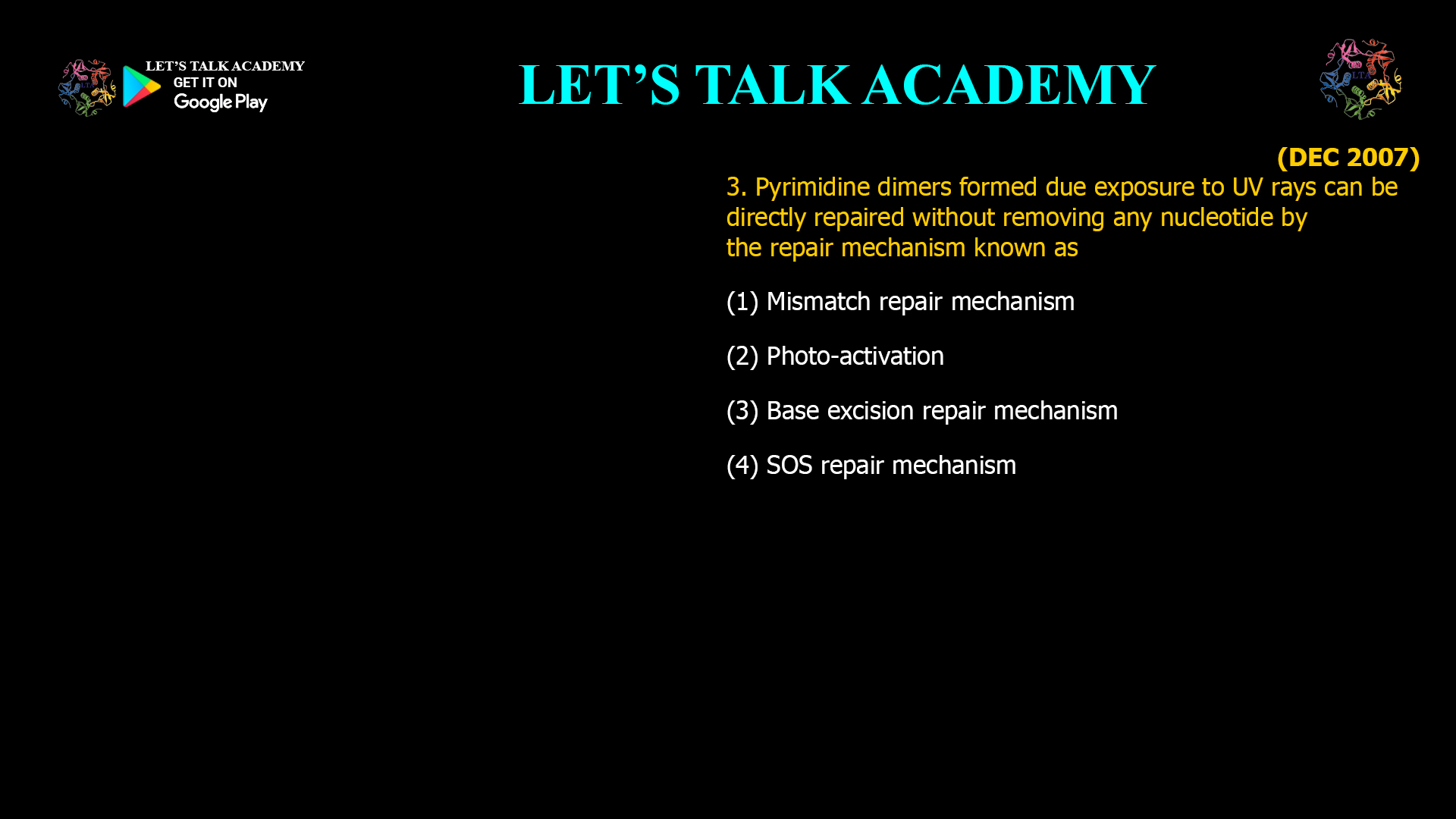
- Pyrimidine dimers formed due exposure to UV rays can be directly repaired without removing any nucleotide by the repair mechanism known as
(1) Mismatch repair mechanism
(2) Photo-activation
(3) Base excision repair mechanism
(4) SOS repair mechanism
Direct Repair of UV-Induced Pyrimidine Dimers: The Role of Photoreactivation
Ultraviolet (UV) radiation from the sun is a major cause of DNA damage in living organisms, particularly through the formation of pyrimidine dimers. These lesions can disrupt DNA replication and transcription, potentially leading to mutations and even cancer if not repaired. Fortunately, cells have evolved sophisticated mechanisms to counteract this damage. Among these, photoreactivation stands out as a unique and efficient process for directly repairing pyrimidine dimers without removing any nucleotides. This article explores the repair mechanism, the correct answer, and related keywords for search engine optimization.
Understanding UV-Induced Pyrimidine Dimers
When DNA is exposed to UV light, particularly UV-B and UV-C, adjacent pyrimidine bases—thymine or cytosine—can form covalent bonds, creating pyrimidine dimers. The most common types are cyclobutane pyrimidine dimers (CPDs) and 6-4 photoproducts. These lesions distort the DNA helix, block replication and transcription, and are considered pre-mutagenic, meaning they can lead to mutations if left unrepaired241.
DNA Repair Mechanisms for Pyrimidine Dimers
Several DNA repair pathways exist to address UV-induced damage, but not all are equally direct or efficient:
-
Mismatch Repair (Option 1): This mechanism corrects errors that occur during DNA replication, such as mismatched base pairs. It does not repair pyrimidine dimers.
-
Photo-activation (Option 2): This is a colloquial term for photoreactivation, the process by which the enzyme photolyase uses light energy to directly reverse pyrimidine dimers.
-
Base Excision Repair (Option 3): This pathway involves the removal of damaged or inappropriate bases, followed by replacement with the correct ones. It does not directly repair pyrimidine dimers.
-
SOS Repair (Option 4): Also known as translesion synthesis, this is an error-prone process that allows DNA replication to proceed past lesions but does not remove or repair the damage directly.
Photoreactivation: The Direct Repair Mechanism
Photoreactivation is the process by which the enzyme photolyase binds to pyrimidine dimers and, using energy from visible or near-UV light (typically blue light, 300–500 nm), directly reverses the damage. The original pyrimidine bases remain in place, and no nucleotides are removed or replaced186. This makes photoreactivation one of the most efficient and elegant DNA repair mechanisms.
How Photoreactivation Works
-
Photolyase Binds to the Damage: The enzyme recognizes and binds specifically to the site of the pyrimidine dimer.
-
Light Absorption: Photolyase absorbs a photon of blue or near-UV light.
-
Energy Transfer: The absorbed energy is used to break the covalent bonds in the dimer.
-
DNA Restoration: The dimer is split, and the DNA is restored to its original, undamaged state.
-
Enzyme Release: Photolyase releases the repaired DNA and is ready for another cycle.
This process is called direct reversal because it does not involve excision of nucleotides or use of a template strand for repair185.
Why Other Repair Mechanisms Are Not Correct
-
Mismatch Repair: Targets replication errors, not UV-induced dimers.
-
Base Excision Repair: Involves removal and replacement of damaged bases, not direct reversal.
-
SOS Repair: Allows replication past lesions but does not repair them.
Importance of Photoreactivation in Nature
Photoreactivation is common in many prokaryotes and some eukaryotes, including bacteria, plants, and certain animals. However, it is notably absent in humans and other mammals, which rely on other repair pathways such as nucleotide excision repair to fix UV damage524. Despite this, photoreactivation remains a powerful example of nature’s ingenuity in maintaining genomic stability.
Related Keywords for SEO Optimization
-
Pyrimidine dimers repair
-
Photoreactivation
-
Direct DNA repair mechanism
-
UV-induced DNA damage
-
Photolyase enzyme
-
Cyclobutane pyrimidine dimers
-
DNA repair enzymes
-
UV radiation DNA damage
-
Photo-activation repair
-
Base excision repair vs photoreactivation
-
SOS repair mechanism
-
DNA photolesions
-
Direct reversal of DNA damage
-
UV-B and UV-C DNA damage
-
Photoreactivation process
-
DNA repair pathways
Summary Table: DNA Repair Mechanisms for Pyrimidine Dimers
Mechanism Direct Reversal? Removes Nucleotides? Correct for UV Dimers? Mismatch Repair No Yes No Photoreactivation Yes No Yes Base Excision Repair No Yes No SOS Repair No No No
Conclusion
Pyrimidine dimers formed due to exposure to UV rays can be directly repaired without removing any nucleotides by the repair mechanism known as photoreactivation (photo-activation), which is the correct answer to the question (2) Photo-activation. This process is mediated by the photolyase enzyme and is a prime example of direct reversal in DNA repair, ensuring genomic integrity in many organisms
-


6 Comments
Deepika Sheoran
November 4, 2025Photoreactivation
Enzyme photolyase uses light energy to directly reverse pyrimidine dimers.
Sakshi Kanwar
November 7, 2025Photo-activation directly repaired without removing any nucleotides
Sonal Nagar
November 7, 2025Photoactivation
Muskan Yadav
November 7, 2025Photo-activation (Option 2) is correct.
Divya rani
November 8, 2025Photo activation for direct repair of pyrimidine dimer.
Komal Sharma
November 11, 2025Pyrimidine dimers formed due to exposure to UV rays can be directly repaired without removing any nucleotides by the repair mechanism known as photoreactivation (photo-activation)