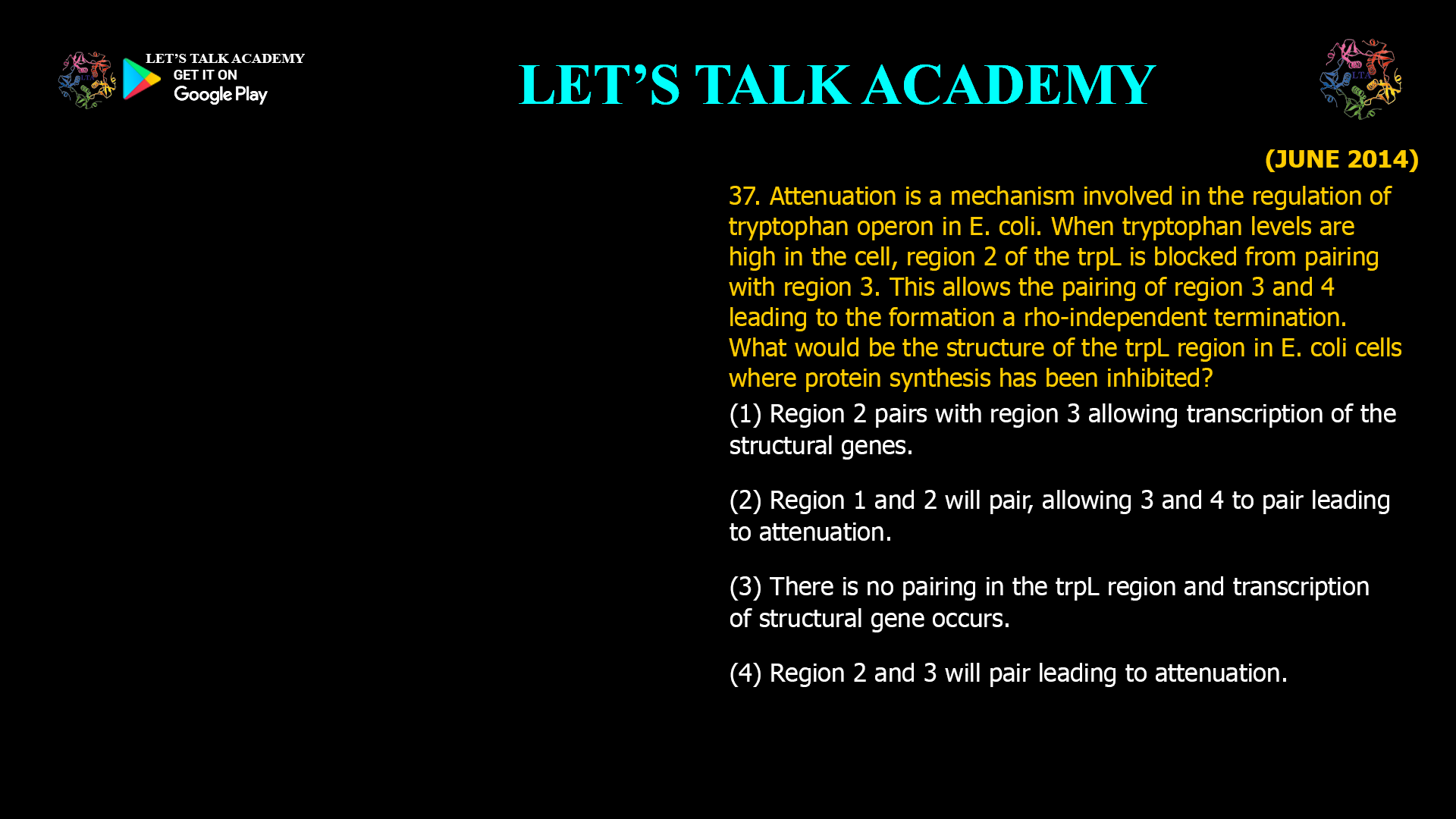
37. Attenuation is a mechanism involved in
the regulation of tryptophan operon in E. coli.
When tryptophan levels are high in the cell,
region 2 of the trpL is blocked from pairing
with region 3. This allows the pairing of
region 3 and 4 leading to the formation a
rho-independent termination.
What would be the structure of the trpL
region in E. coli cells where protein synthesis
has been inhibited?
(1) Region 2 pairs with region 3 allowing
transcription of the structural genes.
(2) Region 1 and 2 will pair, allowing 3 and 4
to pair leading to attenuation.
(3) There is no pairing in the trpL region and
transcription of structural gene occurs.
(4) Region 2 and 3 will pair leading to
attenuation.
The tryptophan (trp) operon in Escherichia coli is a classic example of gene regulation that integrates multiple layers of control to ensure efficient biosynthesis of tryptophan. Among these, attenuation is a sophisticated regulatory mechanism that fine-tunes operon expression in response to intracellular tryptophan levels. This article explores the structural dynamics of the trpL (leader) region during attenuation, especially when protein synthesis is inhibited, and explains the consequences for trp operon transcription.
Overview of Attenuation in the trp Operon
Attenuation is a regulatory process that controls the continuation of transcription into the structural genes of the trp operon based on the availability of tryptophan. The trpL region, located between the promoter and the first structural gene, encodes a short leader peptide and contains four segments (regions 1–4) that can form alternative secondary structures in the mRNA148.
When tryptophan is abundant, the ribosome quickly translates the leader peptide, blocking the pairing of region 2 with region 3. This allows region 3 to pair with region 4, forming a rho-independent transcription terminator (attenuator). As a result, transcription is prematurely terminated, and the structural genes are not expressed458.
Conversely, when tryptophan is scarce, the ribosome stalls at the tandem tryptophan codons in the leader peptide, preventing region 1 from pairing with region 2 and allowing region 2 to pair with region 3. This 2–3 pairing forms an antiterminator structure, which prevents the formation of the 3–4 terminator and allows transcription to continue into the structural genes458.
The Role of Protein Synthesis in Attenuation
Protein synthesis (translation) is crucial for attenuation because the ribosome’s position on the leader peptide mRNA determines which secondary structures can form. The ribosome’s movement is directly influenced by the availability of charged tryptophan tRNA: high tryptophan allows rapid translation, while low tryptophan causes the ribosome to stall458.
Scenario: Inhibition of Protein Synthesis
When protein synthesis is inhibited (for example, by antibiotics like chloramphenicol or by experimental conditions), ribosomes are unable to initiate or continue translation of the leader peptide. This has important implications for the secondary structure of the trpL mRNA and, consequently, for attenuation.
Effect on trpL mRNA Structure
With protein synthesis inhibited, no ribosome is present on the leader mRNA to block the pairing of any region. Under these conditions, the mRNA can adopt its most stable secondary structure. The leader region is designed so that, in the absence of ribosome interference, region 1 pairs with region 2, and region 3 pairs with region 4458.
-
Region 1–2 Pairing: When region 1 pairs with region 2, it frees up region 3 to pair with region 4.
-
Region 3–4 Pairing: The pairing of region 3 with region 4 forms the rho-independent transcription terminator, leading to attenuation.
Thus, in the absence of ribosome stalling or interference, the default outcome is the formation of the terminator structure and premature termination of transcription.
Why Does This Happen?
The attenuation mechanism is based on the competition between two possible hairpin structures:
-
Antiterminator (2–3 pairing): Prevents terminator formation and allows transcription to continue.
-
Terminator (3–4 pairing): Causes transcription to stop.
Normally, the ribosome’s position determines which structure forms. If the ribosome stalls at the tryptophan codons (low tryptophan), it blocks region 1, allowing region 2 to pair with region 3 (antiterminator). If the ribosome translates the leader peptide (high tryptophan), it blocks region 2, allowing region 3 to pair with region 4 (terminator). If there is no ribosome (protein synthesis inhibited), the default is terminator formation458.
Answering the Question
The question asks:
“Attenuation is a mechanism involved in the regulation of tryptophan operon in E. coli. When tryptophan levels are high in the cell, region 2 of the trpL is blocked from pairing with region 3. This allows the pairing of region 3 and 4 leading to the formation a rho-independent termination.
What would be the structure of the trpL region in E. coli cells where protein synthesis has been inhibited?
(1) Region 2 pairs with region 3 allowing transcription of the structural genes.
(2) Region 1 and 2 will pair, allowing 3 and 4 to pair leading to attenuation.
(3) There is no pairing in the trpL region and transcription of structural gene occurs.
(4) Region 2 and 3 will pair leading to attenuation.”
The correct answer is (2) Region 1 and 2 will pair, allowing 3 and 4 to pair leading to attenuation.
When protein synthesis is inhibited, no ribosome is present to block the pairing of region 1 with region 2. This allows region 3 to pair with region 4, forming the terminator structure and causing attenuation458.
Biological Significance
Attenuation ensures that the trp operon is only expressed when tryptophan is truly needed, conserving cellular resources. The coupling of transcription and translation is essential for this regulation, as it allows the cell to monitor tryptophan availability in real time. Inhibition of protein synthesis disrupts this coupling, leading to default termination of transcription.
Practical Implications
Understanding the structural dynamics of the trpL region is important for genetic engineering and synthetic biology. By manipulating leader sequences or inhibiting translation, scientists can control the expression of genes in bacteria, optimizing the production of desired proteins or metabolic products.
Comparison with Other Regulatory Mechanisms
The trp operon is regulated by both repression and attenuation. Repression blocks transcription initiation when tryptophan is present, while attenuation allows transcription to begin but terminates it prematurely under the same conditions. The combination of these mechanisms provides robust control over tryptophan biosynthesis345.
Conclusion
In summary, when protein synthesis is inhibited in E. coli, the trpL mRNA adopts a secondary structure in which region 1 pairs with region 2, allowing region 3 to pair with region 4. This results in the formation of the rho-independent transcription terminator and attenuation of transcription. Thus, the correct answer to the question is (2) Region 1 and 2 will pair, allowing 3 and 4 to pair leading to attenuation.
This mechanism highlights the elegance of bacterial gene regulation and the importance of coupling between transcription and translation for efficient metabolic control.


3 Comments
Heena Mahlawat
November 6, 2025Option 2
Hanshika Bansal
November 8, 2025Pair 1 and 2 and 3 and 4 this leads to attenuation
Sakshi yadav
November 30, 2025Option 2