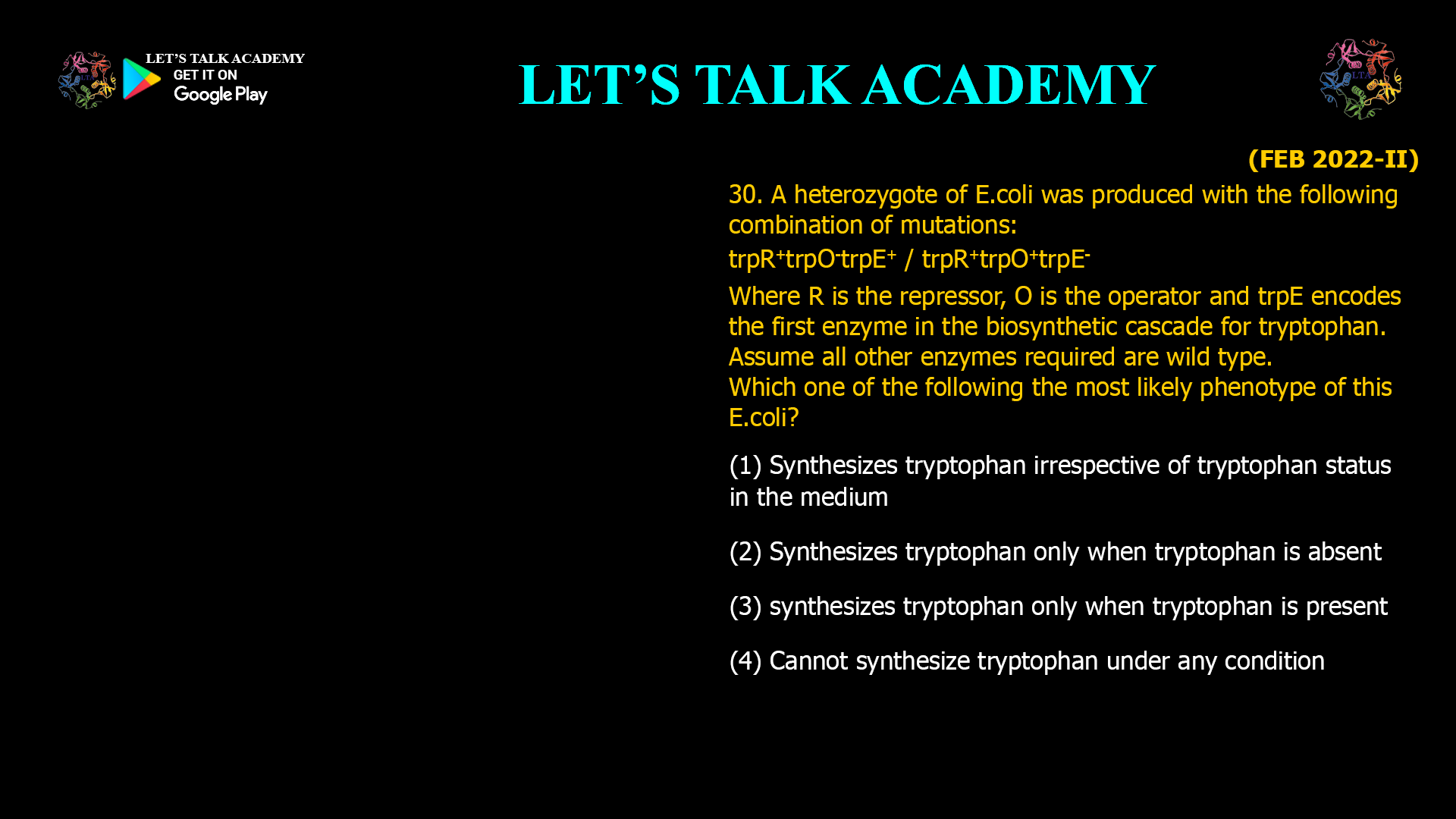
30. A heterozygote of E.coli was produced with the following combination of mutations:
trpR+ trpO– trpE+ / trpR+ trpO+ trpE–
Where R is the repressor, O is the operator and trpE encodes the first enzyme in the biosynthetic cascade for tryptophan. Assume all other enzymes required are wild type. Which one of the following the most likely phenotype of this E.coli?
(1) Synthesizes tryptophan irrespective of tryptophan status in the medium
(2) Synthesizes tryptophan only when tryptophan is absent
(3) synthesizes tryptophan only when tryptophan is present
(4) Cannot synthesize tryptophan under any condition
Introduction
The trp operon in Escherichia coli is a classic example of negative feedback gene regulation, allowing the bacterium to synthesize tryptophan only when it is not available from the environment. The operon includes the repressor gene (trpR), the operator (trpO), and several structural genes including trpE, which encodes the first enzyme in the tryptophan biosynthetic pathway. Understanding how mutations in these elements affect operon function is key to grasping bacterial gene regulation.
Genotype Breakdown
The heterozygote in question has the following allelic combinations:
-
trpR+ trpO- trpE+:
-
trpR+: Wild-type repressor gene (functional repressor protein produced)
-
trpO-: Mutant operator (cannot bind repressor; operon is always ON)
-
trpE+: Wild-type structural gene (functional enzyme produced)
-
-
trpR+ trpO+ trpE-:
-
trpR+: Wild-type repressor gene
-
trpO+: Wild-type operator (can bind repressor; operon is regulated normally)
-
trpE-: Mutant structural gene (nonfunctional enzyme)
-
Functional Analysis
trpR+ (Repressor)
-
Both copies are wild-type, so functional repressor protein is produced in the cell.
trpO- (Operator)
-
The trpO- mutation is cis-dominant: it only affects the operon on the same DNA molecule.
-
trpO- means the repressor cannot bind, so the operon is always ON, regardless of tryptophan levels.
trpE+ (Structural Gene)
-
Only the trpO- trpE+ chromosome can produce functional TrpE enzyme.
-
The trpO+ trpE- chromosome cannot produce TrpE, even if the operon is transcribed.
Predicting the Phenotype
-
trpO- trpE+ chromosome:
-
The operator cannot bind the repressor, so the operon is constitutively ON.
-
Functional TrpE enzyme is produced regardless of tryptophan presence.
-
-
trpO+ trpE- chromosome:
-
The operator is normal, so the operon is regulated by tryptophan levels.
-
However, the structural gene is nonfunctional, so no TrpE enzyme is produced from this copy.
-
-
Net Result:
-
The only functional TrpE enzyme comes from the trpO- trpE+ chromosome, and this operon is always ON.
-
Tryptophan will be synthesized irrespective of tryptophan status in the medium.
-
Correct Answer
(1) Synthesizes tryptophan irrespective of tryptophan status in the medium
Molecular Explanation
The trpO- mutation prevents the repressor from binding to the operator, making the operon constitutively active. Since the only functional trpE gene is linked to this unregulated operator, the cell will always produce the enzymes needed for tryptophan biosynthesis, even if tryptophan is abundant in the environment. This is a classic example of a constitutive operator mutation overriding normal repression456.
Summary Table
| Chromosome | trpR | trpO | trpE | TrpE Enzyme Produced? | Regulation by Tryptophan? |
|---|---|---|---|---|---|
| Chromosome 1 | + | – | + | Yes | No (always ON) |
| Chromosome 2 | + | + | – | No | Yes (but gene defective) |
Conclusion
In an E. coli heterozygote with the genotype trpR+ trpO- trpE+ / trpR+ trpO+ trpE-, the cell synthesizes tryptophan irrespective of tryptophan status in the medium. This is due to the presence of a constitutive operator mutation (trpO-) linked to the only functional copy of the trpE gene, resulting in continuous expression of the tryptophan biosynthetic pathway.
Keywords: trp operon, E. coli, operator mutation, constitutive expression, trpR, trpO, trpE, tryptophan synthesis, gene regulation, bacterial genetics


15 Comments
Suman bhakar
June 13, 2025✅✅
Kabeer narwal
June 14, 2025👍👍
Kajal
November 3, 2025The correct answer is (1) Synthesizes tryptophan irrespective of tryptophan status in the medium
Kirti Agarwal
November 4, 2025Synthesizes tryptophan irrespective of tryptophan status in the medium
Komal Sharma
November 5, 2025Done ✅
Neelam Sharma
November 5, 2025Synthesizes tryptophan irrespective of tryptophan status in the medium
Neha Yadav
November 6, 2025Synthesizes tryptophan irrespective of tryptophan status in the medium
Heena Mahlawat
November 6, 2025Synthesis of trp irrespective of trp status in medium
Sonal Nagar
November 6, 2025Option 1st
Roopal Sharma
November 6, 2025Synthesis of trp irrespective of trp status
Priti khandal
November 6, 2025Option 1st is right
Dipti Sharma
November 7, 2025Tryptophan will be synthesized irrespective of tryptophan status in the medium.
Rishita
November 8, 2025Tryptophan will be synthesized irrespective of tryptophan status in the medium.
Neeraj Sharma
November 9, 2025Option A
Manisha choudhary
November 15, 2025Synthesizes tryptophan irrespective of tryptophan status in the medium