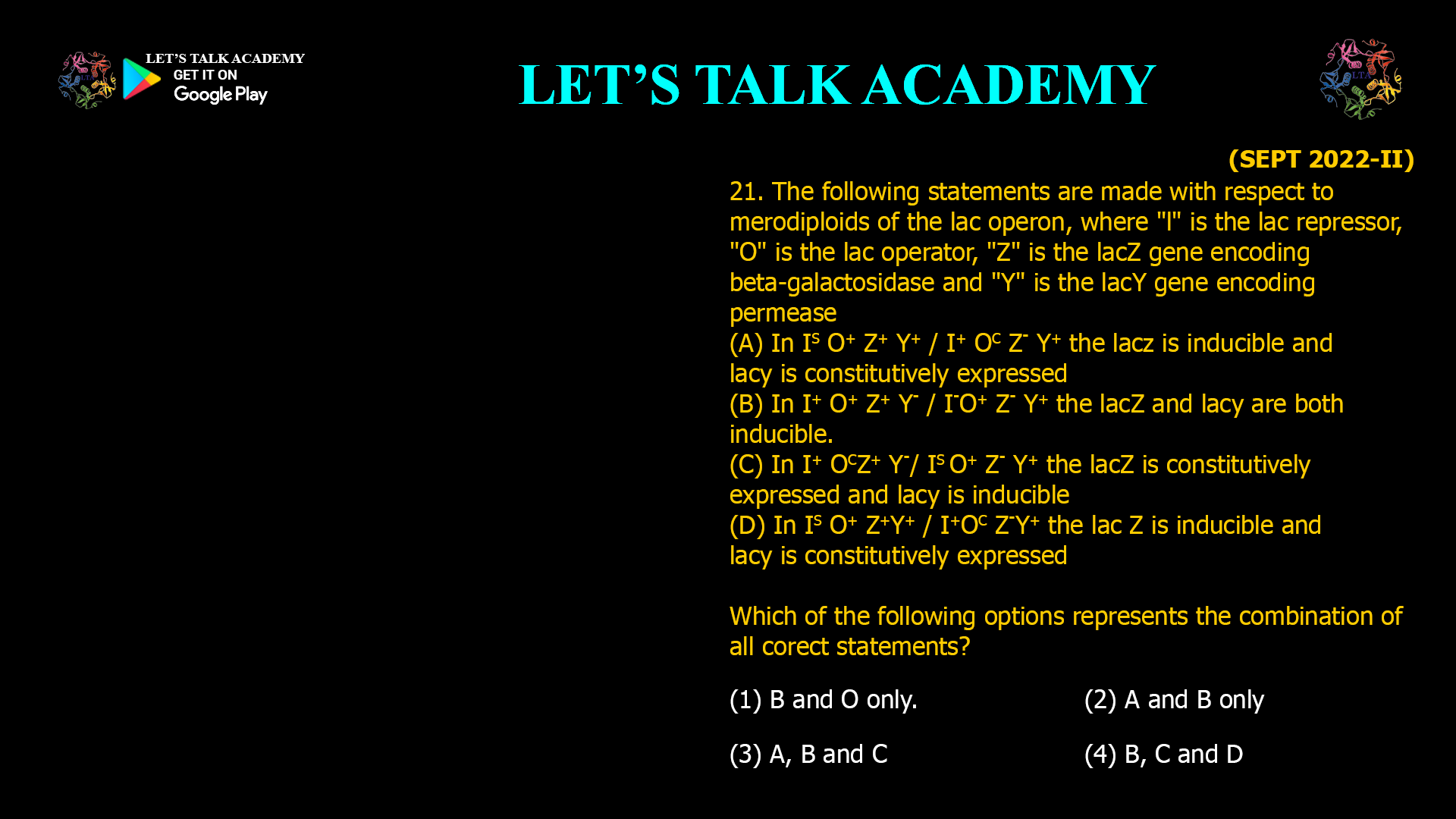
- The following statements are made with respect to merodiploids of the lac operon, where “I” is the lac repressor, “O” is the lac operator, “Z” is the lacZ gene encoding beta-galactosidase and “Y” is the lacY gene encoding permease
(A) In IS O+ Z+ Y+ / I+ OC Z– Y+ the lacz is inducible and lac Y is constitutively expressed
(B) In I+ O+ Z+ Y– / I– O+ Z– Y+ the lacZ and lac Y are both inducible.
(C) In I+ OC Z+ Y– / IS O+ Z– Y+ the lacZ is constitutively expressed and lac Y is inducible
(D) In IS O+ Z+Y+ / I+OC Z-Y+ the lac Z is inducible and lac Y is constitutively expressed
Which of the following options represents the combination of all corect statements?
(1) B and O only. (2) A and B only
(3) A, B and C (4) B, C and D
The lac operon in Escherichia coli is a well-studied model of gene regulation, where the interplay of regulatory elements like the lac repressor (I), operator (O), and structural genes lacZ and lacY determines the expression of enzymes needed for lactose metabolism. Merodiploid strains, carrying two copies of the lac operon with different mutations, provide powerful insights into these regulatory mechanisms.
This article analyzes four specific merodiploid genotypes and their expected β-galactosidase (lacZ) and lactose permease (lacY) expression patterns, identifying which statements about their phenotypes are correct.
Background: Regulatory Elements and Their Roles
-
I (lac repressor): Acts in trans; a functional I+ produces repressor protein that can regulate both operons in a merodiploid.
-
O (operator): Acts in cis; mutations like OC (operator-constitutive) affect only the operon on the same DNA molecule.
-
Z (lacZ): Encodes β-galactosidase; mutations affect enzyme production.
-
Y (lacY): Encodes lactose permease; mutations affect lactose transport.
Analysis of Each Statement
(A) IS O+ Z+ Y+ / I+ OC Z– Y+
-
IS (super-repressor): Non-inducible repressor that cannot be inactivated by inducer; represses operons with wild-type operator.
-
O+ operon (chromosomal): Wild-type operator; repressed by IS, so lacZ is inducible (repressed, no expression without inducer).
-
I+ OC operon (F’ plasmid): Operator constitutive (OC) causes constitutive expression of downstream genes regardless of repressor.
-
Z–: No β-galactosidase from plasmid.
-
Y+: Permease constitutively expressed from plasmid.
-
Conclusion: lacZ inducible (chromosome), lacY constitutive (plasmid).
-
Statement (A) is correct.
(B) I+ O+ Z+ Y– / I– O+ Z– Y+
-
I+ O+ Z+ Y– (chromosome): Wild-type operon, inducible expression but no permease (Y–).
-
I– O+ Z– Y+ (F’ plasmid): Nonfunctional repressor (I–), so constitutive expression of lac operon; functional permease (Y+).
-
Effect:
-
lacZ inducible (chromosome).
-
lacY constitutive (plasmid).
-
-
Statement (B) says both lacZ and lacY inducible, which is incorrect because lacY is constitutive on plasmid.
-
Statement (B) is incorrect.
(C) I+ OC Z+ Y– / IS O+ Z– Y+
-
I+ OC Z+ Y– (chromosome): Constitutive operator causes constitutive lacZ expression; no permease (Y–).
-
IS O+ Z– Y+ (F’ plasmid): Super-repressor and wild-type operator; lac operon repressed, but permease gene Y+ is present.
-
Effect:
-
lacZ constitutive (chromosome).
-
lacY inducible (plasmid, repressed by IS).
-
-
Statement (C) is correct.
(D) IS O+ Z+ Y+ / I+ OC Z– Y+
-
IS O+ Z+ Y+ (chromosome): Super-repressor represses lac operon; no induction.
-
I+ OC Z– Y+ (F’ plasmid): Constitutive operator causes constitutive expression of permease (Y+); no β-galactosidase (Z–).
-
Effect:
-
lacZ inducible (chromosome) is incorrect because IS is non-inducible (repressor never releases).
-
lacY constitutive (plasmid).
-
-
Statement (D) says lacZ inducible and lacY constitutive, which is incorrect.
-
Statement (D) is incorrect.
Correct Combination of Statements
-
(A) Correct
-
(B) Incorrect
-
(C) Correct
-
(D) Incorrect
Therefore, the correct answer is:
(3) A and C only
Summary Table
| Statement | Genotype | lacZ Expression | lacY Expression | Correct? |
|---|---|---|---|---|
| (A) | IS O+ Z+ Y+ / I+ OC Z– Y+ | Inducible (chromosome) | Constitutive (plasmid) | Yes |
| (B) | I+ O+ Z+ Y– / I– O+ Z– Y+ | Inducible (chromosome) | Constitutive (plasmid) | No |
| (C) | I+ OC Z+ Y– / IS O+ Z– Y+ | Constitutive (chromosome) | Inducible (plasmid) | Yes |
| (D) | IS O+ Z+ Y+ / I+ OC Z– Y+ | Non-inducible (chromosome) | Constitutive (plasmid) | No |
Conclusion
Merodiploid analysis of the lac operon reveals the interplay of cis-acting operators and trans-acting repressors in controlling gene expression. Among the given statements, only (A) and (C) correctly describe the expected phenotypes of β-galactosidase and permease expression.
Keywords: lac operon, merodiploid, lac repressor, operator mutation, lacZ, lacY, β-galactosidase, lactose permease, inducible expression, constitutive expression, E. coli gene regulation.


5 Comments
Suman bhakar
June 12, 2025Best explanation Sir 👍
Kajal
November 3, 2025Thee correct answer is:(3) A and C only
Kirti Agarwal
November 5, 2025A and C
Dipti Sharma
November 7, 2025A and C only
Neeraj Sharma
November 9, 2025A and C option 3