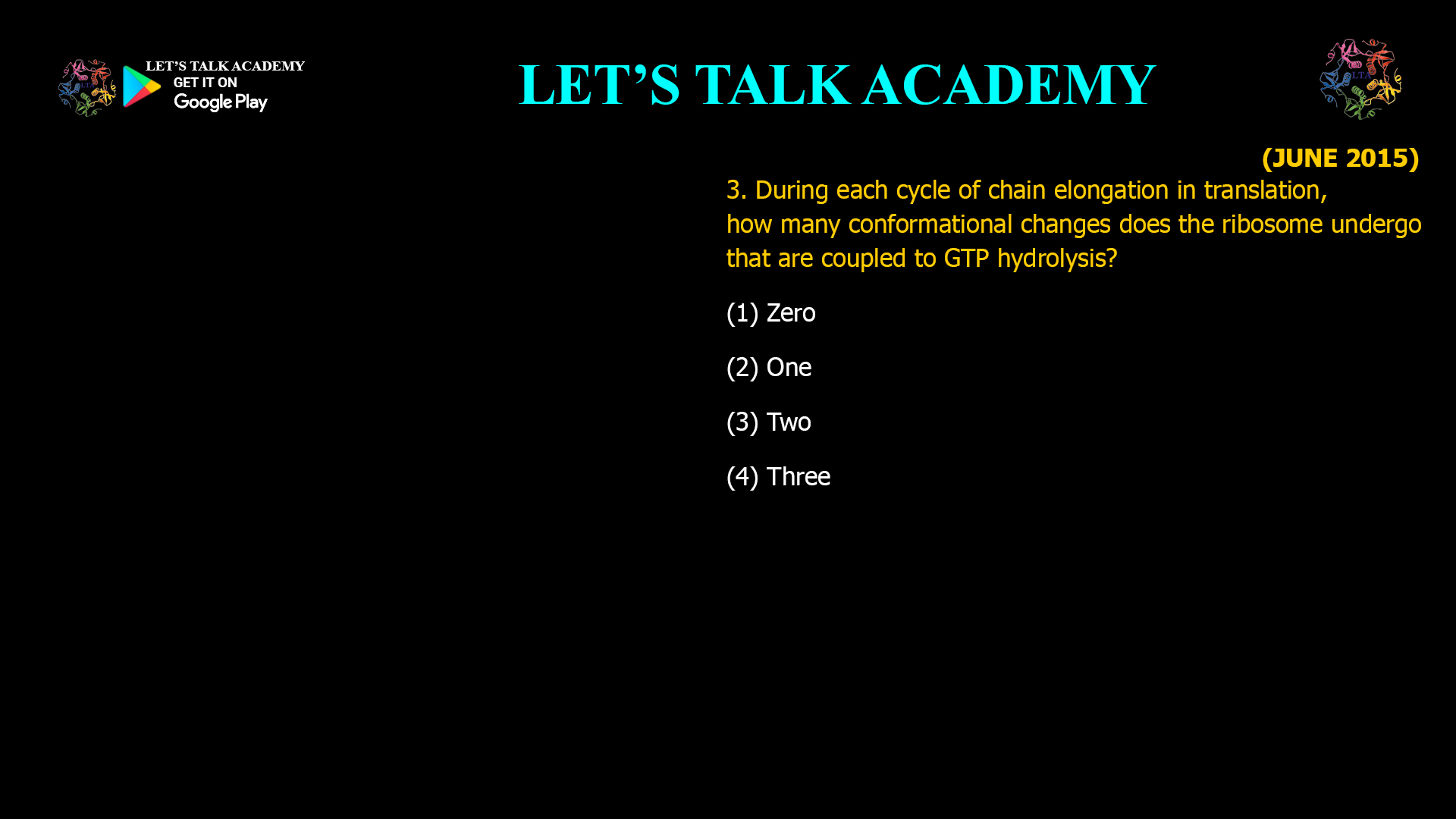
During each cycle of chain elongation in translation, how many conformational changes does the ribosome undergo that are coupled to GTP hydrolysis?
(1) Zero (2) one
(3) Two (4) Three
The correct answer is:
(3) Two
Detailed Explanation
During each cycle of chain elongation in translation, the ribosome undergoes two major conformational changes that are directly coupled to GTP hydrolysis:
-
1. Delivery of aminoacyl-tRNA to the A site (by EF-Tu in prokaryotes or eEF1A in eukaryotes):
The elongation factor (EF-Tu) binds GTP and the aminoacyl-tRNA, bringing the tRNA to the ribosomal A site. Upon correct codon-anticodon pairing, GTP is hydrolyzed, causing a conformational change in both EF-Tu and the ribosome, allowing the tRNA to fully enter the A site and EF-Tu to dissociate. -
2. Translocation of tRNA and mRNA (by EF-G in prokaryotes or eEF2 in eukaryotes):
After peptide bond formation, elongation factor G (EF-G) binds to the ribosome with GTP. GTP hydrolysis by EF-G induces a large conformational change in the ribosome, resulting in the movement (translocation) of tRNAs and mRNA to the next position. This step is essential for the ribosome to advance along the mRNA and is tightly coupled to GTP hydrolysis.
Supporting Evidence
-
Two GTP-dependent steps per elongation cycle:
“Elongation follows two GTP hydrolysis-dependent processes in a cyclical manner: Delivery of aminoacyl-(aa)tRNA to the ribosomal A site by Elongation Factor Thermo unstable (EF-Tu) and peptide bond formation, followed by translocation of the mRNA-tRNA2 substrate from the A and P sites to the respective P and E sites by…”1. -
Conformational changes during translocation:
“EF-G-dependent GTP hydrolysis induces translocation accompanied by large conformational changes in the 70S ribosome…”2. -
Mechanistic details:
“The data suggest that GTP hydrolysis induces, by a conformational change of EF-G, a rapid conformational rearrangement of the ribosome (‘unlocking’) which determines the rates of both tRNA-mRNA translocation and recycling of the factor.”5
Summary Table
| Step | GTPase Factor | GTP Hydrolysis | Ribosomal Conformational Change |
|---|---|---|---|
| Aminoacyl-tRNA delivery to A site | EF-Tu | Yes | Yes |
| Translocation (tRNA/mRNA movement) | EF-G | Yes | Yes |
Therefore, during each elongation cycle, the ribosome undergoes two conformational changes coupled to GTP hydrolysis.
Correct answer: (3) Two


6 Comments
Suman bhakar
June 12, 2025👍👍
Arushi
June 12, 2025✅👍
Kirti Agarwal
November 2, 2025Two
Deepika Sheoran
November 4, 2025Two
EF-Tu
EF-G
Heena Mahlawat
November 6, 2025Two
MOHIT AKHAND
November 14, 2025Done sir ✅