
56. After sequencing the genome of a new species you have obtained 2,500,000 reads each of 100-nt
in length. Following assembly, the draft genome obtained is of 5 Mb size. What is the depth of
coverage of the sequencing?
1. 200x
2. 125x
3. 50x
4. 150x
Calculating Sequencing Depth Coverage: Understanding Genome Assembly
Introduction
Sequencing depth coverage is a crucial metric in genomics that determines how well a genome has been sequenced. It helps assess data quality, completeness, and accuracy of genome assembly. In this article, we will explore how to calculate sequencing depth coverage and its impact on genome analysis.
How to Calculate Sequencing Depth Coverage?
The formula for sequencing depth coverage (C) is:
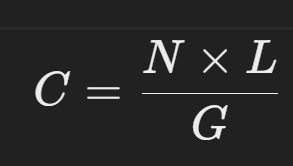
Where:
- N = Total number of sequencing reads
- L = Length of each read (in base pairs)
- G = Size of the genome (in base pairs)
Applying the Formula to the Given Data
Given:
- Number of reads (N) = 2,500,000
- Read length (L) = 100 bp
- Genome size (G) = 5,000,000 bp (5 Mb)
-
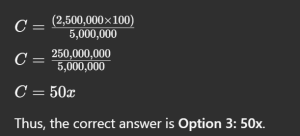
How to Calculate Sequencing Depth Coverage
Thus, the correct answer is Option 3: 50x.
Importance of Sequencing Depth Coverage
1. Ensuring Accurate Genome Assembly
Higher coverage improves the accuracy of sequencing results and reduces sequencing errors.
2. Identifying Genetic Variants
Adequate depth coverage allows for reliable detection of single nucleotide polymorphisms (SNPs), insertions, and deletions.
3. Improving Structural Variant Detection
Higher sequencing depth helps in identifying large genomic rearrangements.
Coverage Depth Interpretation in Sequencing
| Coverage Depth | Interpretation |
|---|---|
| <10x | Low coverage, potential errors |
| 30x–50x | Sufficient for most genome studies |
| 100x+ | High accuracy, useful for variant detection |
Conclusion
Sequencing depth coverage is essential for high-quality genome sequencing and analysis. Using the formula, we determined that the depth coverage for a 5 Mb genome with 2.5 million reads of 100 bp length is 50x. This ensures an adequate representation of the genome for further analysis.
Frequently Asked Questions (FAQs)
1. Why is sequencing depth important?
Higher sequencing depth increases accuracy and reduces sequencing errors, improving genome assembly quality.
2. What happens if sequencing depth is too low?
Low sequencing depth can result in incomplete genome coverage, leading to gaps and misassembled sequences.
3. How can sequencing depth be increased?
Increasing the number of reads or read length can improve sequencing depth.
Understanding sequencing depth coverage helps researchers design better sequencing experiments for high-quality genome analysis.


8 Comments
Suman bhakar
March 24, 2025Done sir 👍
Ujjwal
March 27, 2025Done
Prami Masih
March 27, 2025Done sir ji
Lokesh kumawat
March 30, 2025Done
yogesh sharma
April 9, 2025I’ve just started solving the questions without reading topics
Thank you so much suraj sir for giving this type of easy language explanation of questions
By explanation it becomes very easy to solve and. Understand the concept of questions
😊😊
Komal Sharma
April 17, 2025Sir math aati nhi h smj lykin yha sb aa rha h fer bhi.✅
SEETA CHOUDHARY
April 17, 2025Done ✅
Rani Sharma
April 23, 2025✅✅