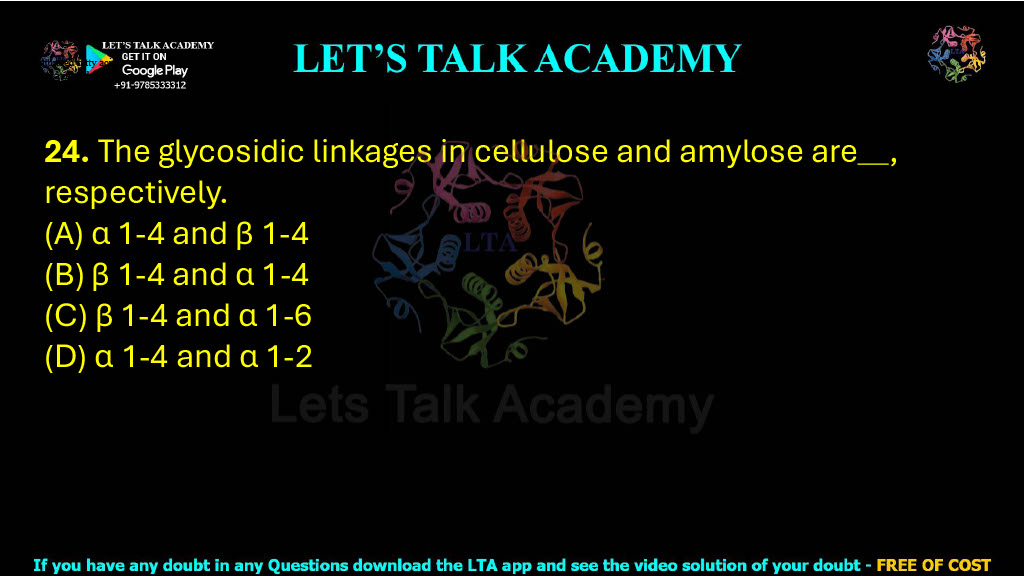
24. The glycosidic linkages in cellulose and amylose are , respectively.
(A) α 1-4 and β 1-4
(B) β 1-4 and α 1-4
(C) β 1-4 and α 1-6
(D) α 1-4 and α 1-2
Glycosidic Linkages in Cellulose and Amylose
Correct Answer
(B) β(1→4) and α(1→4)
Introduction
Carbohydrates are among the most abundant biomolecules in nature and serve as essential sources of energy, structural support, and cellular communication. While simple sugars such as glucose exist as individual monosaccharides, nature often links hundreds or thousands of glucose molecules together to form polysaccharides. The physical properties and biological functions of these polysaccharides are determined primarily by the type of glycosidic linkage connecting the glucose units.
Two of the most important glucose polymers are cellulose and amylose. Although both are composed entirely of D-glucose molecules, they differ dramatically in structure, digestibility, and biological function because of the orientation of their glycosidic bonds. This seemingly small difference transforms cellulose into the major structural component of plant cell walls, while amylose becomes an energy-storage polysaccharide in plants.
Understanding the Concept Behind the Question
A glycosidic bond is a covalent linkage formed between the anomeric carbon of one monosaccharide and the hydroxyl group of another. Depending on the orientation of the hydroxyl group at the anomeric carbon, the bond may be either α (alpha) or β (beta).
Although cellulose and amylose are both polymers of glucose, they differ in the stereochemistry of this linkage.
- Cellulose contains β(1→4) glycosidic bonds.
- Amylose contains α(1→4) glycosidic bonds.
This single stereochemical difference determines whether the polymer forms rigid linear fibers or flexible helical chains.
Therefore, the correct answer is Option (B).
Why Option (A) Is Incorrect
α(1→4) and β(1→4)
This option reverses the glycosidic linkages of cellulose and amylose.
The α(1→4) linkage is characteristic of amylose, not cellulose. Likewise, β(1→4) is the defining linkage of cellulose rather than amylose.
This distinction is extremely important because human digestive enzymes such as α-amylase can hydrolyze α(1→4) bonds but cannot hydrolyze β(1→4) bonds. Therefore, reversing these linkages changes the biological properties of the polymers completely.
Hence, Option (A) is incorrect.
Why Option (B) Is Correct
β(1→4) and α(1→4)
This option correctly identifies the glycosidic linkages present in both polysaccharides.
Cellulose consists of D-glucose molecules joined through β(1→4) glycosidic bonds. Each successive glucose residue is rotated by approximately 180°, producing long, straight chains that associate through extensive hydrogen bonding. This arrangement gives cellulose exceptional tensile strength and makes it the primary structural component of plant cell walls.
Amylose, on the other hand, contains α(1→4) glycosidic bonds between glucose molecules. Because of the alpha configuration, the polymer naturally coils into a helical structure. Amylose is one of the two major components of starch and functions primarily as an energy-storage molecule in plants.
Since the linkages are correctly matched, Option (B) is the correct answer.
Why Option (C) Is Incorrect
β(1→4) and α(1→6)
The first part of this option correctly identifies the linkage present in cellulose. However, the second part is incorrect because amylose does not contain α(1→6) glycosidic bonds.
The α(1→6) linkage is characteristic of branched polysaccharides, such as amylopectin and glycogen, where it forms branch points. Amylose is an unbranched polymer and therefore contains only α(1→4) glycosidic bonds.
Because the second statement is incorrect, the entire option becomes incorrect.
Hence, Option (C) is incorrect.
Why Option (D) Is Incorrect
α(1→4) and α(1→2)
Neither of these linkages correctly describes cellulose and amylose together.
As already discussed, cellulose contains β(1→4) rather than α(1→4) linkages. Furthermore, α(1→2) glycosidic bonds are not present in amylose. This type of linkage is encountered in certain disaccharides but not in the linear starch component.
Therefore, Option (D) is incorrect.
Structural Difference Between Cellulose and Amylose
Although both polymers consist entirely of glucose molecules, the orientation of the glycosidic bond determines their three-dimensional structure.
In cellulose, β(1→4) bonds produce long, straight chains capable of forming extensive hydrogen-bonding networks between adjacent molecules. These interactions generate strong microfibrils that provide mechanical support to plant cell walls.
In amylose, α(1→4) bonds cause the polymer chain to curl into a helical configuration. This compact structure facilitates energy storage because enzymes can easily access the glycosidic bonds during starch digestion.
Thus, a single stereochemical difference changes the function of the polymer completely.
Biological Importance of Cellulose
Cellulose is the most abundant organic polymer on Earth and serves as the principal structural material of plant cell walls. The extensive hydrogen bonding between adjacent cellulose molecules produces fibers with exceptional strength and rigidity, allowing plants to withstand mechanical stress.
Humans lack the enzyme cellulase, which is required to hydrolyze β(1→4) glycosidic bonds. Consequently, cellulose cannot be digested and instead functions as dietary fiber, promoting intestinal motility and digestive health. Herbivorous animals digest cellulose through symbiotic microorganisms present in the rumen or hindgut that produce cellulase.
Biological Importance of Amylose
Amylose is one of the two major components of starch, the primary storage polysaccharide of plants. Because it contains α(1→4) glycosidic bonds, human digestive enzymes such as salivary α-amylase and pancreatic α-amylase can hydrolyze it efficiently into maltose and glucose.
The helical structure of amylose also enables it to form inclusion complexes with iodine, producing the characteristic blue color observed during the iodine test for starch. This property is widely used in laboratories for the qualitative detection of starch.
Comparison Between Cellulose and Amylose
| Feature | Cellulose | Amylose |
|---|---|---|
| Monomer | β-D-Glucose | α-D-Glucose |
| Glycosidic Linkage | β(1→4) | α(1→4) |
| Structure | Linear | Helical |
| Biological Role | Structural | Energy storage |
| Digestible by Humans | No | Yes |
| Major Location | Plant cell wall | Starch granules |
High-Yield Points
- Cellulose consists of β(1→4) glycosidic bonds.
- Amylose consists of α(1→4) glycosidic bonds.
- Amylopectin contains α(1→4) and α(1→6) bonds.
- Glycogen contains α(1→4) and more frequent α(1→6) branches.
- Humans digest α-linkages but not β(1→4) cellulose.
- Cellulose is the major structural polysaccharide of plants.
Frequently Asked Questions
Why can’t humans digest cellulose?
Humans lack the enzyme cellulase, which is required to hydrolyze β(1→4) glycosidic bonds. As a result, cellulose passes through the digestive tract as dietary fiber.
Why is amylose digestible?
Amylose contains α(1→4) glycosidic bonds, which are readily hydrolyzed by α-amylase present in saliva and pancreatic secretions.
Does amylose contain α(1→6) bonds?
No. Amylose is an unbranched polysaccharide composed exclusively of α(1→4) glycosidic linkages. Branching α(1→6) linkages occur only in amylopectin and glycogen.
Key Takeaways
Cellulose and amylose are both polymers of glucose, but they differ fundamentally in the orientation of their glycosidic linkages. Cellulose contains β(1→4) glycosidic bonds, producing straight, hydrogen-bonded fibers that provide structural support to plant cell walls and resist digestion by human enzymes. Amylose contains α(1→4) glycosidic bonds, resulting in a helical, digestible polysaccharide that serves as an energy-storage component of starch. This single stereochemical difference explains the striking contrast between the structural and biological properties of these two polysaccharides.
Final Answer
Correct Option: (B) β(1→4) and α(1→4)
Explanation
Cellulose is composed of β(1→4) glycosidic linkages, which produce long, straight chains capable of extensive hydrogen bonding, making cellulose the major structural component of plant cell walls. In contrast, amylose is an unbranched component of starch composed of α(1→4) glycosidic linkages, allowing it to adopt a helical structure that is readily hydrolyzed by human α-amylase. Therefore, the correct combination of glycosidic linkages is β(1→4) in cellulose and α(1→4) in amylose, making Option (B) the correct answer.


