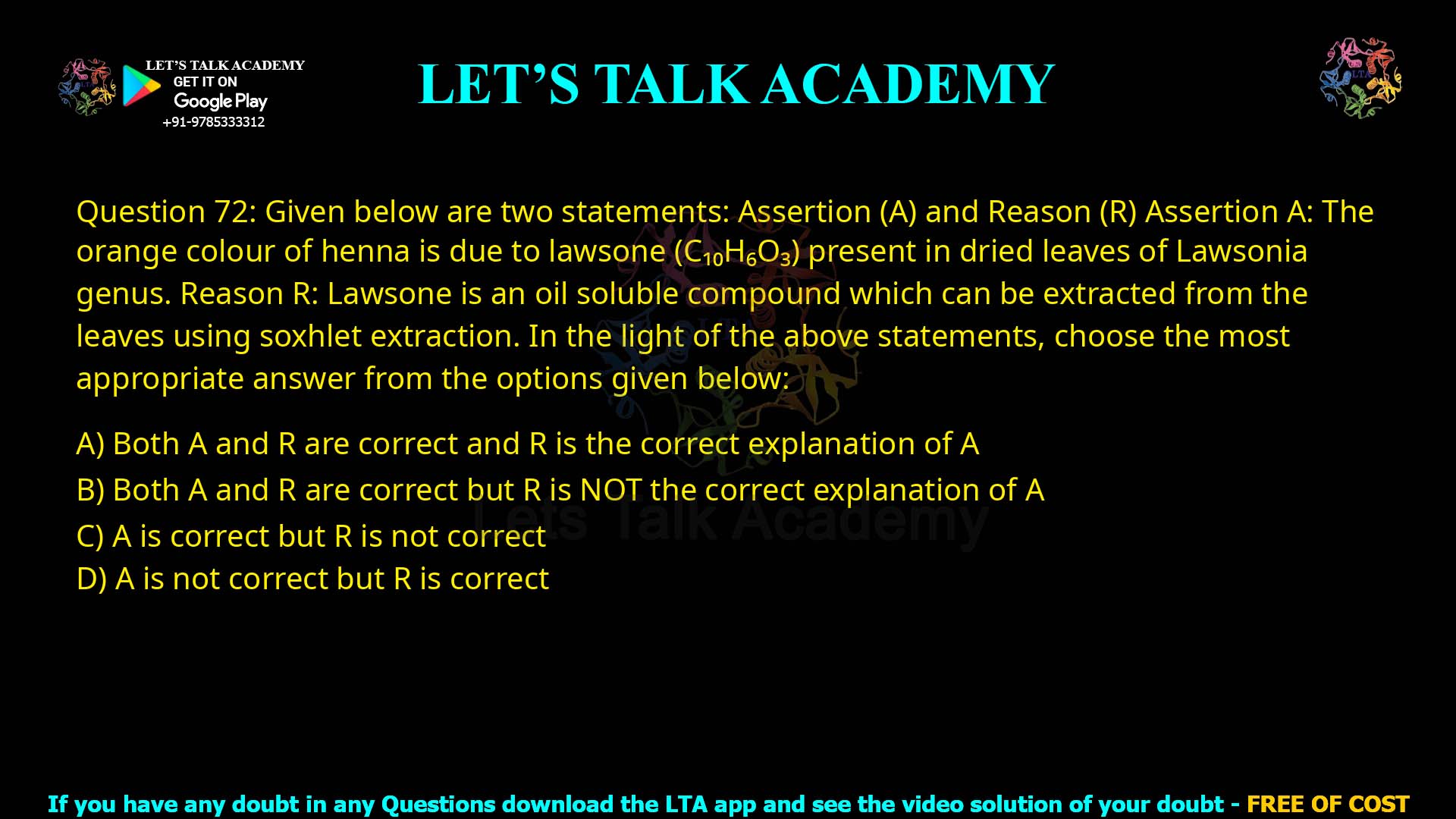
Q72.Given below are two statements: one is labelled as Assertion A and the other is labelled as Reason R.
Assertion A: The orange colour of henna is due to lawsone (C₁₀H₆O₃) present in dried leaves of Lawsonia genus.
Reason R: Lawsone is an oil soluble compound which can be extracted from the leaves using soxhlet extraction.
In the light of the above statements, choose the most appropriate answer from the options given below:
-
Both A and R are correct and R is the correct explanation of A
-
Both A and R are correct but R is NOT the correct explanation of A
-
A is correct but R is not correct
-
A is not correct but R is correct
Both Assertion A and Reason R are correct, but R is NOT the correct explanation of A.
Detailed Explanation
Assertion A is true: Lawsone (2-hydroxy-1,4-naphthoquinone, C₁₀H₆O₃) is the primary pigment in dried leaves of Lawsonia inermis (henna), responsible for its orange-red dye color upon oxidation and binding to keratin in skin/hair.
Reason R is true: Lawsone is oil-soluble (lipophilic due to naphthoquinone structure) and commonly extracted via Soxhlet apparatus using non-polar solvents like hexane or chloroform for efficient recovery from plant material.
However, R does not explain A: The orange color arises from lawsone’s inherent chromophoric properties (extended conjugation in the naphthoquinone ring), not its extraction method or solubility. Color is observed directly in leaf extracts or dyes, independent of Soxhlet use.
Option Analysis
Option A Correct? R Correct? R Explains A? Status Both correct, R explains A Yes Yes No Wrong (R doesn’t explain color origin) Both correct, R does NOT explain A Yes Yes No Correct A correct, R incorrect Yes No N/A Wrong (lawsone is oil-soluble) A incorrect, R correct No Yes N/A Wrong (A is factual)
Henna lawsone orange colour assertion reason questions test phytochemistry knowledge: lawsone (C₁₀H₆O₃) from Lawsonia inermis gives the dye its hue via naphthoquinone structure.
Lawsone Chemistry
-
Structure: 2-Hydroxy-1,4-naphthoquinone; yellow-orange solid, MW 174.15 g/mol.
-
Source: 1-2% in dried henna leaves; binds keratin via Michael addition.
-
Properties: Oil-soluble, UV-absorbent; three tautomers (1,4-quinone most stable).
Why R Fails Explanation
Color is due to π-conjugation absorbing ~450 nm light, not solubility/extraction. Soxhlet is a lab method, irrelevant to natural pigmentation.
Aspect Assertion A Reason R Fact Lawsone causes orange dye Oil-soluble, Soxhlet extractable Link to Color Direct (chromophore) Indirect (processing aid) NEET Relevance Phytochemical ID Extraction technique Keywords: henna lawsone orange colour, C10H6O3 Lawsonia, soxhlet extraction, assertion reason NEET, lawsone solubility.
-


