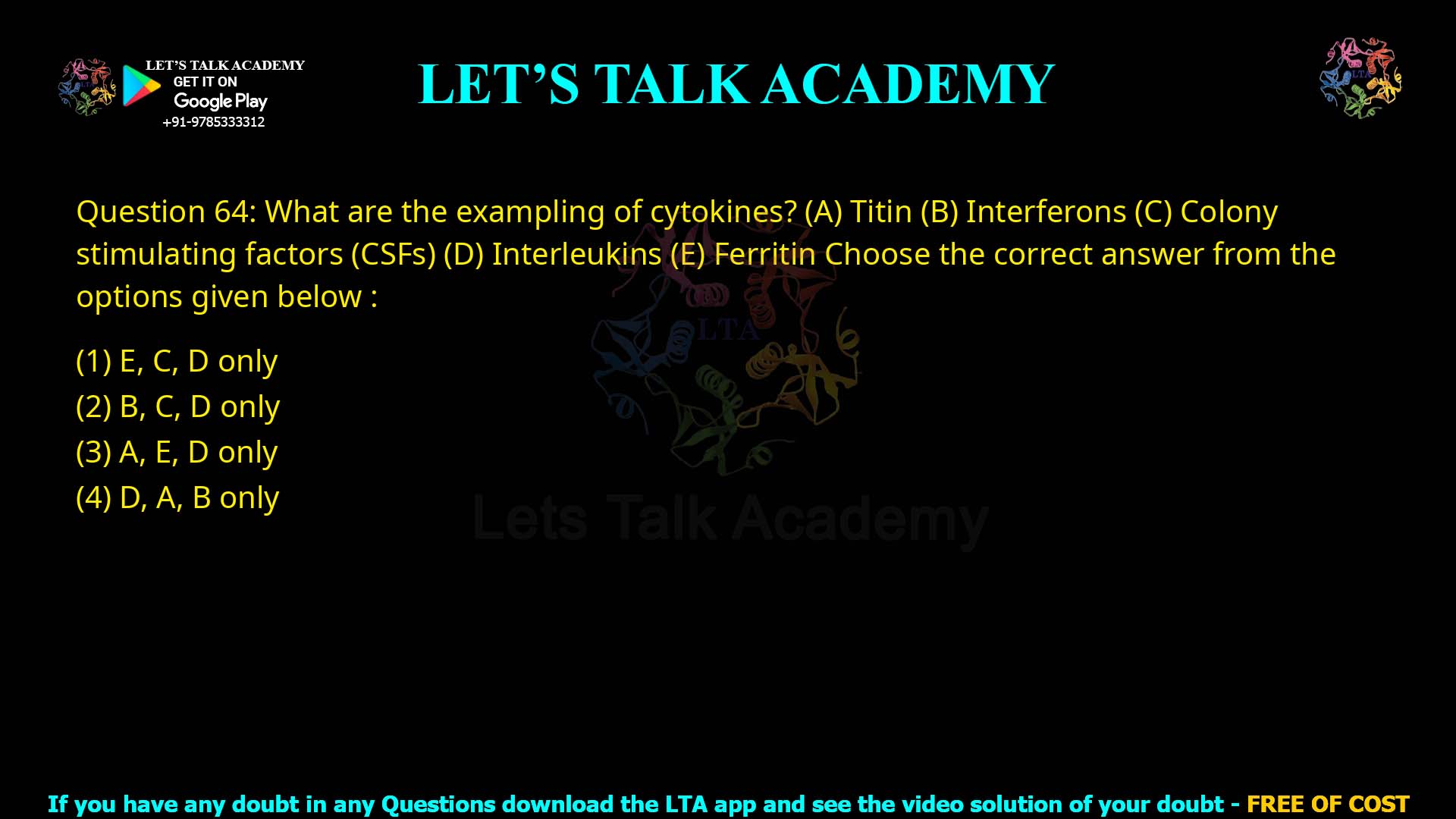
Q.64 What are the examples of cytokines?
- Titin
- Interferons
- Colony stimulating factors (CSFs)
- Interleukins
- Ferritin
Choose the correct answer from the options given below:
- E, C, D only
- B, C, D only
- A, E, D only
- D, A, B only
B, C, D only (Interferons, Colony stimulating factors (CSFs), Interleukins) are examples of cytokines.
Statement Analysis
Titin (A) – FALSE: Titin is the largest known protein, a structural component of muscle sarcomeres providing elasticity. Not a signaling molecule or cytokine.
Interferons (B) – TRUE: Antiviral cytokines (IFN-α, IFN-β, IFN-γ) produced by leukocytes in response to pathogens/tumors. Activate JAK-STAT pathway inducing antiviral state.
Colony stimulating factors (CSFs) (C) – TRUE: Hematopoietic growth factors (G-CSF, GM-CSF, M-CSF) stimulate bone marrow stem cell differentiation into specific blood cell lineages.
Interleukins (D) – TRUE: Major cytokine family (IL-1 to IL-38+) mediating immune cell communication. T-cell/macrophage-derived; regulate inflammation, B/T-cell proliferation, differentiation.
Ferritin (E) – FALSE: Intracellular iron storage protein preventing free radical damage via Fe³⁺ sequestration. Acute phase reactant but not a cytokine.
Option Breakdown
Option Evaluation Reason B, C, D only Correct Captures all three cytokine classes; excludes structural proteins. E, C, D only Incorrect Ferritin not cytokine despite C,D valid. A, E, D only Incorrect Neither titin nor ferritin are cytokines. D, A, B only Incorrect Titin disqualifies despite D,B correct. Cytokines examples interferons CSFs interleukins dominate immunology MCQs—essential signaling proteins coordinating immune responses, excluding structural molecules like titin and ferritin.
Interferons (Statement B)
Type I (α,β): All nucleated cells → antiviral state via 2′-5′ oligoadenylate synthetase, PKR.
Type II (γ): Tₕ1/NK cells → MHC I/II upregulation, macrophage activation.
Type III (λ): Epithelial cells → mucosal antiviral defense.Colony Stimulating Factors (Statement C)
-
G-CSF: Neutrophil production (cancer chemotherapy).
-
GM-CSF: Granulocyte + macrophage differentiation.
-
M-CSF: Monocyte/macrophage proliferation.
-
EPO (erythropoietin): RBC production.
Interleukins Major Classes (Statement D)
IL-1 family: Fever, acute phase response (IL-1α/β).
Common γ-chain: Lymphocyte growth (IL-2,4,7,9,15,21).
IL-6/gp130: APR, B-cell differentiation (IL-6,11).
IL-10 family: Anti-inflammatory (IL-10).
IL-12/IL-23: Tₕ1/Tₕ17 differentiation.Common Distractors Explained
Titin: Muscle giant protein (3.7 MDa), Z-disk to M-line.
Ferritin: 24-subunit iron cage (4,500 Fe atoms), not secreted signaling molecule.Exam Pattern Recognition
NEET tests functional classification: signaling peptides (B,C,D) vs. structural/storage (A,E). B,C,D only recurring correct combination.
-


