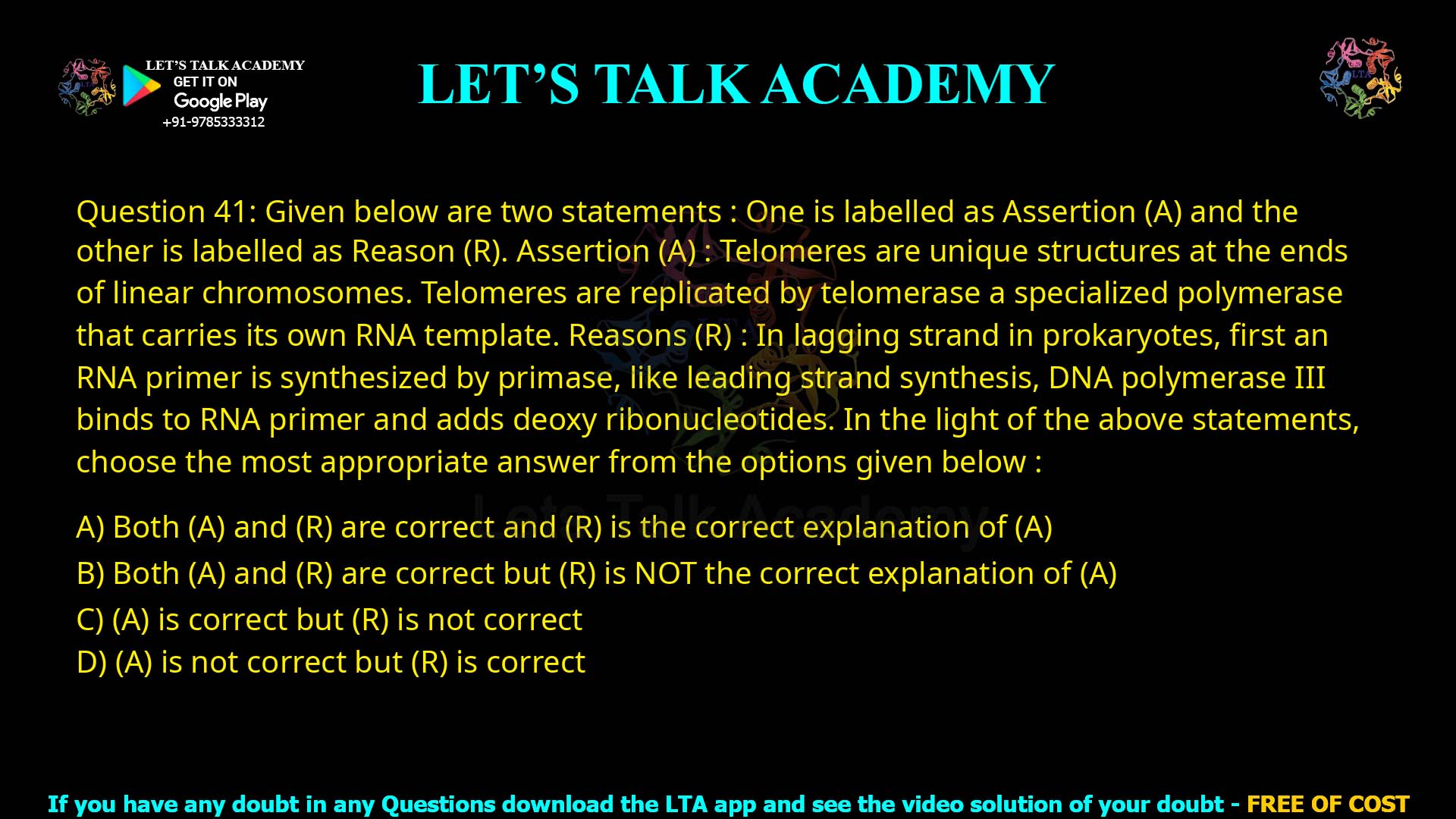
Q.41 Given below are two statements : One is labelled as Assertion (A) and the other is
labelled as Reason (R).
Assertion (A) :Telomeres are unique structures at the ends of linear
chromosomes. Telomeres are replicated by telomerase a
specialized polymerase that carries its own RNA template.
Reasons (R) :In lagging strand in prokaryotes, first an RNA primer is synthesized
by primase, like leading strand synthesis, DNA polymerase III binds
to RNA primer and adds deoxy ribonucleotides.
In the light of the above statements, choose the most appropriate answer from the
options given below :
(1)Both (A) and (R) are correct and (R) is the correct explanation of (A)
(2)Both (A) and (R) are correct but (R) is NOT the correct explanation of (A)
(3)(A) is correct but (R) is not correct
(4)(A) is not correct but (R) is correct
Both (A) and (R) are correct but (R) is NOT the correct explanation of (A). Assertion (A) accurately describes eukaryotic telomere structure and telomerase replication using its internal RNA template (3′-CAAUCCCAAUC-5′). Reason (R) correctly states prokaryotic lagging strand synthesis mechanism with primase RNA primers, but describes standard replication unrelated to telomere end-replication problem.
Option Analysis
-
(1) Both correct, R explains A: Wrong—R discusses prokaryotic primase/DNA Pol III, unrelated to eukaryotic telomerase mechanism.
-
(2) Both correct, R not explanation: Correct—A = telomere biology (eukaryotes); R = prokaryotic replication fork (circular chromosomes, no end problem).
-
(3) A correct, R incorrect: Wrong—R accurately describes primase priming on prokaryotic lagging strand.
-
(4) A incorrect, R correct: Wrong—A precisely states telomere function/replication.
Answer: (2)
Telomere Replication Mechanism (A)
Telomeres solve end-replication problem of linear eukaryotic chromosomes:
5'-TTAGGG(TTAGGG)n   3'  (G-rich strand)

3'-AATCCC(AATCCC)n   5'  (C-rich strand)
Telomerase (TERT + TERC) adds repeats using internal RNA template via RNA-dependent DNA polymerase activity.
Prokaryotic Lagging Strand (R)
Primase synthesizes ~10 nt RNA primers → DNA Pol III extends 5′-3′:
Leading: 5' ← Pol III continuous

Lagging: 3' → RNA primer → Pol III → Okazaki fragment → RNaseH/Pol I
Circular prokaryotic chromosomes lack telomere end problem.
Why R Doesn’t Explain A
| Statement | Topic | Organism | Mechanism |
|---|---|---|---|
| A | Telomere ends | Eukaryotes | Telomerase |
| R | Replication fork | Prokaryotes | Primase |
GATE AR Question Strategy
Pattern: A = eukaryotic special case; R = prokaryotic standard mechanism. Always separate organism-specific replication pathways. Tests conceptual linkage recognition.


