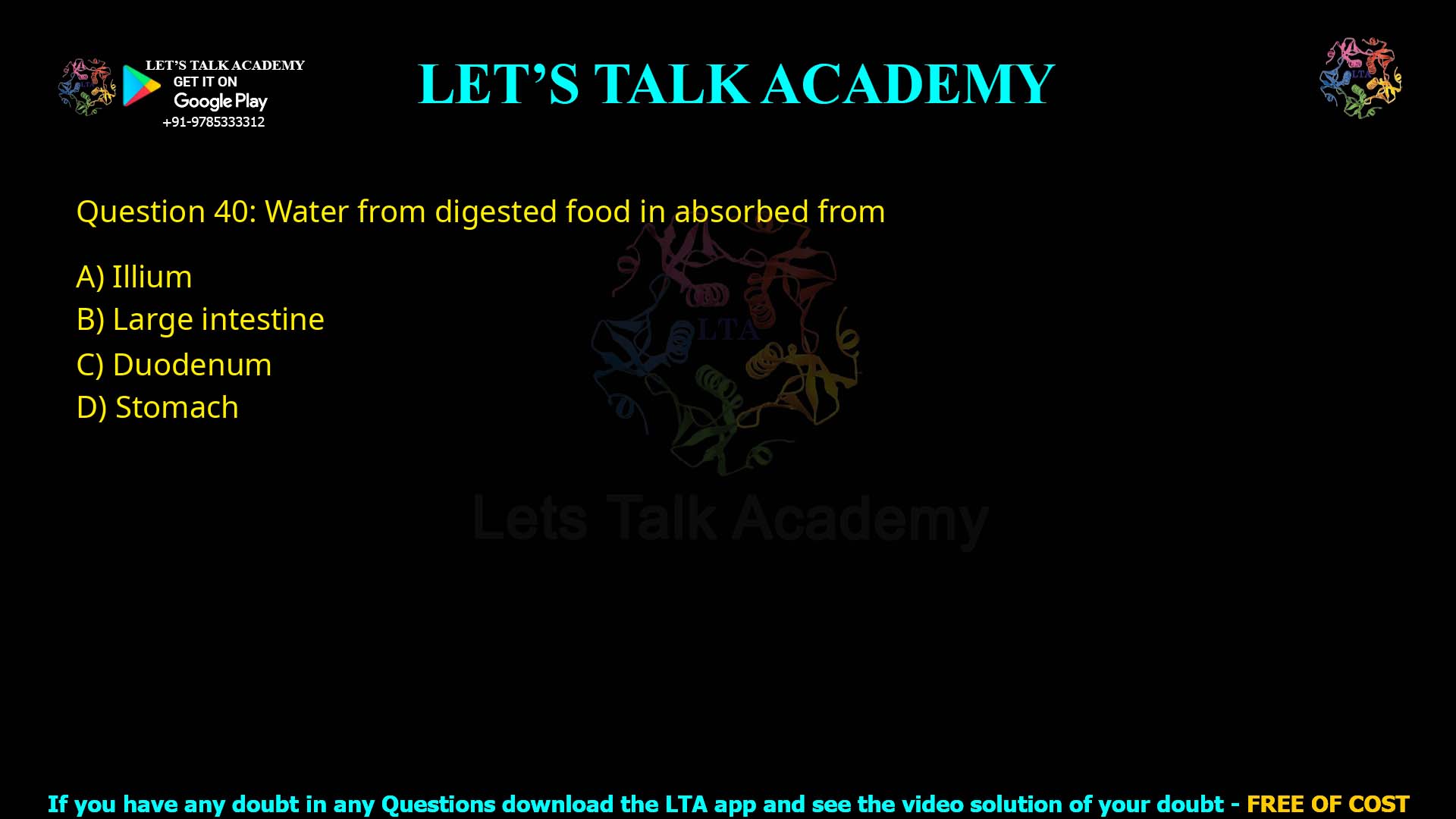
Q.40 Water from digested food is absorbed from
Water from digested food is primarily absorbed in the large intestine, making option (2) correct.
Question Breakdown
“Digested food” refers to chyme (partially digested material) entering the large intestine after nutrient absorption in the small intestine. While ~90% water is absorbed earlier, the large intestine reabsorbs remaining water (up to 90% of what enters it), forming solid feces.
Option Analysis
-
(1) Ileum: Incorrect; ileum (small intestine end) absorbs bile salts/vitamins B12 but minimal water compared to colon—most small intestine water uptake occurs proximally.
-
(2) Large intestine: Correct; colon absorbs residual water/electrolytes via osmosis (Na⁺ gradient pulls water), preventing dehydration (only ~100 mL lost daily).
-
(3) Duodenum: Incorrect; duodenum neutralizes chyme/adds enzymes but limited surface area/surface area for major water absorption.
-
(4) Stomach: Incorrect; stomach secretes HCl/water, absorbs negligible amounts—primarily mechanical/chemical digestion site.
Water digested food absorbed primarily occurs in the large intestine, crucial for GATE Life Sciences digestive physiology MCQs. After small intestine nutrient extraction (~8-8.5L water/day), colon reabsorbs ~1L remaining water via Na⁺-driven osmosis, forming feces.
Absorption Cascade
-
Small intestine: 90% water (villi/microvilli maximize area).
-
Large intestine: Final 5-10% via colonocytes, aquaporins (AQP3).
-
Feces: <100 mL water loss.
Region Comparison
| Site | Water Absorbed | Primary Role |
|---|---|---|
| Stomach | Negligible | Acid secretion |
| Duodenum | Minor | Enzyme mixing |
| Ileum | Moderate (nutrients) | Bile salts |
| Large intestine | Major (residual) | Feces formation |
Exam Strategy
GATE emphasizes “digested food” = post-small intestine chyme. Traps: Ileum (nutrient focus); ignore small intestine bulk vs. large intestine final reabsorption. Key: Colon prevents diarrhea via water conservation.


