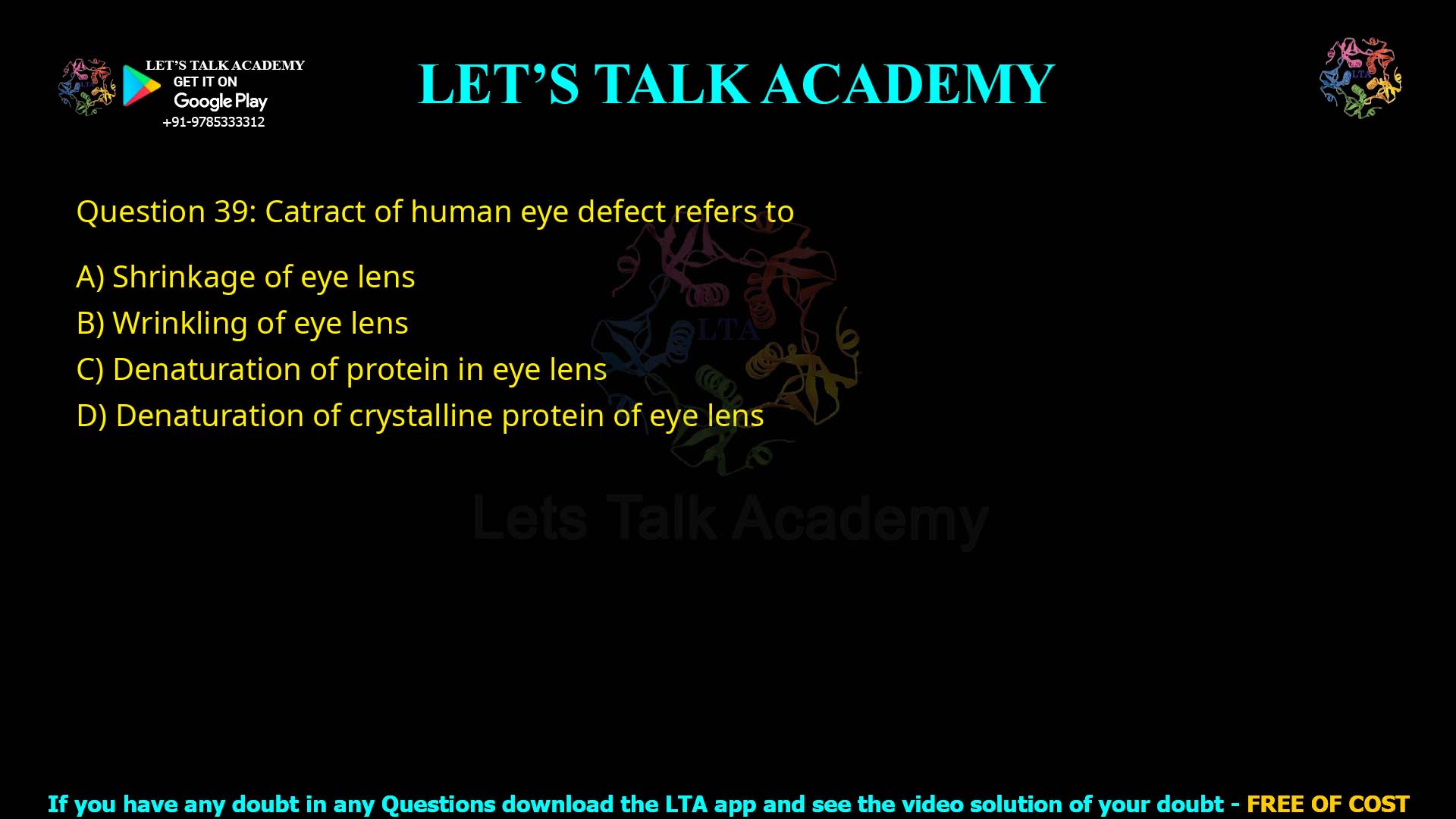
Q.39 Cataract of human eye defect refers to
Cataract refers to the denaturation of crystalline protein in the eye lens, making option (4) correct.
Question Breakdown
Cataract is an eye defect causing lens opacity due to molecular changes in lens proteins called crystallins (α, β, γ types), which normally maintain transparency. Aging, oxidation, or UV damage causes protein unfolding/aggregation, scattering light and blurring vision.
Option Analysis
-
(1) Shrinkage of eye lens: Incorrect; lens may harden (nuclear sclerosis) but primary defect is protein aggregation, not size reduction.
-
(2) Wrinkling of eye lens: Incorrect; superficial description—actual pathology involves biochemical protein changes, not surface wrinkling.
-
(3) Denaturation of protein in eye lens: Partially correct but incomplete; specifies “crystalline” proteins (90% of lens mass) as key culprits.
-
(4) Denaturation of crystalline protein of eye lens: Correct; crystallins denature/aggregate, losing chaperone function (α-crystallin) and forming light-scattering clumps.
Cataract human eye defect crystalline protein denaturation causes lens clouding, essential for GATE Life Sciences human physiology MCQs. Crystallins (α, β, γ) aggregate due to oxidative stress, UV exposure, aging—blocking light to retina.
Molecular Mechanism
Crystallins maintain lens transparency via high concentration (450 mg/mL). Denaturation exposes hydrophobic regions → aggregation → opacity.
-
α-Crystallin: Loses chaperone activity.
-
β/γ-Crystallins: Form amyloid fibrils.
Comparison Table
| Option | Mechanism | Accuracy |
|---|---|---|
| 1 | Shrinkage | Wrong |
| 2 | Wrinkling | Wrong |
| 3 | General protein | Incomplete |
| 4 | Crystalline protein | Correct |
Exam Strategy
GATE tests specificity: “Crystalline” distinguishes from general proteins. Symptoms: Progressive blurring, glare. Treatment: Phacoemulsification + IOL. Key trap: Physical changes vs. biochemical (denaturation).


