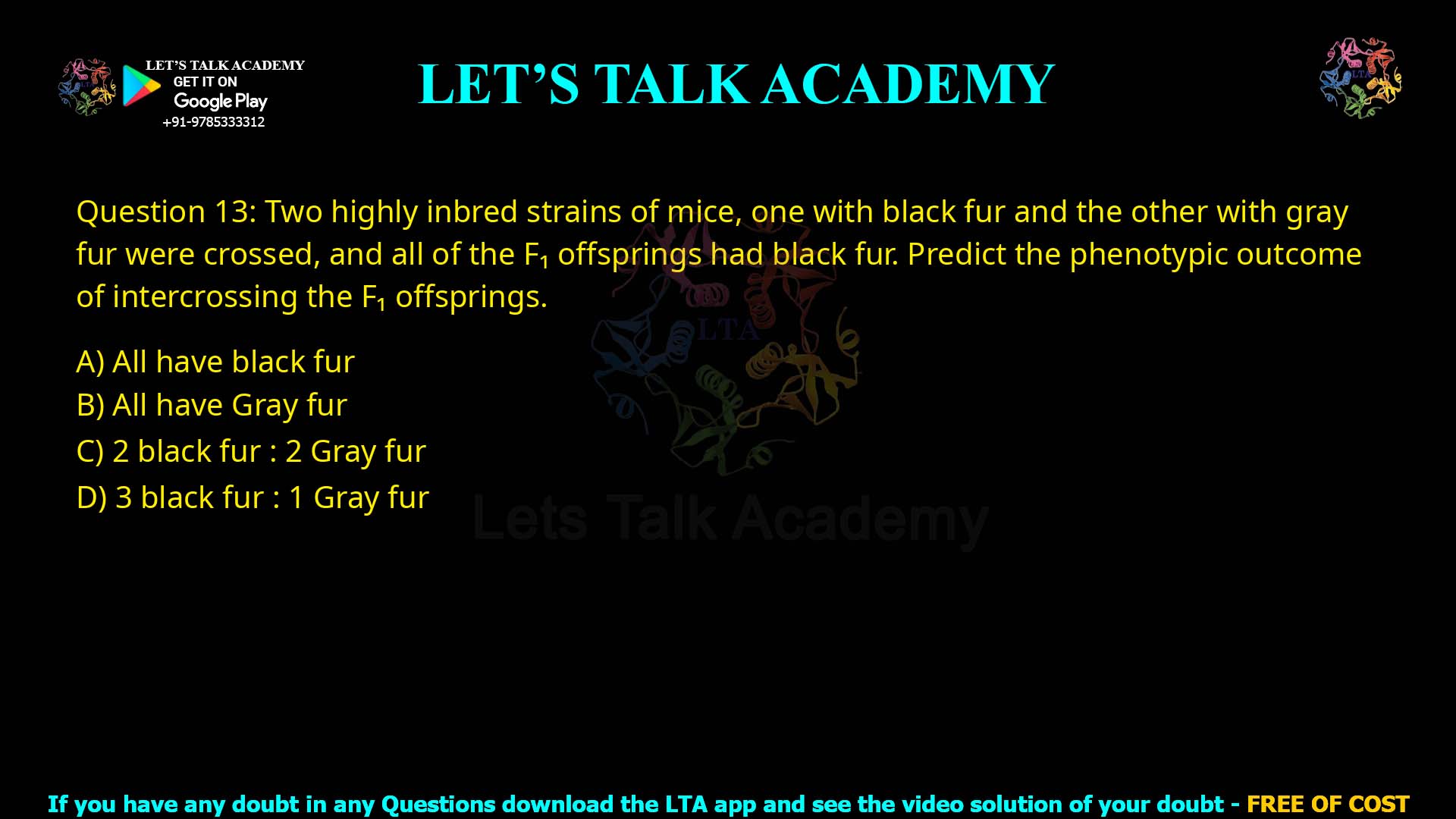
Q.13 Two highly inbred strains of mice, one with black fur and the other with gray fur were
crossed, and all of the F1 offsprings had black fur. Predict the phenotypic outcome of
intercrossing the F1 offsprings.
(1) All have black fur
(2) All have Gray fur
(3)2 black fur: 2 Gray fur
(4) 3 black fur: 1 Gray fur
Intercrossing F1 offspring from black and gray fur inbred mice yields a 3 black fur : 1 gray fur phenotypic ratio. Since all F1 show black fur, black is dominant (let’s denote B=dominant black, b=recessive gray). Inbred parents are BB (black) × bb (gray) → all F1 Bb (black). F1 × F1 (Bb × Bb) follows Mendel’s 1st law, producing 3 black (BB, Bb, Bb) : 1 gray (bb).
Option Analysis
-
(1) All have black fur: Would occur only if black were codominant/complete dominance without segregation, but F2 reveals recessive via 1/4 bb.
-
(2) All have Gray fur: Impossible—F1 are black (Bb), so F2 inherits B allele showing dominance.
-
(3) 2 black fur: 2 Gray fur: Suggests 1:1 ratio (testcross Bb × bb), not F1 intercross.
-
(4) 3 black fur: 1 Gray fur: Correct—Punnett square: BB (1/4 black), Bb (2/4 black), bb (1/4 gray); phenotypic 3:1.
Answer: (4) 3 black fur: 1 Gray fur.
Introduction to Fur Color Inheritance
Two highly inbred strains of mice—one black fur, one gray fur—crossed produce all black F1 offspring, indicating black dominance over recessive gray. The phenotypic outcome of intercrossing the F1 offsprings follows standard monohybrid 3:1 ratio in F2 generation.
Punnett Square Breakdown
Parents: BB (black) × bb (gray) → F1 all Bb (black).
F1 × F1:
| B | b | |
|---|---|---|
| B | BB | Bb |
| b | Bb | bb |
| Genotypes: 1 BB : 2 Bb : 1 bb → Phenotypes: 3 black : 1 gray. |
Why Other Ratios Are Incorrect
-
All black ignores segregation.
-
All gray contradicts F1 data.
-
2:2 (1:1) fits backcross, not F1 intercross.
GATE Genetics Application
Tests complete dominance in inbred lines: F1 uniform → F2 3:1 confirms monogenic trait. Essential for quantitative genetics, breeding experiments.


