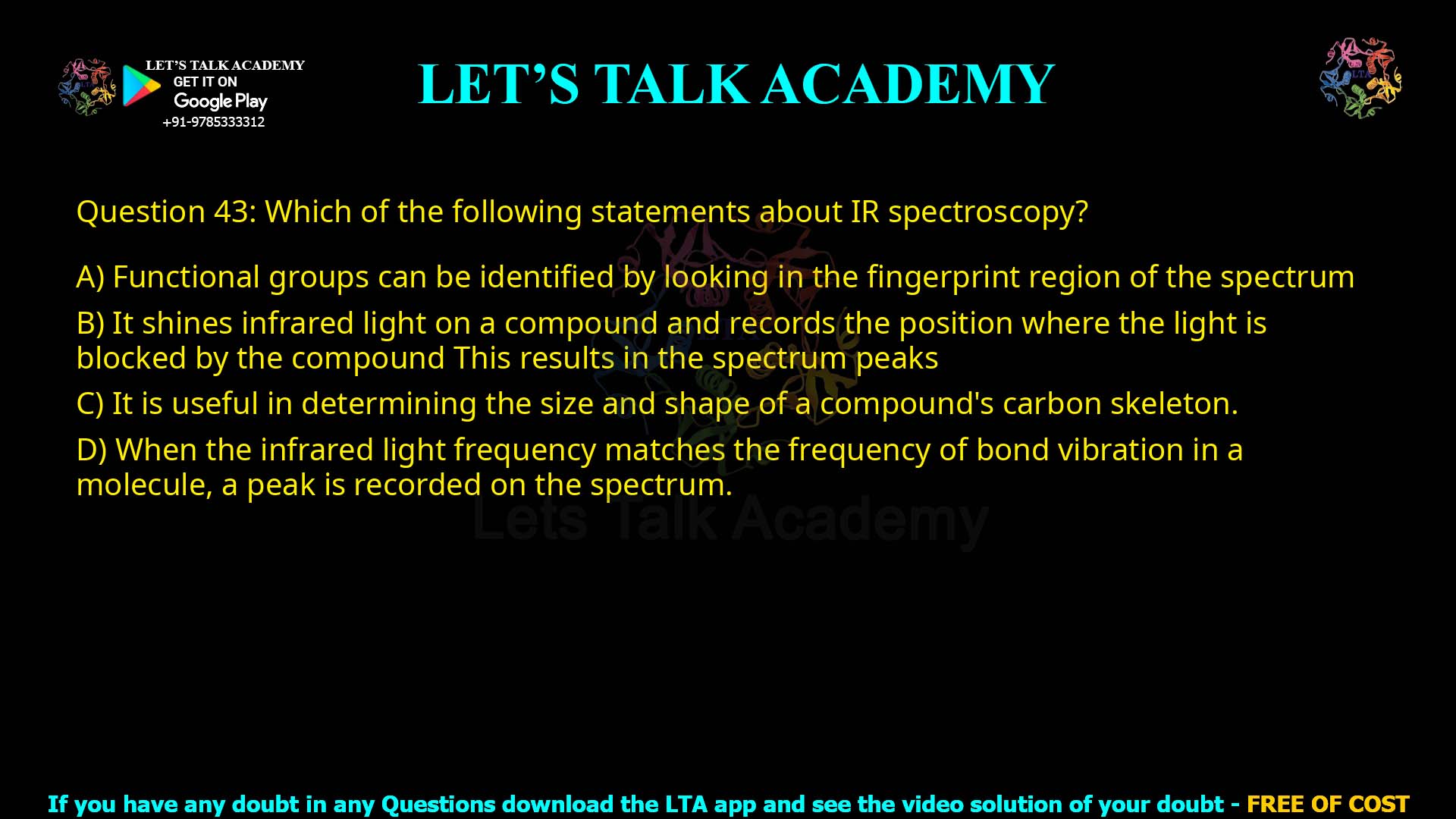
Q.43 Which of the following statements is true concerning infrared spectroscopy ?
1. Functional groups can be identified by looking in the fingerprint region of the spectrum.
2. It shines infrared light on a compound and records the position, where the light is blocked by the compound. This results
in the spectrum peaks.
3. It is useful in determining the size and shape of a compound’s carbon skeleton.
4. When the infrared light frequency matches the frequency of bond vibration in a molecule, a peak is recorded on the
spectrum.
Infrared (IR) spectroscopy identifies molecular structures by analyzing bond vibrations. The correct answer to the given question is option 4.
Correct Answer
4. When the infrared light frequency matches the frequency of bond vibration in a molecule, a peak is recorded on the spectrum.
IR spectroscopy works on the principle of molecular vibration. When IR light frequency matches a bond’s natural vibration frequency, energy absorption occurs, producing a characteristic peak on the spectrum.
Option Analysis
Option 1: False
Functional groups are identified in the functional group region (4000–1500 cm⁻¹), not the fingerprint region (1500–500 cm⁻¹). The fingerprint region shows complex, molecule-specific patterns used for compound identification, not straightforward functional group detection.
Option 2: False
IR spectrometers measure transmitted or absorbed IR light, recording peaks where absorption occurs due to vibrational transitions. They do not simply “record positions where light is blocked”; peaks represent specific frequency absorptions corresponding to bond vibrations.
Option 3: False
IR spectroscopy excels at detecting functional groups via bond vibrations but cannot determine the size or shape of the carbon skeleton. Techniques like NMR or mass spectrometry better address skeletal structure.
Option 4: True
This accurately describes IR spectroscopy’s core mechanism. Bond vibrations (stretching, bending) absorb IR at matching frequencies, generating peaks that reveal molecular fingerprints.
| Option | Statement Summary | Correct? | Reason |
|---|---|---|---|
| 1 | Fingerprint region for functional groups | No | Functional groups in 4000–1500 cm⁻¹ |
| 2 | Records “blocked” light positions | No | Measures absorption at vibration frequencies |
| 3 | Determines carbon skeleton size/shape | No | Limited to functional groups |
| 4 | Frequency match records peak | Yes | Core principle of IR |


