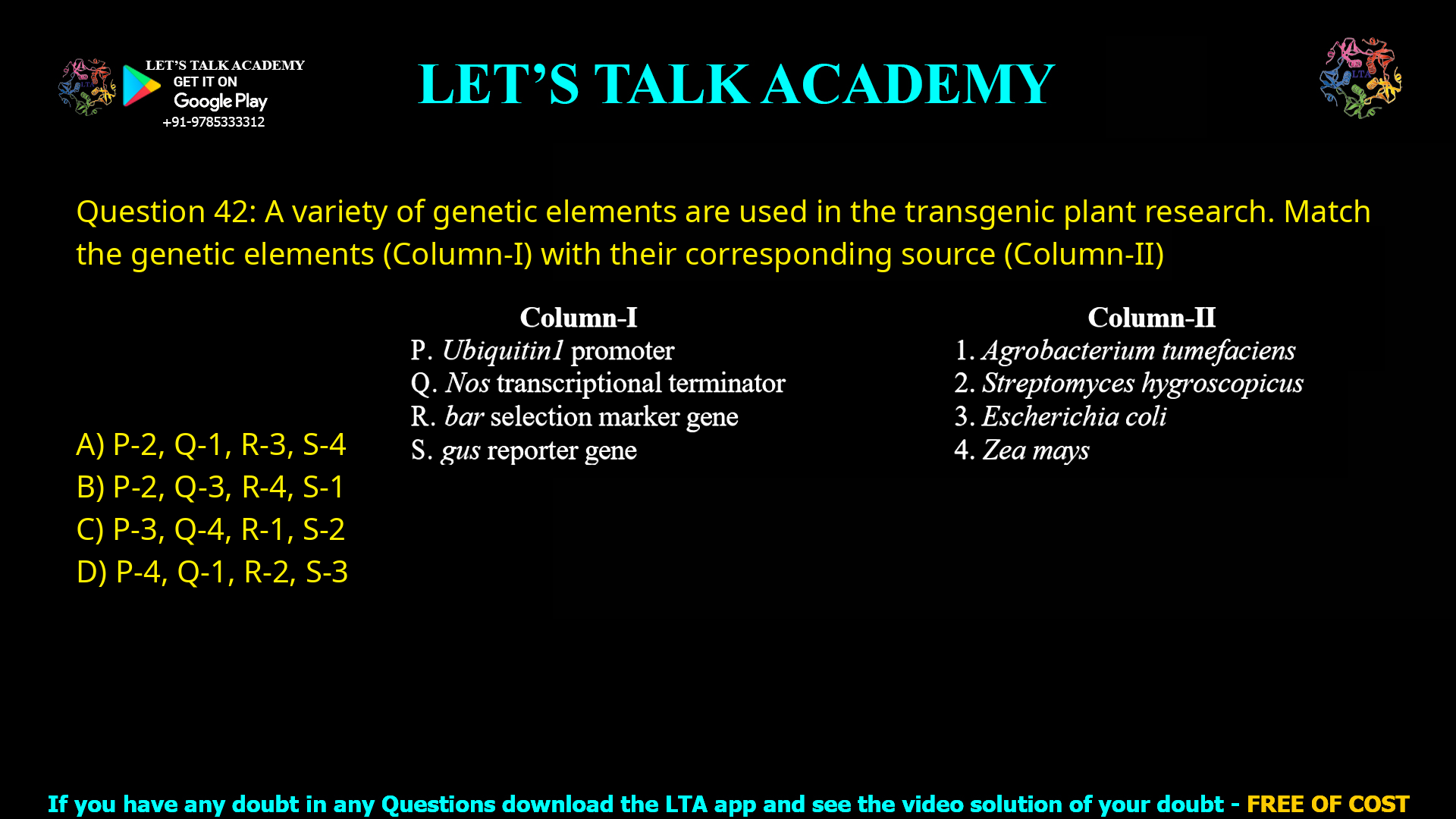
Q.42 A variety of genetic elements are used in the transgenic plant research. Match the genetic elements
(Column-I) with their corresponding source (Column-II).
Column-I Column-II
P. Ubiquitin1 promoter 1. Agrobacterium tumefaciens
Q. Nos transcriptional terminator 2. Streptomyces hygroscopicus
R. bar selection marker gene 3. Escherichia coli
S. gus reporter gene 4. Zea mays
(A) P-2, Q-1, R-3, S-4 (B) P-2, Q-3, R-4, S-1
(C) P-3, Q-4, R-1, S-2 (D) P-4, Q-1, R-2, S-3
Genetic Elements in Transgenic Plant Research: Matching Sources MCQ Solution
Transgenic plant research relies on specific genetic elements like promoters, terminators, and selectable markers sourced from bacteria, plants, and microbes. The correct matching identifies their origins accurately for biotechnology applications.
Option Breakdown
-
P. Ubiquitin1 promoter → 4. Zea mays: Correct. Maize polyubiquitin (Ubi-1) promoter drives constitutive expression in monocots due to strong, root-specific activity.
-
Q. Nos transcriptional terminator → 1. Agrobacterium tumefaciens: Correct. Nopaline synthase (nos) terminator from Ti plasmid stabilizes mRNA and prevents read-through.
-
R. bar selection marker gene → 2. Streptomyces hygroscopicus: Correct. Phosphinothricin acetyltransferase (bar/PAT) gene confers Basta/glufosinate resistance.
-
S. gus reporter gene → 3. Escherichia coli: Correct. β-glucuronidase (uidA/gusA) enables histochemical GUS assays for transformation success.
Option Evaluation
-
(A) P-2, Q-1, R-3, S-4: Incorrect. Ubi1 not from Streptomyces; bar not E. coli.
-
(B) P-2, Q-3, R-4, S-1: Incorrect. Ubi1 mismatches; nos not E. coli.
-
(C) P-3, Q-4, R-1, S-2: Incorrect. Ubi1 not E. coli; nos not Zea mays.
-
(D) P-4, Q-1, R-2, S-3: Correct. All pairings match standard transgenic cassette origins.
Correct Answer
(D) P-4, Q-1, R-2, S-3. These reflect established vectors like pBI121 (CaMV35S-nos-gus-bar) used in 90% of plant transformations.
Genetic elements transgenic plant research power modern crop improvement through precise gene cassettes. Ubiquitin1 promoter ensures constitutive expression, nos terminator stabilizes transcripts, bar enables herbicide selection, and gus visualizes transformation—each from optimized sources for stable integration via Agrobacterium or biolistics.
Element-Source Pairings
-
Ubiquitin1 promoter (P-4, Zea mays): Maize Ubi-1 with intron drives high-level expression in cereals; 5-10x stronger than CaMV35S in rice/wheat.
-
Nos terminator (Q-1, Agrobacterium tumefaciens): 230-bp octopine synthase 3′ UTR from pTiT37; polyA signal used in pBIN19 vectors.
-
bar gene (R-2, Streptomyces hygroscopicus): 555-bp PAT detoxifies phosphinothricin; 80% regeneration efficiency in tissue culture.
-
gus gene (S-3, E. coli K12): 1.8-kb uidA; X-glucuronide hydrolysis yields blue precipitate for screening.
Exam Strategy
Mnemonic: Ubi (corn=Zea=4), Nos (Agrobacterium=1), Bar (Streptomyces=2), Gus (E.coli=3). Option (D) aligns with binary vector standards (pCAMBIA1300 series). Visualize cassettes: Promoter-Intron-GOI-Terminator.
These tools generated herbicide-tolerant canola (Roundup Ready) and Bt crops, comprising 190M hectares globally, revolutionizing agriculture.


