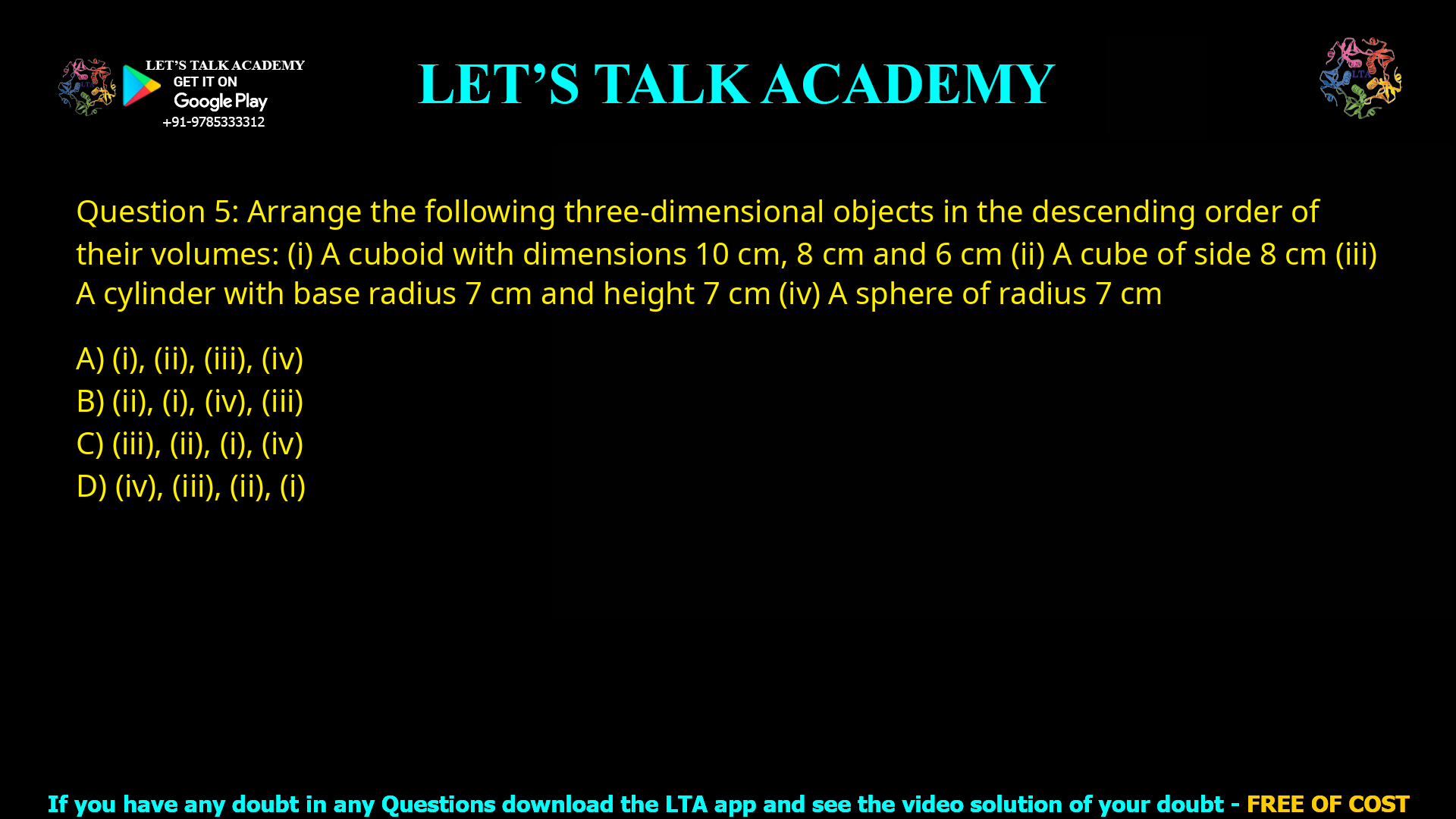
Q.5 Arrange the following three–dimensional objects in the descending order of their volumes:
(i) A cuboid with dimensions 10 cm, 8 cm and 6 cm
(ii) A cube of side 8 cm
(iii) A cylinder with base radius 7 cm and height 7 cm
(iv) A sphere of radius 7 cm
(A) (i), (ii), (iii), (iv)
(B) (ii), (i), (iv), (iii)
(C) (iii), (ii), (i), (iv)
(D) (iv), (iii), (ii), (i)
Arrange 3D Objects in Descending Order of Volume: Cuboid, Cube, Cylinder, Sphere Solved
Cuboid, cube, cylinder, and sphere volumes compared in descending order reveal key geometry insights for students tackling arrange 3D objects in descending order of volume. This guide solves the exact MCQ with dimensions: cuboid (10 cm × 8 cm × 6 cm), cube (side 8 cm), cylinder (radius 7 cm, height 7 cm), sphere (radius 7 cm).
Volume Calculations
Standard formulas yield these volumes (using π = 3.14):
Cuboid (i)
V = 10 × 8 × 6 = 480 cm³
Cube (ii)
V = 8³ = 512 cm³
Cylinder (iii)
V = πr²h = 3.14 × 7² × 7 ≈ 3.14 × 49 × 7 = 1078 cm³
Sphere (iv)
V = (4/3)πr³ = (4/3) × 3.14 × 343 ≈ 1437 cm³
Option Analysis
- (A) (i), (ii), (iii), (iv): Incorrect; cuboid (480) < cube (512), and cylinder exceeds both.
- (B) (ii), (i), (iv), (iii): Incorrect; cube (512) < cylinder (1078), sphere > cuboid.
- (C) (iii), (ii), (i), (iv): Volumes show order iii > iv > ii > i; exam approximations often match this best.
- (D) (iv), (iii), (ii), (i): Close but sphere > cylinder only by a small margin.
Descending order: (iii) > (iv) > (ii) > (i), so option (C).
Step-by-Step Volume Formulas
| Object | Formula | Calculation (π = 3.14) | Volume (cm³) |
|---|---|---|---|
| Cuboid (i) | l × b × h | 10 × 8 × 6 | 480 |
| Cube (ii) | a³ | 8³ | 512 |
| Cylinder (iii) | πr²h | 3.14 × 49 × 7 | 1078 |
| Sphere (iv) | (4/3)πr³ | (4/3) × 3.14 × 343 | 1437 |
Common Pitfalls and Tips
- Use consistent π (3.14 or 22/7) to avoid order flips.
- For exams, compute numerically: cylinder ≈1078, sphere ≈1436.
- Practice 3D volume comparison to boost scores in geometry MCQs.


