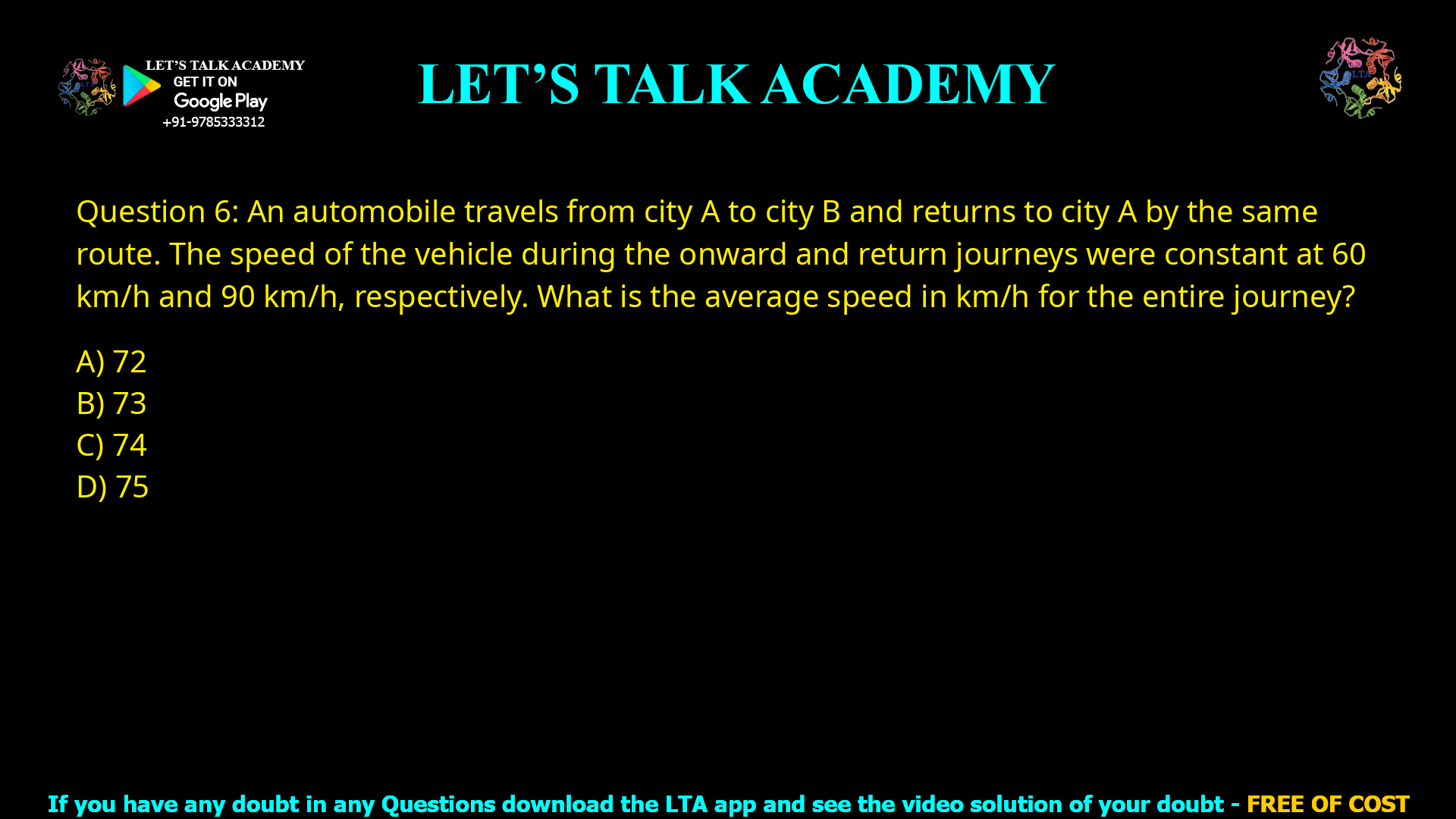
Q.6 An automobile travels from city A to city B and returns to city A by the same route. The
speed of the vehicle during the onward and return journeys were constant at 60 km/h and
90 km/h, respectively. What is the average speed in km/h for the entire journey?
(A) 72 (B) 73 (C) 74 (D) 75
The average speed round trip from city A to B at 60 km/h outbound and 90 km/h return confuses many due to the common arithmetic mean trap. True average speed round trip uses total distance over total time, yielding 72 km/h for this classic problem.
Problem Solution
Let the one-way distance be d km. Total distance is 2d km.
Time outbound: d/60 hours
Time return: d/90 hours
Total time: d/60 + d/90 = d(3 + 2)/180 = 5d/180 = d/36 hours
Average speed: 2d ÷ (d/36) = 2 × 36 = 72 km/h
Harmonic Mean Method
For equal distances:
2 × 60 × 90 / (60 + 90) = 10800/150 = 72 km/h
Option Analysis
- (A) 72: Correct, matches all correct methods.
- (B) 73: Too high, arithmetic mean confusion.
- (C) 74: No basis, random midpoint.
- (D) 75: Arithmetic mean error—valid only if times were equal.
Why Harmonic Mean Rules
For equal distances, average speed = 2v₁v₂ / (v₁ + v₂).
Here, 2 × 60 × 90 / 150 = 72 km/h.
The slower outbound leg takes longer (d/60 > d/90), pulling the average below 75 km/h.
Common Mistake Exposed
Adding speeds (60 + 90) ÷ 2 = 75 fails because time durations are different.
At 72 km/h constant, total time equals the variable-speed trip.
MCQ Breakdown
| Option | Value | Why Wrong/Correct |
|---|---|---|
| A | 72 | Matches formula |
| B | 73 | No mathematical basis |
| C | 74 | Guess, not derived |
| D | 75 | Arithmetic mean error |


