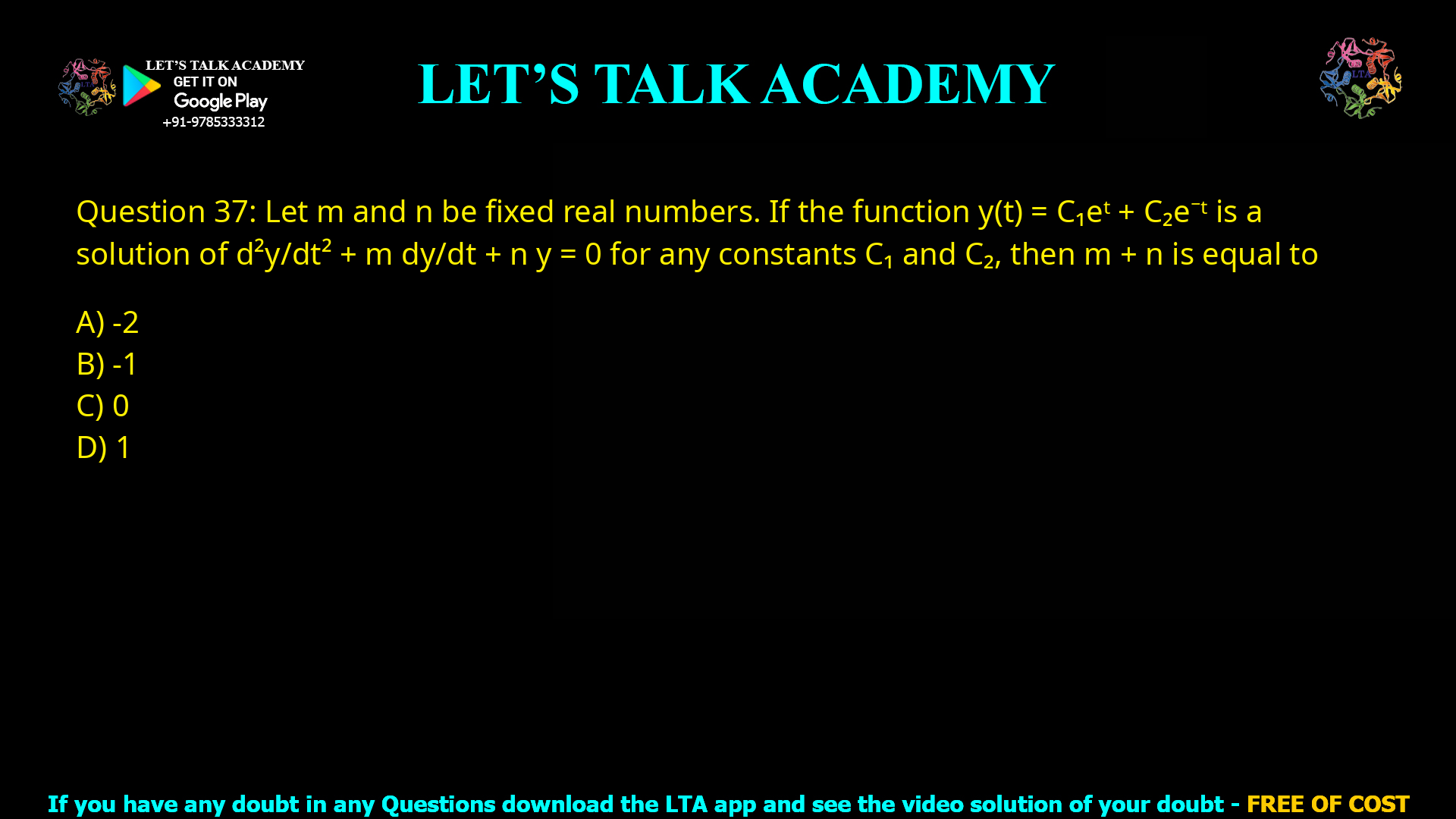
Q.45 Let m and n be fixed real numbers.
Characteristic Equation Solution: m + n = 0 for y = C1et + C2e−t
The correct answer is (C) 0. The function
y(t) = C1et + C2e−t
satisfies the differential equation
d²y/dt² + m dy/dt + n y = 0 when
m + n = 0.
Solving the Characteristic Equation
The given equation is a second-order linear homogeneous differential equation
with constant coefficients:
d²y/dt² + m dy/dt + n y = 0
Assume a solution of the form y = ert. This leads
to the characteristic equation:
r² + mr + n = 0
Since the general solution is
y(t) = C1et + C2e−t,
the roots of the characteristic equation are:
- r = 1
- r = −1
Thus,
(r − 1)(r + 1) = r² − 1 = 0.
Comparing with r² + mr + n = 0, we get:
- m = 0
- n = −1
Hence,
m + n = 0.
Verification by Substitution
Compute the derivatives:
y′ = C1et − C2e−t
y′′ = C1et + C2e−t
Substitute into the differential equation:
y′′ + m y′ + n y =
(C1et + C2e−t)
+ m(C1et − C2e−t)
+ n(C1et + C2e−t) = 0
Grouping terms:
C1et(1 + m + n)
+ C2e−t(1 − m + n) = 0
For this to hold for all C1 and C2:
- 1 + m + n = 0
- 1 − m + n = 0
Adding gives 2 + 2n = 0 → n = −1
Subtracting gives 2m = 0 → m = 0
Therefore, m + n = 0.
Explanation of Options
| Option | Value | Explanation |
|---|---|---|
| (A) | −2 | Roots do not match ±1; solution form differs from the given function. |
| (B) | −1 | Leads to unequal roots, not matching et and e−t. |
| (C) | 0 | Correct. Matches roots ±1 exactly. |
| (D) | 1 | Produces incorrect root structure and solution form. |


