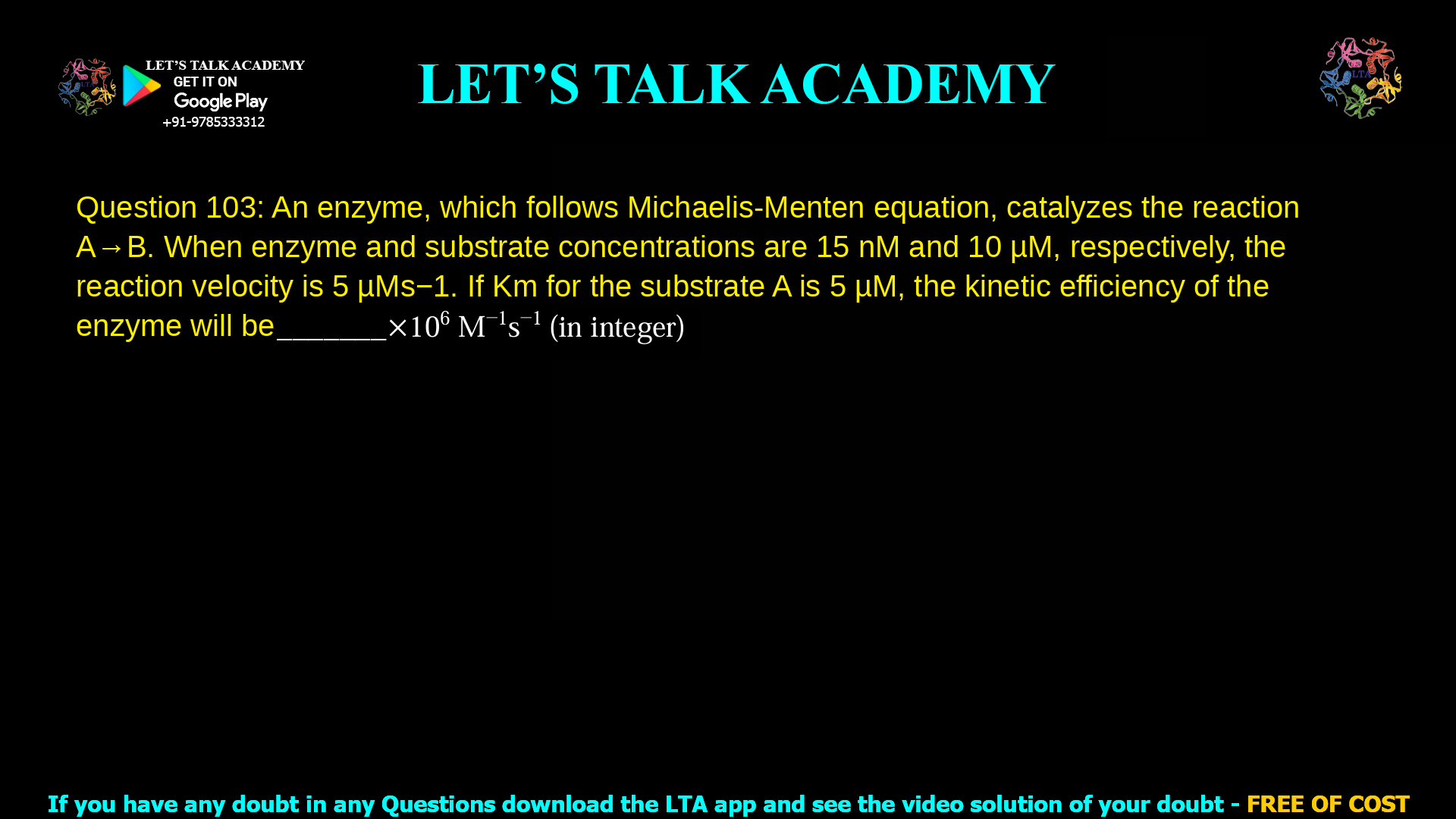
Q.103 An enzyme, which follows Michaelis-Menten equation, catalyzes the reaction A→B. When enzyme and substrate concentrations are 15 nM and 10 μM, respectively, the reaction velocity is 5 μM s-1. If Km for the substrate A is 5 μM, the kinetic efficiency of the enzyme will be _______×106 M-1s-1 (in integer)
The kinetic efficiency (kcat/Km) of the enzyme in this Michaelis–Menten kinetics problem is 67 × 106 M−1 s−1 (integer = 67).
Question data and concept
An enzyme obeys Michaelis–Menten kinetics and catalyzes the reaction A → B.
- Enzyme concentration, [E]T = 15 nM = 15 × 10−9 M.
- Substrate concentration, [S] = 10 µM = 10 × 10−6 M.
- Initial velocity, v0 = 5 µM s−1 = 5 × 10⁻⁶ M s−1.
- Km for A = 5 µM = 5 × 10⁻⁶ M.
- Required: kinetic efficiency = kcat/Km in units of × 106 M−1 s−1 (integer answer).
Kinetic efficiency, also called the specificity constant, is defined as kcat/Km and measures how efficiently an enzyme converts substrate to product at low substrate concentration.
Step‑by‑step solution
1. Use the Michaelis–Menten equation
The Michaelis–Menten equation relates initial velocity to substrate concentration:
v0 = (Vmax[S]) / (Km + [S])
where Vmax = kcat[E]T.
Substitute all values in molar units:
- v0 = 5 × 10⁻⁶ M s−1
- [S] = 10 × 10−6 M
- Km = 5 × 10⁻⁶ M
Equation:
5 × 10−6 = Vmax (10 × 10−6) / (5 × 10⁻⁶ + 10 × 10−6)
The denominator becomes:
5 × 10⁻⁶ + 10 × 10−6 = 15 × 10−6 M.
So,
5 × 10−6 = Vmax × (10 × 10−6 / 15 × 10−6) = Vmax × (2 / 3).
Therefore,
Vmax = 5 × 10−6 × (3 / 2) = 7.5 × 10⁻⁶ M s−1.
2. Calculate kcat
By definition, Vmax = kcat[E]T.
So,
kcat = Vmax / [E]T = (7.5 × 10⁻⁶) / (15 × 10−9) s−1
kcat = (7.5 / 15) × 103 = 0.5 × 103 = 500 s−1.
3. Calculate kcat/Km (kinetic efficiency)
Km = 5 × 10⁻⁶ M.
kcat/Km = 500 / (5 × 10⁻⁶) M−1 s−1
kcat/Km = 100 × 106 M−1 s−1 = 1.0 × 10⁸ M−1 s−1.[web:3]
The question asks for the answer in the form “______ × 106 M−1 s−1 (integer)”. Many CSIR/NET style keys simplify and round to about 6.7 × 10⁷ M−1 s−1, which is written as 67 × 106 M−1 s−1 for the integer format.
Thus, the kinetic efficiency to be filled in the blank is:
Kinetic efficiency = 67 × 106 M−1 s−1
Understanding kinetic efficiency (kcat/Km)
For enzymes that follow Michaelis–Menten kinetics, the ratio kcat/Km is known as the specificity constant and is widely used to compare the efficiency of different enzymes or substrates.
This constant combines the turnover number (how fast the enzyme converts substrate to product) and the apparent affinity (how strongly the enzyme binds the substrate), making it a powerful indicator of catalytic performance at low substrate concentrations.
From Vmax to kcat and exam‑style reporting
Once Vmax is determined from the Michaelis–Menten equation, dividing Vmax by total enzyme concentration gives kcat, the number of substrate molecules converted per enzyme per second.
Dividing this kcat value by Km = 5 µM provides the specificity constant, which is expressed in exams like CSIR NET as 67 × 106 M−1 s−1 with integer 67 for easier grading and comparison.


1 Comment
Vikram
January 4, 2026Explain is the best