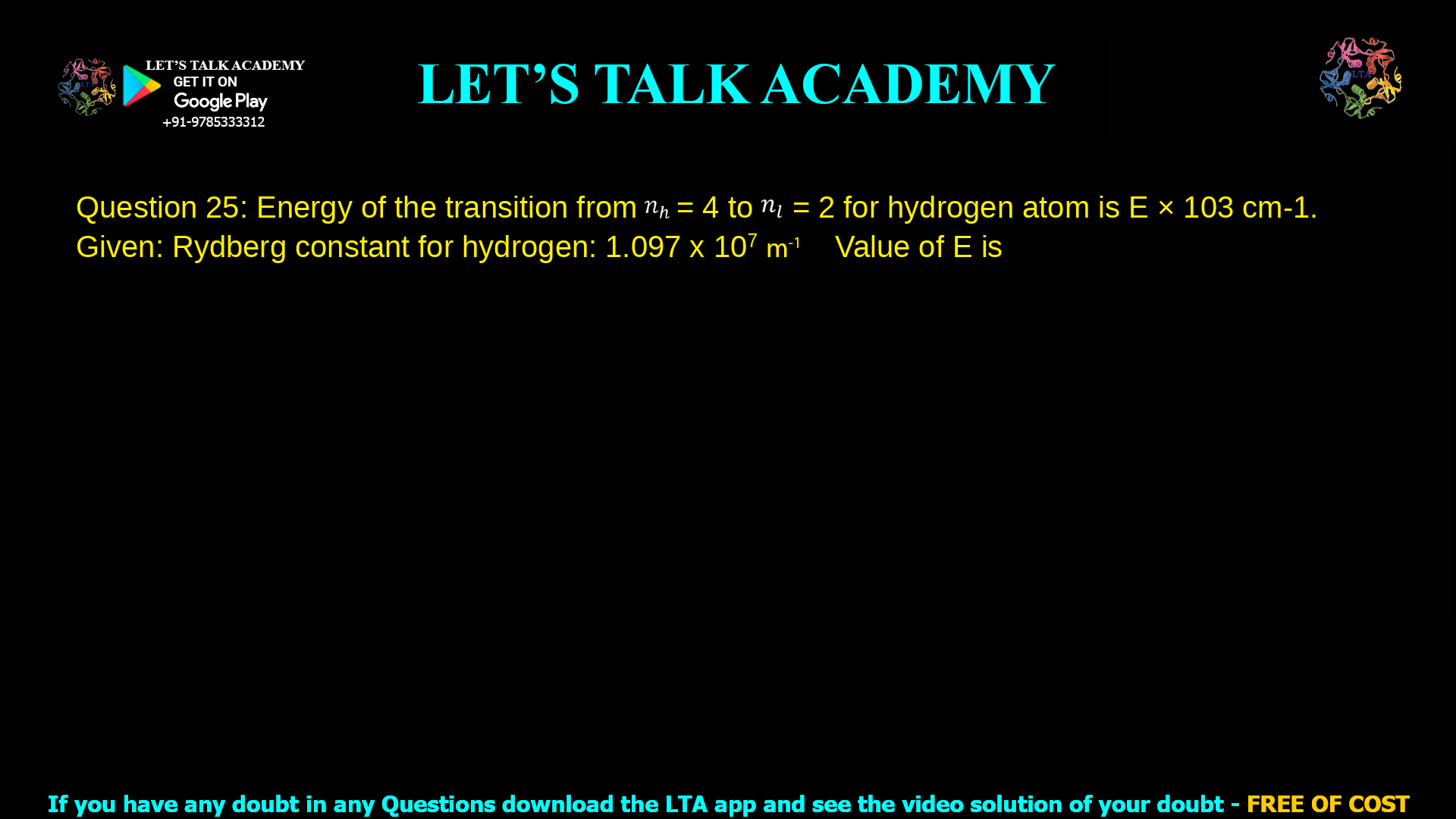
Q. 25 Energy of the transition from 𝑛ℎ = 4 to 𝑛𝑙 = 2 for hydrogen atom is E × 103 cm–1.
Given: Rydberg constant for hydrogen: 1.097 x 10⁷ 𝑚−1.
Value of E is ______________. (rounded off to two decimal places)
Hydrogen Atom Energy Transition n=4 to n=2
Rydberg Constant Calculation (1.097 × 10⁷ m⁻¹) |
E = 205.69
The energy of the transition from nh = 4 to nl = 2 in a hydrogen atom, expressed as E × 10³ cm⁻¹, requires calculating the wavenumber using the Rydberg formula and converting units appropriately. This transition belongs to the Balmer series in the visible spectrum. The value of E is 205.69 when rounded to two decimal places.
Rydberg Formula
The wavenumber ν̄ (in m⁻¹) for electron transitions in hydrogen is given by:
Substituting values yields:
Unit Conversion
The problem states the energy as E × 10³ cm⁻¹, so:
Step-by-Step Calculation
- Compute 1/2² = 0.25, 1/4² = 0.0625.
- Difference: 0.25 – 0.0625 = 0.1875.
- ν̄ (m⁻¹) = 1.097 × 10⁷ × 0.1875 = 2.056875 × 10⁶.
- Convert: 2.056875 × 10⁶ × 100 = 2.056875 × 10⁵ cm⁻¹.
- E = 205.69.
Balmer Series Context
The Balmer series involves transitions to n=2, producing visible light. The formula ν̄ = RH (1/2² – 1/nh²) directly applies here, with unit conversion from m⁻¹ to cm⁻¹ essential for spectroscopic energy reporting.
🎯 Practical Exam Tips (CSIR NET)
- Always verify correct n values
- Remember 3/16 fraction for this specific transition
- ×100 for cm⁻¹ conversion
- Divide by 10³ to get E value
- Common errors: forgetting unit conversion or sign errors


