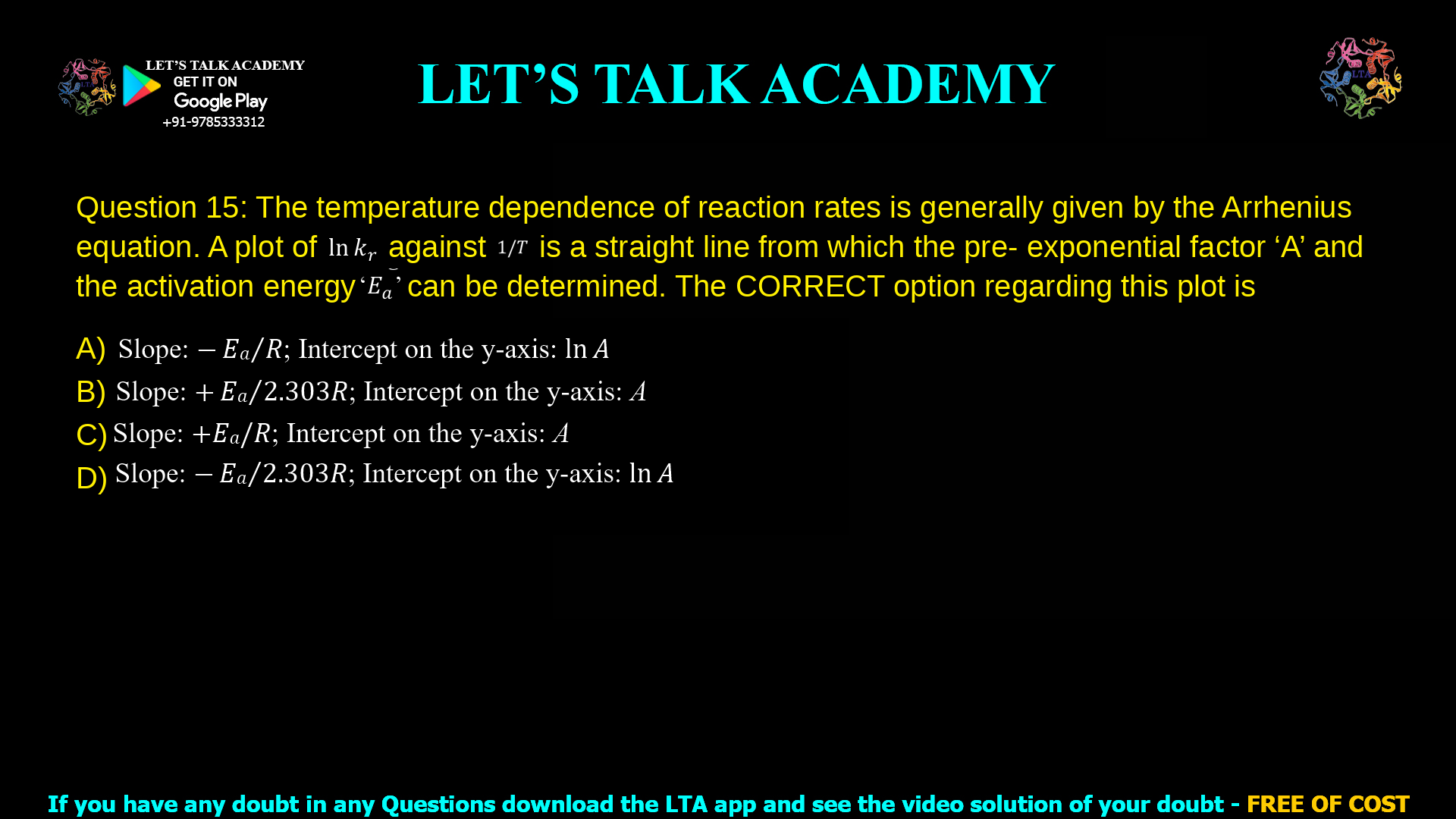
Q. 15 The temperature dependence of reaction rates is generally given by the Arrhenius
equation. A plot of ln 𝑘𝑟 against 1/𝑇 is a straight line from which the pre–
exponential factor ‘A’ and the activation energy ‘𝐸𝑎’ can be determined.
The CORRECT option regarding this plot is
(A) Slope: − 𝐸𝑎 𝑅⁄ ; Intercept on the y–axis: ln 𝐴
(B) Slope: + 𝐸𝑎 2.303𝑅⁄ ; Intercept on the y–axis: A
(C) Slope: +𝐸𝑎/𝑅; Intercept on the y–axis: A
(D) Slope: − 𝐸𝑎 2.303𝑅⁄ ; Intercept on the y–axis: ln 𝐴
The correct option is (A), as the Arrhenius plot of ln k_r against 1/T yields a straight line with slope -E_a/R and y-intercept ln A.
Arrhenius Equation Basics
The Arrhenius equation, k = A e^{-E_a / RT}, describes how reaction rate constants depend on temperature T, where A is the pre-exponential factor, E_a is activation energy, and R is the gas constant. Taking the natural logarithm gives ln k = ln A – (E_a / R) (1/T), which is in y = mx + c form. Plotting ln k_r (y-axis) versus 1/T (x-axis) produces a straight line, enabling determination of E_a from the slope and A from the intercept.
Option Analysis
-
(A) Slope: -E_a/R; Intercept: ln A – Matches the logarithmic form exactly, as slope m = -E_a/R and c = ln A.
-
(B) Slope: +E_a/(2.303R); Intercept: A – Incorrect; slope is negative, uses common log factor 2.303 (for log10 k plots), and intercept is ln A, not A.
-
(C) Slope: +E_a/R; Intercept: A – Wrong sign on slope (should be negative) and incorrect intercept (ln A, not A).
-
(D) Slope: -E_a/(2.303R); Intercept: ln A – Slope magnitude wrong; 2.303 applies to log10 k vs 1/T plots, not ln k.
The Arrhenius equation plot ln k vs 1/T is essential for CSIR NET aspirants studying temperature dependence of reaction rates. This straight-line graph reveals activation energy E_a from the slope and pre-exponential factor A from the intercept, aiding precise analysis in chemical kinetics.
Core Concept
In the Arrhenius equation, k = A exp(-E_a/RT), natural log transformation yields ln k = ln A – (E_a/R)(1/T). The plot’s negative slope reflects higher energy barriers reducing rates at lower T, while the y-intercept gives ln A, related to collision frequency.
Practical CSIR NET Application
For exams, recognize that only natural log (ln) plots avoid the 2.303 factor used in log10 versions. Calculate E_a as -slope × R (R ≈ 8.314 J/mol·K). This distinguishes correct options like (A) in multiple-choice questions on reaction kinetics.
Common Pitfalls
Options with positive slopes or 2.303 confuse log10 plots; always verify ln usage for direct -E_a/R slope. Practice plotting sample data to visualize linearity and extract parameters accurately.


