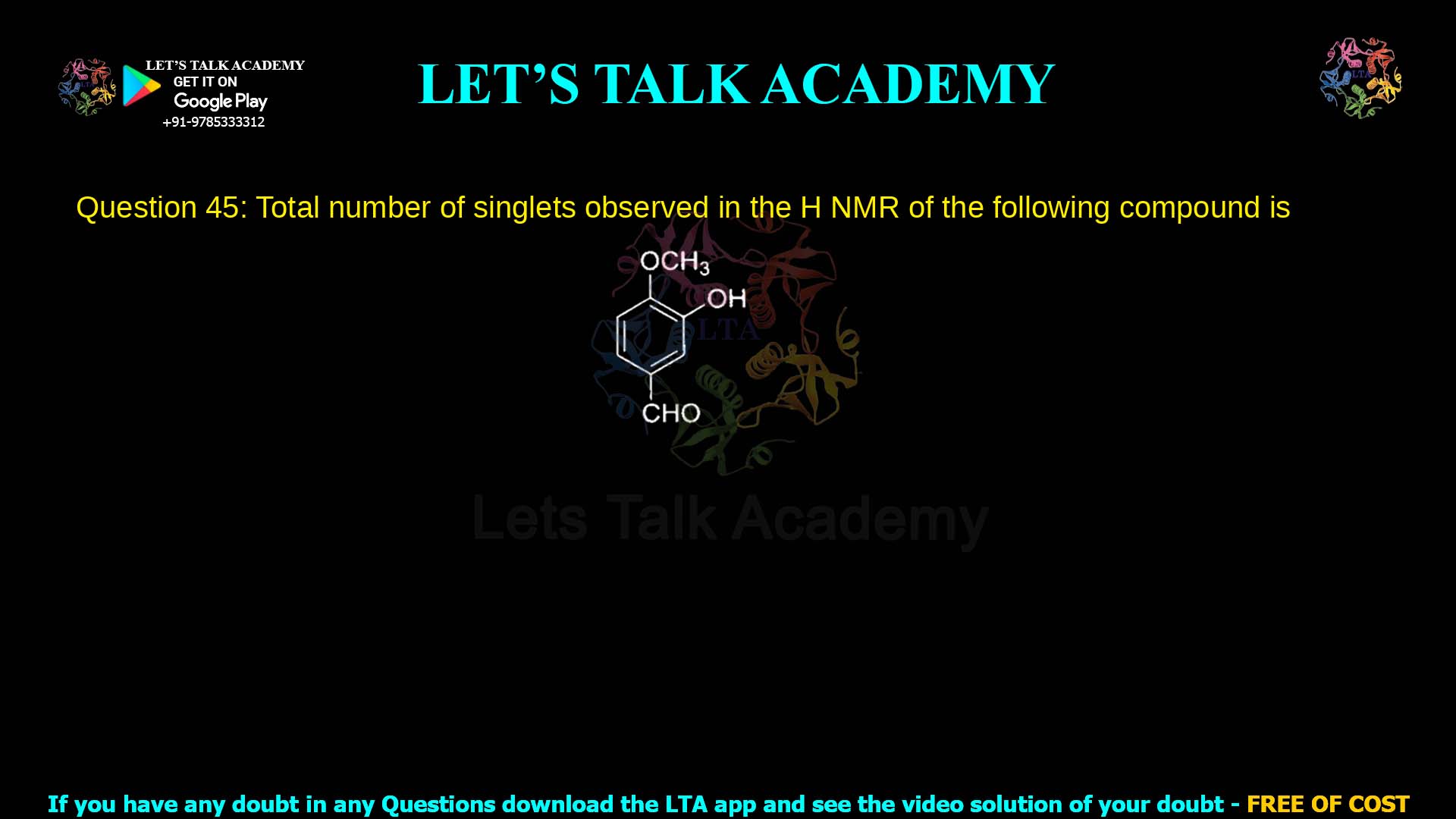
Q45. Total number of singlets observed in the H NMR of the following compound is
The compound shown is 2‑methoxy‑3‑hydroxybenzaldehyde, and the total number of singlets in its 1H NMR spectrum is four.
Structure and key protons
The ring carries three substituents:
-
−OCH3 (methoxy)
-
−OH (phenolic)
-
−CHO (aldehyde)
Distinct proton sets:
-
Methoxy protons –OCH3
-
Phenolic OH proton
-
Aldehyde CHO proton
-
One isolated aromatic proton (because of ortho–disubstitution pattern)
Why each appears as a singlet
-
The methoxy protons have no vicinal protons to couple with, so they appear as a singlet.
-
The phenolic OH proton is rapidly exchanged and normally appears as a broad singlet (no consistent coupling).
-
The aldehydic proton is ortho only to substituted carbons and not vicinal to any aromatic hydrogen, so it also appears as a singlet.
-
In this substitution pattern the remaining aromatic proton is flanked by substituted carbons, leaving it without vicinal aromatic neighbours, so it too appears as a singlet.
Thus, there are four distinct, non‑coupled proton environments, giving four singlets in the 1H NMR spectrum.
SEO‑friendly explanation article
Introduction
Understanding how to count the total number of singlets in the H NMR of the following compound is a common conceptual task in spectroscopy and competitive chemistry exams. By analysing the symmetry, substitution pattern and coupling possibilities, the answer for 2‑methoxy‑3‑hydroxybenzaldehyde can be obtained logically and quickly.
Step 1: Identify all proton types
For 2‑methoxy‑3‑hydroxybenzaldehyde, list every unique proton environment:
-
Aromatic protons on the benzene ring
-
Methoxy −OCH3 protons
-
Phenolic −OH proton
-
Aldehydic −CHO proton
Because of the three adjacent substituents on the ring, only one aromatic carbon still carries a hydrogen; the rest are substituted. That single aromatic hydrogen is chemically unique.
So, there are four types of protons overall:
-
One aromatic H
-
Three equivalent methoxy H
-
One OH H
-
One CHO H
Each type can, in principle, give one separate signal.
Step 2: Check possible spin–spin coupling
To know how many singlets appear, check which protons have neighbouring (vicinal) protons to couple with.
-
Methoxy −OCH3: Adjacent only to oxygen; no vicinal hydrogens on the directly bonded carbon, so there is no n+1 splitting. This signal is a singlet.
-
Phenolic −OH: The OH proton exchanges rapidly with traces of water or acid/base in typical NMR solvents, so coupling with nearby hydrogens is averaged out. It appears as a broad singlet and is treated as a singlet for counting purposes.
-
Aldehydic −CHO: This proton is attached to the formyl carbon, which is directly bonded to the aromatic ring carbon but has no vicinal proton on the adjacent carbon, so no aromatic–aldehydic coupling occurs here. The CHO signal therefore appears as a singlet.
-
Single aromatic proton: The ortho and meta positions around it are substituted by −OCH3, −OH, and −CHO, leaving no neighbouring aromatic hydrogens to couple with. Hence, this aromatic proton also appears as a singlet.
Step 3: Count the singlets
Since all four distinct proton environments lack effective vicinal partners for spin–spin splitting, each appears as an independent singlet:
-
Singlet from methoxy protons
-
Singlet (broad) from OH proton
-
Singlet from aldehydic proton
-
Singlet from the isolated aromatic proton
Therefore, the total number of singlets in the H NMR of the following compound is four.


