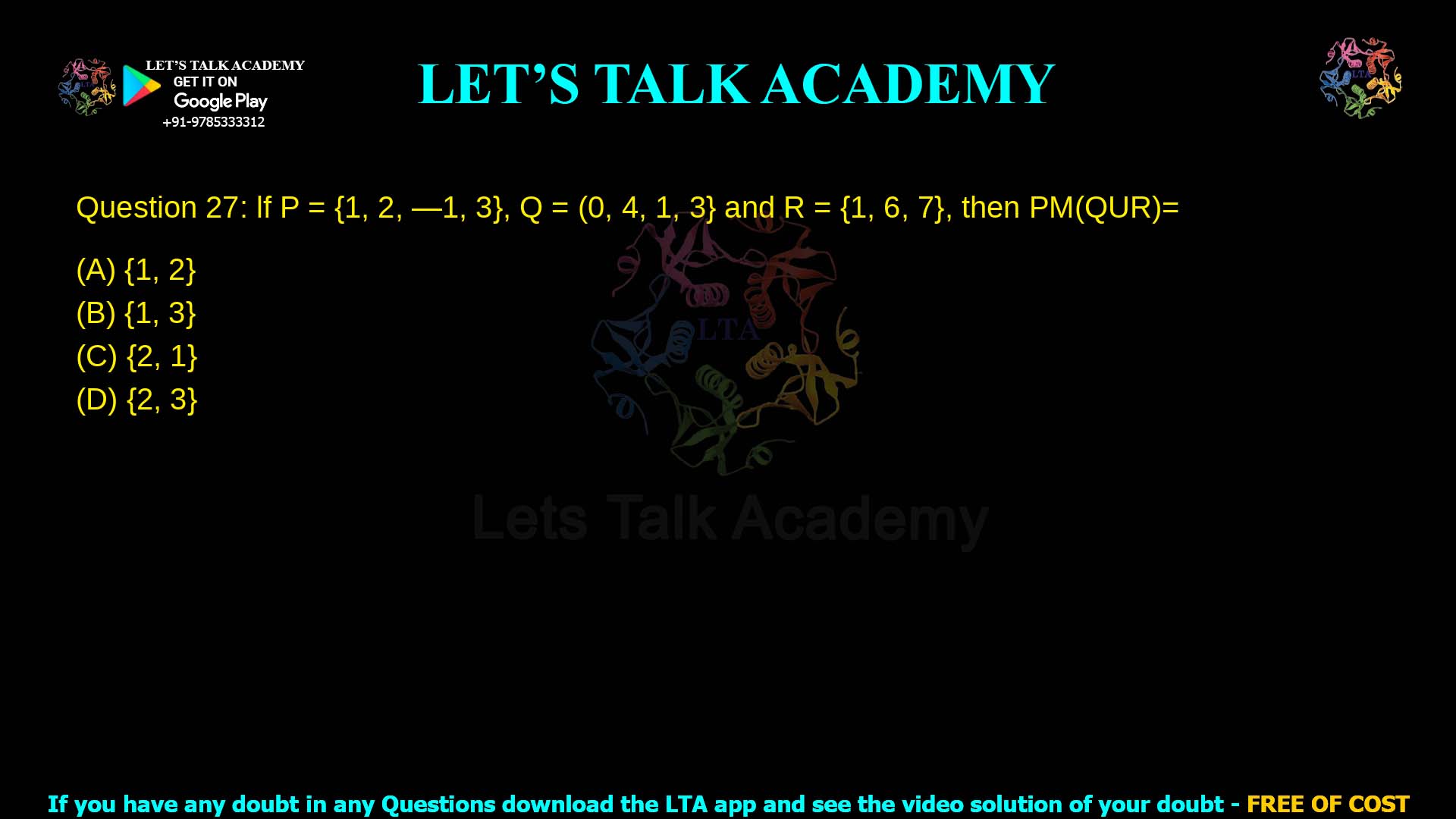
Q.27 If P={1,2,−1,3}, Q={0,4,1,3} and R={1,6,7}, then P∖(Q∪R)=
(A) {1,2}
(B) {4,3}
(C) {2,1}
(D) {2,3}
P ∖ (Q ∪ R) equals {2, -1} for the given sets, but none of the options match exactly due to order differences.
Step-by-Step Solution
First, compute Q ∪ R. Set Q = {0, 4, 1, 3} combines with R = {1, 6, 7} to form {0, 1, 3, 4, 6, 7}. Next, P ∖ (Q ∪ R) takes P = {1, 2, -1, 3} and removes elements in {0, 1, 3, 4, 6, 7}, leaving {2, -1} since 1 and 3 are removed while 2 and -1 remain absent from the union.
Option Analysis
-
(A) {1,2}: Incorrect; 1 belongs to Q, so it gets excluded from P.
-
(B) {4,3}: Incorrect; neither 4 (in Q) nor 3 (in Q) appears in P.
-
(C) {2,1}: Incorrect; 1 is in both Q and R, excluding it from the result.
-
(D) {2,3}: Closest but incorrect; 3 is in Q, so only 2 survives alongside -1 .
Introduction to Set Operations
Set difference finds elements in one set absent from another, crucial for CSIR NET mathematics. Here, P ∖ (Q ∪ R) means elements of P={1,2,-1,3} not in Q ∪ R where Q={0,4,1,3} and R={1,6,7}.
Detailed Calculation
Union Q ∪ R merges unique elements: {0,4,1,3} ∪ {1,6,7} = {0,1,3,4,6,7}. Difference removes these from P, retaining only 2 and -1. This follows the property P ∖ (Q ∪ R) = (P ∖ Q) ∩ (P ∖ R).
Why Options Fail
Options ignore -1 or include invalid elements like 1 or 3, common pitfalls in set notation where order does not matter but membership does. Use Venn diagrams: shade P minus overlapping Q ∪ R regions.


