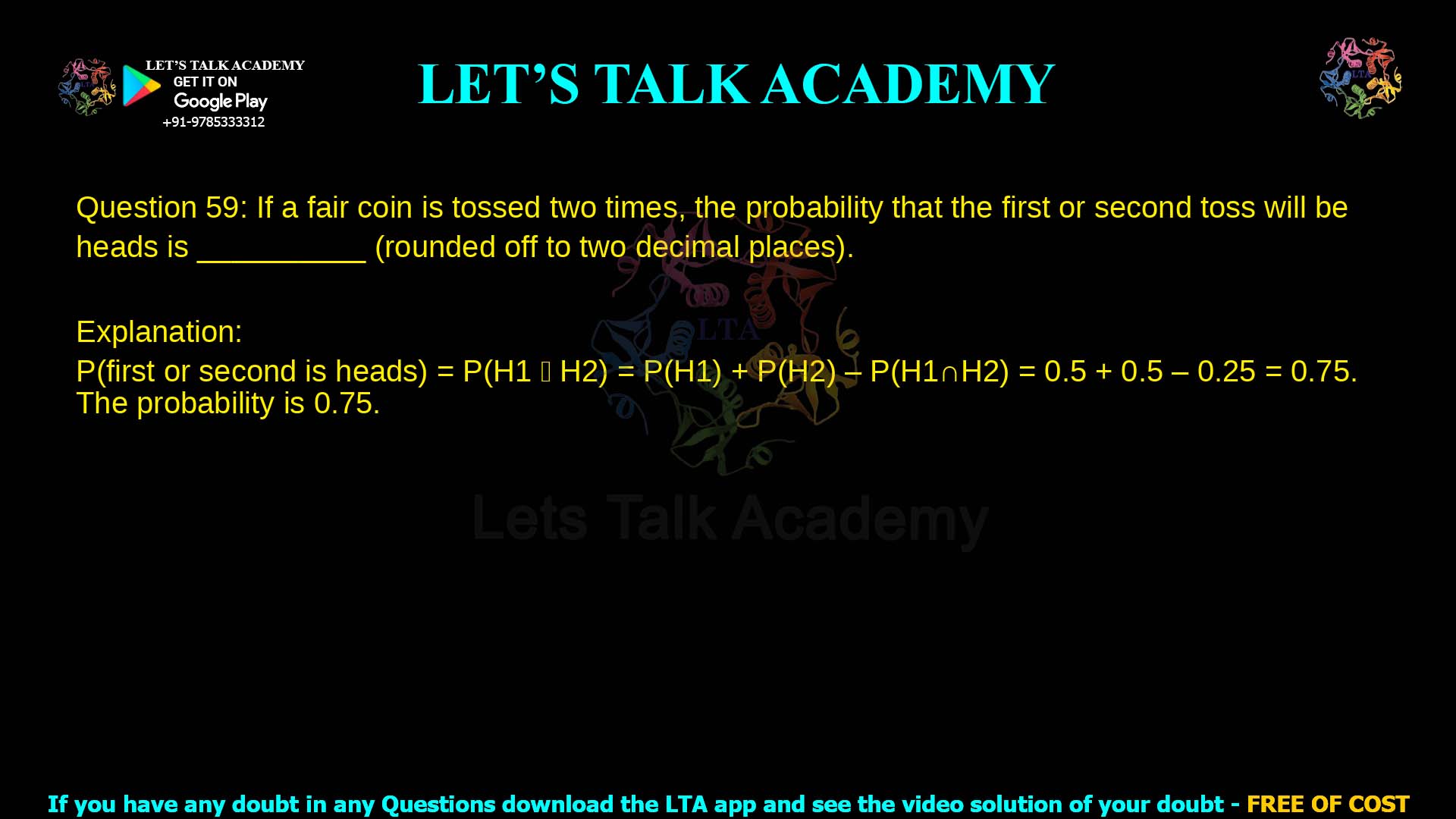
Q.59 If a fair coin is tossed two times, the probability that the first or the second toss
will be heads is __________ (rounded off to two decimal places).
Sample Space
The sample space consists of four equally likely outcomes: HH, HT, TH, TT, each with probability \( \frac{1}{4} \).
Favorable outcomes where at least one toss shows heads are HH, HT, and TH.
Union Rule Calculation
Let \( E \) be heads on first toss (\( P(E) = \frac{1}{2} \), outcomes HH, HT) and \( F \) be heads on second toss (\( P(F) = \frac{1}{2} \), outcomes HH, TH).
The intersection \( E \cap F \) is HH (\( P(E \cap F) = \frac{1}{4} \)).
By inclusion-exclusion:
Complementary Probability
The only unfavorable outcome is TT (both tails), with probability \( \frac{1}{4} \).
Common Errors
- Adding probabilities directly (\( \frac{1}{2} + \frac{1}{2} = 1 \)) double-counts HH.
- Assuming independence without subtraction overestimates by ignoring overlap.
This matches CSIR NET-style quantitative reasoning, emphasizing union rules and sample spaces.


