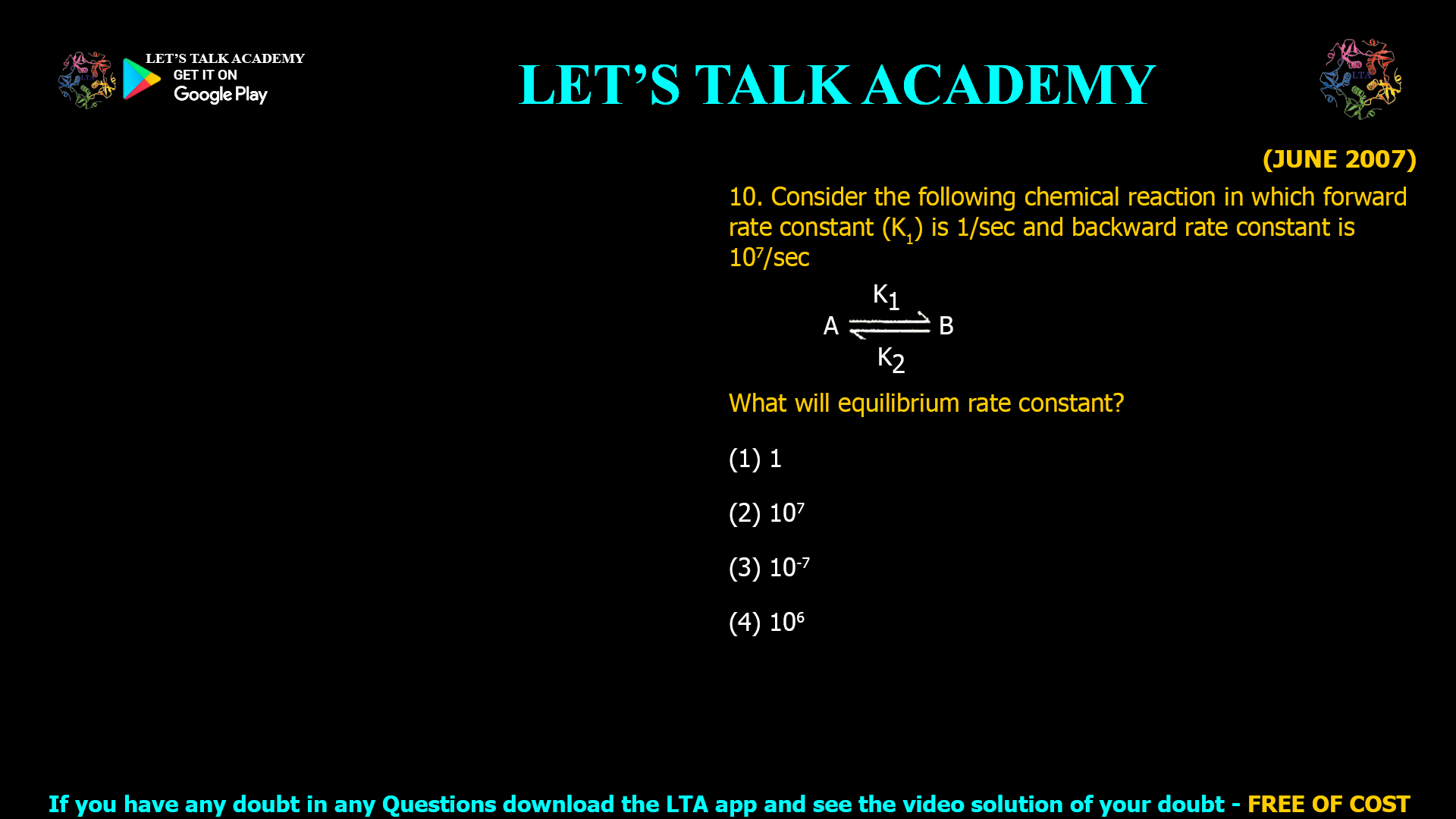
10. Consider the following chemical reaction in which forward rate constant (K1) is 1/sec and
backward rate constant is 107/sec
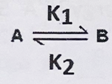
What will equilibrium rate constant?
(1) 1 (2) 107
(3) 10-7 (4) 106
The correct answer is (3) 10−7. The equilibrium constant (Keq) for the reaction is calculated as the ratio of the forward rate constant K1=1 s−1 to the backward rate constant K2=107 s−1, so Keq=K1K2=1107=10−7.
Introduction
The equilibrium constant is a fundamental concept in chemistry and biochemistry, representing the ratio of product to reactant concentrations at equilibrium in reversible reactions. Understanding how to calculate the equilibrium constant using the rate constants for the forward and backward reactions is essential for students, researchers, and those preparing for competitive exams such as CSIR NET and GATE. This article provides a step-by-step explanation for calculating equilibrium rate constants from provided kinetic data.
Theoretical Background: Rate Constants and Equilibrium
A reversible chemical reaction can be represented as:
A⇌K1K2B
-
Forward rate constant (K1): Rate at which A converts to B.
-
Reverse (backward) rate constant (K2): Rate at which B converts back to A.
At equilibrium, the rates of forward and reverse reactions equalize, and the equilibrium constant (Keq) links the two:
Keq=K1K2
Problem Breakdown
Given:
-
Forward rate constant (K1) = 1 s−1
-
Backward rate constant (K2) = 107 s−1
To find:
Equilibrium constant (Keq)
Mathematical Calculation
Plugging the numbers into the equation:
Keq=K1K2=1107=10−7
Thus, the equilibrium rate constant for this reaction is 10−7.
Conceptual Explanation
-
Low Equilibrium Constant (Keq<1): Indicates that at equilibrium, the concentration of reactant A is much higher than product B. The reverse reaction dominates.
-
High Equilibrium Constant (Keq>1): Favors product formation—most reactant is converted into product at equilibrium.
-
In this scenario, K2 (backward rate) is much larger than K1, meaning the system heavily favors the reactant side (A) at equilibrium.
Importance in Life Sciences
Equilibrium constants dictate the direction and extent of biological and chemical reactions:
-
Enzyme kinetics: Understanding how enzymes drive reactions toward products or substrates.
-
Metabolic control: Pathways with low equilibrium constants limit the conversion of substrates to products unless coupled with favorable reactions.
-
Drug design: Binding affinities, reaction reversibility, and metabolic flux control are all governed by kinetic and equilibrium principles.
Real-World Applications
-
Clinical Chemistry: Drug binding, metabolic transformations, enzymatic assays use equilibrium constants for quantitation.
-
Biochemical Research: Protein folding, ligand interactions, nucleic acid hybridization all rely on these calculations.
-
Environmental Chemistry: Predicting the fate of pollutants based on kinetic and equilibrium data.
Examples and Practice for Students
-
If a reaction has K1=100 s−1 and K2=50 s−1, calculate Keq:
Keq=10050=2
The product (B) is favored at equilibrium.
-
For K1=5 s−1 and K2=20 s−1:
Keq=520=0.25
The reactant (A) is favored.
Common Pitfalls and Misconceptions
-
Units: Equilibrium constants are typically dimensionless for concentration-based equilibria, but kinetic units (s⁻¹) must be consistent for proper calculations.
-
Directionality: Always use the forward and backward rate constants according to the direction specified in the question.
-
Reaction Type: Applies only to simple, reversible reactions. Complex mechanisms may require more advanced treatment.
Summary Table
| K1 (Forward) | K2 (Backward) | Keq | Equilibrium Favored |
|---|---|---|---|
| 1 | 107 | 10−7 | Reactant (A) |
| 103 | 102 | 10 | Product (B) |
| 2 | 2 | 1 | Both (A ≈ B) |
Conclusion
The equilibrium rate constant for the reaction, given the kinetic parameters, is 10−7. This calculation confirms that the reaction heavily favors the reactant side at equilibrium. Knowledge of equilibrium constants and their calculation from rate constants is crucial for mastering biochemistry, enzyme kinetics, and many fields in life sciences.


47 Comments
Aakansha sharma Sharma
September 12, 2025Equilibrium rate constant (Keq)=kf/kb so 1/(10)7=(10)-7
Mohd juber Ali
September 12, 2025K1 = forward reaction = 1
K2 = backword reaction =10^7
Kf/kb= 1/10^7=(10)^-7
Mansukh Kapoor
September 12, 2025The correct answer is option 3rd
Equilibrium rate constant =
Kf/Kb=1/10^7
So 10^-7 is the answer
Varsha Tatla
September 12, 2025Given data -k1=1
K2=10^7
Keq=k1÷k2
So 1÷10^7=10’7
Tanvi Panwar
September 12, 2025Equilibrium constant= Kf/Kb
So, 1/10^7=10^7.
Heena Mahlawat
September 12, 202510^-7
Santosh Saini
September 13, 2025K1= 1 , K2=10^7 , equilibrium constant=kf/kb , so =1/10^7 ,=10^-7
Kanica Sunwalka
September 13, 2025keq = kf /kb
by putting values of kf =1 , kb = 10^7 in the above formula
keq =10^minus 7
Dharmpal Swami
September 13, 2025Keq.=k1/k2
Keq.=1/ 10’7
=10^-7
Kirti Agarwal
September 13, 202510^-7
Neha Yadav
September 13, 202510^-7
Bhawna Choudhary
September 13, 2025Option C is correct
Soniya Shekhawat
September 14, 2025Equilibrium rate constant keq=kf /kb so answer is c is correct.
Nilofar Khan
September 14, 2025Equilibrium rate constant=kf/kb
Correct answer is ( 3 ) 10^-7
Mitali saini
September 14, 2025(3) 10-7
Mitali sainiKeq= Kf/Kb 1/10^⁷ 10^-⁷ Option 3rd is correct answer
September 14, 2025(3) 10-7
Aafreen Khan
September 14, 2025Keq= Kf/Kb
1/10^⁷
10^-⁷
Option 3rd is correct answer
Kajal
September 14, 2025Option c bcz kc equal to kf/kb
Ayush Dubey
September 14, 2025Option 3
Vanshika Sharma
September 14, 2025Opt 3
Khushi Agarwal
September 14, 2025Option C is correct answer
10^-7
Anjali
September 14, 2025Option 3
Bhavana kankhedia
September 14, 202510^-7
Manisha choudhary
September 14, 2025Equilibrium rate constants=K (foward) / K (backwards)
So option 3 is right 👍🏻
Anurag Giri
September 14, 2025Equilibrium rate constant (Keq)=kf/kb so 1/(10)7=(10)-7
Avni
September 14, 2025Keq = kf/kb
1/ (10)7 = (10)-7
Sonal nagar
September 14, 202510-7
Deepika sheoran
September 14, 2025K1= forward Reaction =1
K2=Backward Reaction=10^7
Kf/Kb =1/10^7=(10)^-7
Rishita
September 14, 2025Done sir 👍🏻
Asha Gurzzar
September 14, 2025Done sir option 3
Simran Saini
September 14, 2025Equilibrium rate constant (Keq)=kf/kb
1/(10)7=(10)-7
Payal Gaur
September 14, 2025Option 3rd equilibrium constant Kf/Kb= 1/10^7 =10^-7
Pallavi Ghangas
September 14, 20253
anjani sharma
September 14, 2025Answer 3
Equilibrium rate constant (Keq)=kf/kb so 1/(10)7=(10)-7
Sneha Kumawat
September 14, 202510^-7
Devika
September 15, 202510^7
Preeti sharma
September 15, 2025Correct answer is option 3rd
Ajay Sharma
September 15, 2025Kf/kb= 1/10^7 = 10^-7 , option 3 is correct
Khushi Vaishnav
September 15, 2025Equilibrium rate constant
(Keq)=kf/kb so,
1/(10)7=(10)-7
Minal Sethi
September 16, 2025keq = kf/kb
= 1/10^7
= 10^-7
Yogita
September 16, 202510-7
Muskan singodiya
September 16, 202510-7
Alec
September 16, 2025option c is correct- 10^ -7
Monika jangid
September 17, 202510-⁷
Muskan Yadav
September 17, 2025K1 = forward reaction = 1
K2 = backward reaction =10^7
Kf/kb= 1/10^7=(10)^-7
Divya rani
September 17, 2025Keq……kf/kb
1/10^7……10^-7
Priti khandal
September 17, 2025C is right