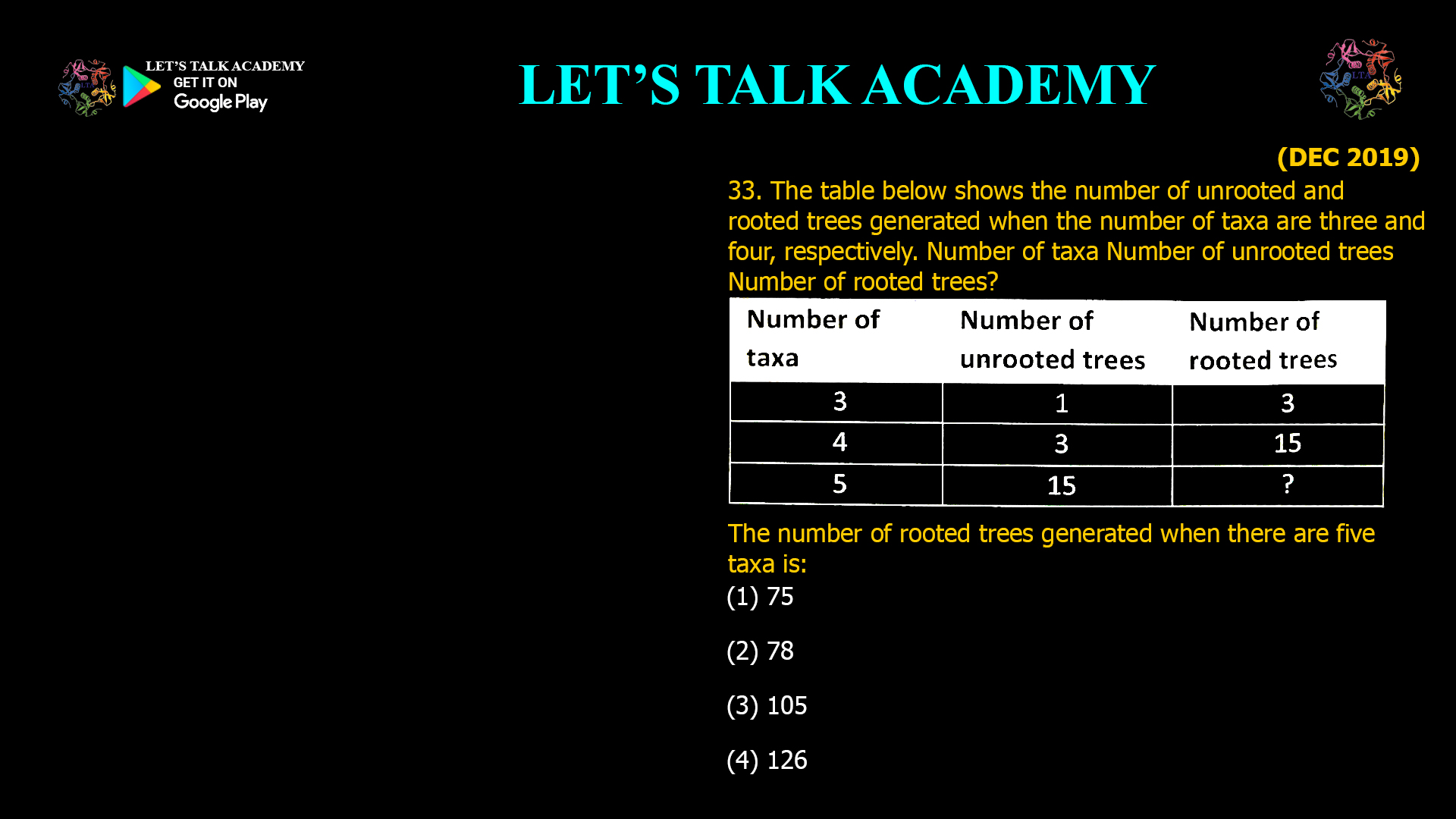
- The table below shows the number of unrooted and rooted trees generated when the number of taxa are three and four, respectively. Number of taxa Number of unrooted trees
Number of rooted trees?The number of rooted trees generated when there are five taxa is:
(1) 75 (2) 78
(3) 105 (4) 126How Many Rooted Trees Can Be Formed with Five Taxa? Understanding Phylogenetic Tree Calculations
Phylogenetic trees are essential tools in evolutionary biology, allowing scientists to visualize the relationships among different species or taxa. When constructing these trees, one fundamental question often arises: How many different rooted trees can be formed for a given number of taxa? This question is not only important for understanding the complexity of evolutionary relationships but also for appreciating the computational challenges in phylogenetic analysis.
Rooted vs. Unrooted Trees
-
Rooted trees have a designated common ancestor (the root), showing the direction of evolution.
-
Unrooted trees display relationships without specifying an ancestral root.
The number of possible trees increases rapidly as the number of taxa increases, making enumeration a classic problem in systematics.
The Formula for Rooted Trees
For n taxa, the number of possible rooted binary trees is given by the double factorial formula:
Number of rooted trees=(2n−3)!!
The double factorial “!!” means you multiply every other integer down to 1.
Examples:
-
For 3 taxa: (2×3−3)!!=3!!=3×1=3
-
For 4 taxa: (2×4−3)!!=5!!=5×3×1=15
-
For 5 taxa: (2×5−3)!!=7!!=7×5×3×1=105
Calculation for Five Taxa
Let’s apply the formula:
(2×5−3)!!=7!!=7×5×3×1=105
So, the number of rooted trees generated when there are five taxa is 105.
Why This Matters
-
The rapid increase in tree numbers with more taxa highlights the complexity of reconstructing evolutionary histories.
-
Understanding tree enumeration is crucial for computational biology, as it impacts the algorithms used for tree searching and comparison.
Conclusion
For five taxa, the number of possible rooted phylogenetic trees is 105.
Correct answer: (3) 105
-