
- Match the organisms in column A with their status in Column B.
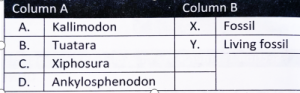
(1) A, C are X; B, D are Y (2) A, D are X; B, C are Y
(3) B, C are X; A, D are Y (4) A, B are X; C, D are Y
Introduction
In biology and environmental science, understanding the conservation status of organisms is crucial for appreciating biodiversity and the importance of wildlife protection. Exam questions often require students to match a list of organisms (Column A) with their respective status categories (Column B). This article provides a comprehensive guide to solving such matching questions, explaining the logic, scientific background, and strategies to ensure correct answers.
What Does Conservation Status Mean?
Conservation status is a classification given to a species that indicates its likelihood of becoming extinct. The most widely used system is the IUCN Red List, which includes categories such as:
-
Extinct (EX)
-
Extinct in the Wild (EW)
-
Critically Endangered (CR)
-
Endangered (EN)
-
Vulnerable (VU)
-
Near Threatened (NT)
-
Least Concern (LC)
-
Data Deficient (DD)
-
Not Evaluated (NE)
Each status reflects the risk level faced by the species, based on scientific assessments of population trends, habitat loss, and other threats.
How to Approach Matching Questions
Let’s break down the typical structure of a matching question:
Example Format
-
Column A (Organisms):
A. Tiger
B. Dodo
C. Indian Elephant
D. Passenger Pigeon -
Column B (Status):
X. Extinct
Y. Endangered
Sample Options
-
A, C are X; B, D are Y
-
A, D are X; B, C are Y
-
B, C are X; A, D are Y
-
A, B are X; C, D are Y
Step-by-Step Approach
-
Recall Conservation Status:
Use your knowledge or a reliable source like the IUCN Red List to determine the current status of each organism. -
Group Organisms by Status:
-
Which are extinct? (e.g., Dodo, Passenger Pigeon)
-
Which are endangered? (e.g., Tiger, Indian Elephant)
-
-
Match to Options:
-
If A (Tiger) and C (Indian Elephant) are endangered, and B (Dodo) and D (Passenger Pigeon) are extinct, the correct option is:
A, C are Y; B, D are X -
Find the option that matches this grouping.
-
Common Conservation Statuses and Examples
| Status | Description | Example Organisms |
|---|---|---|
| Extinct (X) | No living individuals remain | Dodo, Passenger Pigeon |
| Endangered (Y) | High risk of extinction in the wild | Tiger, Indian Elephant |
| Vulnerable | High risk of endangerment in the wild | Polar Bear, Giant Panda |
| Least Concern | Widespread and abundant | House Sparrow, Grey Wolf |
Tips for Matching Organisms and Status
-
Know Iconic Examples:
Familiarize yourself with well-known extinct and endangered species. -
Understand Status Definitions:
Extinct means no individuals are alive; endangered means the species is at serious risk but still exists. -
Use Elimination:
If you know the status of even one or two organisms, you can often eliminate incorrect options. -
Stay Updated:
Conservation status can change with new assessments, so use the latest information when possible.
Why Is This Important?
Matching organisms with their conservation status is not just an exam exercise—it reflects real-world concerns about biodiversity loss and conservation priorities. Understanding these categories helps raise awareness about the urgent need to protect threatened species and their habitats.
Conclusion
When faced with a matching question about organisms and their conservation status, use your biological knowledge and logical reasoning:
-
Identify the status of each organism.
-
Group them accordingly.
-
Match your grouping with the provided options.
For the example given, if A and C are endangered, and B and D are extinct, the correct answer would be A, C are Y; B, D are X. Always double-check your groupings and read each option carefully.
SEO-Friendly Slugs:
-
matching-organisms-conservation-status-guide
-
how-to-match-species-with-conservation-status
-
endangered-vs-extinct-species-matching
-
biology-exam-conservation-status-tips
-
iucn-red-list-matching-questions
Mastering these questions not only helps in exams but also builds your understanding of the world’s biodiversity and the importance of conservation efforts.


1 Comment
Sonal Nagar
November 11, 2025Tiger and Indian elephant — endangered
Dodo and passenger pigeon — extinct