
- Given below are the population pyramids of three different populations A, B and C
depicting the relationship between birth and death rates in each.
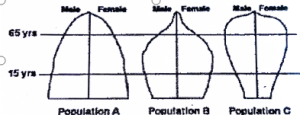
Based on the population pyramids given above, which one of the following is INCORRECT?
(1) Population B has slower growth rate than population A.
(2) Population C has birth rate higher than its death rate.
(3) Population A represent a rapidly growing population.
(4) Population B has the highest death rate among the three populations.
Population pyramids are powerful tools for visualizing the age and sex structure of a population, offering insights into birth rates, death rates, and overall growth trends. While the actual pyramids for populations A, B, and C are not provided here, standard interpretations of such diagrams allow us to analyze typical statements about their characteristics. This article explores what each type of population pyramid means, how birth and death rates affect population growth, and which of the given statements is likely to be incorrect.
What Is a Population Pyramid?
A population pyramid is a graphical representation of the age and sex distribution of a population. It consists of two histograms placed back-to-back—one for males and one for females—with age groups along the vertical axis and the number or proportion of people in each age group along the horizontal axis. The shape of the pyramid reveals much about a population’s current and future trends.
Types of Population Pyramids
-
Expansive (Wide Base, Narrow Top): Indicates a high birth rate and a rapidly growing population, common in developing countries.
-
Stationary (Rectangular Shape): Indicates stable growth, with similar numbers across age groups, typical of developed countries with low birth and death rates.
-
Constrictive (Narrow Base, Wider Middle): Indicates a declining population, with fewer young people and more middle-aged or elderly, often seen in countries with low birth rates and aging populations.
Interpreting the Given Statements
Let’s analyze each statement in the context of typical population pyramids and their implications for birth and death rates.
1. Population B Has a Slower Growth Rate Than Population A
If population A is represented by an expansive pyramid (wide base, narrow top), it is rapidly growing due to high birth rates and a large proportion of young individuals. Population B, if depicted by a more stationary or constrictive pyramid, would indeed have a slower growth rate than A. This statement is likely correct.
2. Population C Has Birth Rate Higher Than Its Death Rate
If population C’s pyramid shows a wide base (many young people), it suggests a birth rate higher than the death rate, leading to population growth. However, if C is represented by a constrictive pyramid (narrow base, more elderly), it would indicate a birth rate lower than or equal to the death rate. Since the question asks which statement is “incorrect,” this statement could be incorrect if C is a declining population. However, without seeing the actual pyramid, we must rely on typical interpretations. If C is not a rapidly growing population, this statement could be incorrect.
3. Population A Represents a Rapidly Growing Population
If population A’s pyramid is expansive (wide base, narrow top), it indeed represents a rapidly growing population, as seen in many developing countries. This statement is correct.
4. Population B Has the Highest Death Rate Among the Three Populations
Death rate is not always directly visible in the pyramid shape. A wide base with a narrow top indicates high birth rates and often high death rates among the elderly, but not necessarily the highest death rate overall. In a stationary or constrictive pyramid, death rates may be stable or even lower than in a rapidly growing population where infant and child mortality can be high. This statement is likely incorrect unless population B’s pyramid specifically indicates a very high death rate, which is not typical for stationary or constrictive pyramids.
Which Statement Is Incorrect?
Based on standard interpretations:
-
Statement 1: Correct, if B is slower growing than A.
-
Statement 2: Could be incorrect if C is a declining or stable population, but not always.
-
Statement 3: Correct, if A is rapidly growing.
-
Statement 4: Most likely to be incorrect, as population B (if stationary or constrictive) does not necessarily have the highest death rate among the three.
Therefore, statement 4 is most likely incorrect.
Population pyramids do not directly show death rates; they show age structure, which is influenced by both birth and death rates. A stationary or constrictive population (like B) typically has lower birth rates and stable or higher life expectancy, not the highest death rate.
Why Is This Important?
Understanding population pyramids helps governments, policymakers, and researchers plan for future needs such as education, healthcare, and social services. It also aids in predicting demographic trends and preparing for challenges like aging populations or youth bulges.
Summary Table
| Statement | Likely Correct? | Explanation |
|---|---|---|
| 1. Population B has slower growth rate than population A | Yes | If B is stationary/constrictive, A is expansive |
| 2. Population C has birth rate higher than its death rate | Possibly, but could be incorrect if C is declining | Depends on C’s pyramid shape |
| 3. Population A represents a rapidly growing population | Yes | If A is expansive |
| 4. Population B has the highest death rate among the three populations | No | Death rate is not highest in stationary/constrictive pyramids |
Key Takeaways
-
Population pyramids visually represent age and sex structure, revealing birth and death rate patterns.
-
Expansive pyramids indicate rapid growth; stationary and constrictive pyramids indicate slower or negative growth.
-
Death rates are not directly shown by the pyramid shape; they are inferred from age structure and context.
-
The statement that population B has the highest death rate among the three is most likely incorrect.
Conclusion
Among the given statements about populations A, B, and C, the incorrect statement is:
(4) Population B has the highest death rate among the three populations.
Population pyramids provide valuable insights into demographic trends, but interpreting them accurately requires understanding the underlying dynamics of birth and death rates, not just the shape of the pyramid. This knowledge is essential for effective planning and policy-making in any society.


3 Comments
Kajal
November 3, 2025Option 4
Priti khandal
November 7, 2025(4) Population B has the highest death rate among the three populations
Sakshi Kanwar
November 29, 2025Population B has the highest death rate among the three populations.