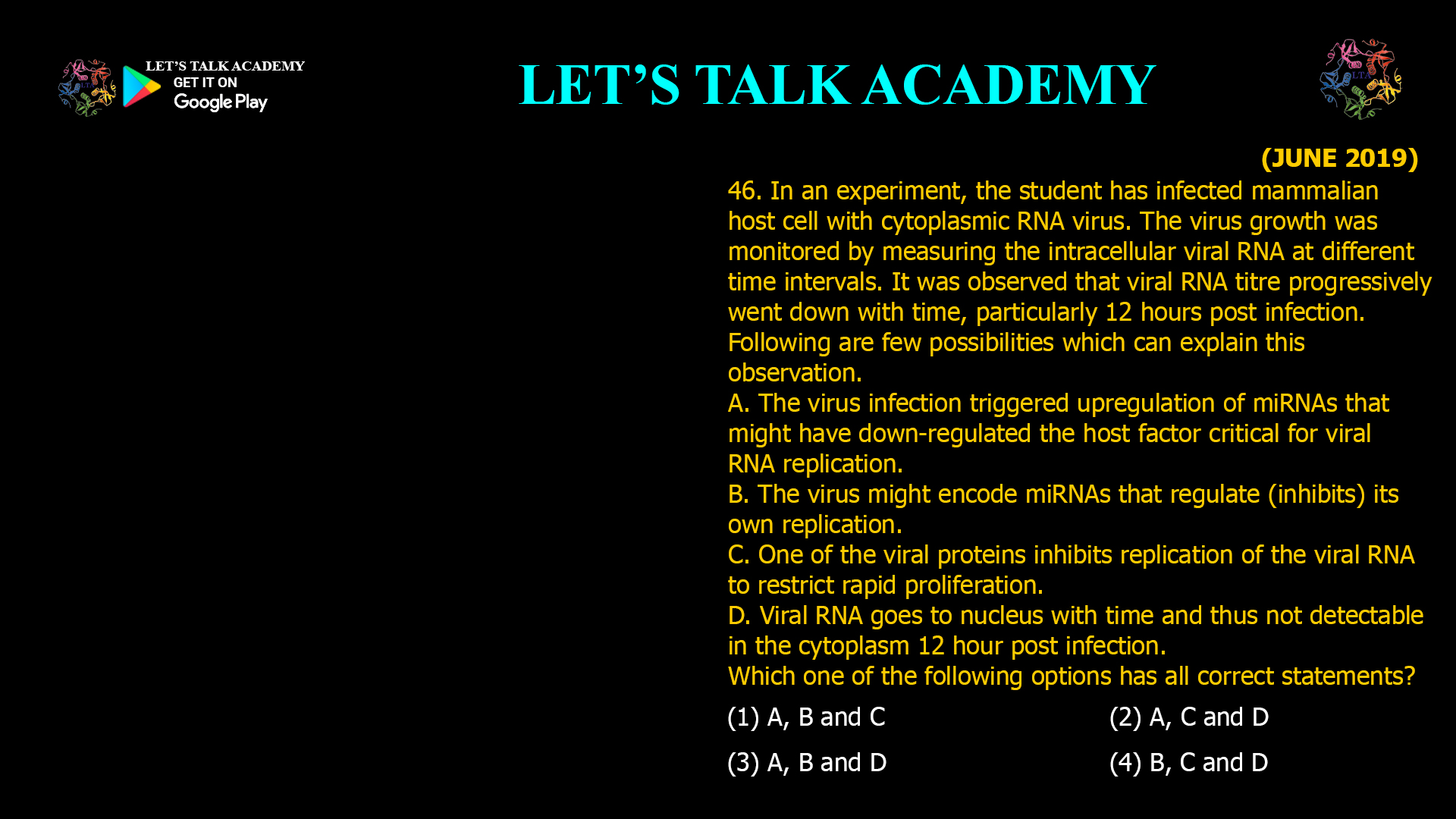
46. In an experiment, the student has infected mammalian host cell with cytoplasmic RNA virus. The virus growth was monitored by measuring the intracellular viral RNA at different time intervals. It was observed that viral RNA titre progressively went down with time, particularly 12 hours post infection. Following are few possibilities which can explain this observation.
A. The virus infection triggered upregulation of miRNAs that might have down-regulated the host factor critical for viral RNA replication.
B. The virus might encode miRNAs that regulate (inhibits) its own replication.
C. One of the viral proteins inhibits replication of the viral RNA to restrict rapid proliferation.
D. Viral RNA goes to nucleus with time and thus not detectable in the cytoplasm 12 hour post infection.
Which one of the following options has all correct statements?
(1) A, B and C
(2) A, C and D
(3) A, B and D
(4) B, C and D
Introduction
In infections by cytoplasmic RNA viruses, viral RNA levels typically increase as the virus replicates. However, in some experiments, viral RNA titres decrease over time, such as 12 hours post-infection. Understanding the mechanisms behind this decline is essential for insights into virus-host interactions and viral replication control. This article evaluates possible explanations for the observed reduction in viral RNA during infection.
Possible Mechanisms for Viral RNA Decline
A. Host miRNA-Mediated Downregulation of Viral Replication Factors
Virus infection can trigger the upregulation of host microRNAs (miRNAs) that target host factors essential for viral RNA replication. By downregulating these critical host proteins, the virus indirectly limits its own replication, leading to reduced viral RNA levels.
B. Viral miRNAs Regulating Their Own Replication
Some viruses encode viral miRNAs that can modulate viral gene expression and replication. These miRNAs may act as negative regulators, inhibiting viral RNA replication to control viral load and evade host immune responses.
C. Viral Protein-Mediated Inhibition of Viral RNA Replication
Certain viral proteins may function to restrain viral RNA replication deliberately, preventing excessive viral proliferation that could be detrimental to both virus and host. This regulatory mechanism ensures balanced replication and persistence.
D. Viral RNA Translocation to the Nucleus
For cytoplasmic RNA viruses, replication and transcription predominantly occur in the cytoplasm. While some studies suggest minimal nuclear localization for a few viruses, viral RNA generally does not translocate to the nucleus. Therefore, decreased cytoplasmic viral RNA due to nuclear sequestration is unlikely.
Evaluating the Statements
-
Statement A: Correct — host miRNAs can downregulate factors critical for viral replication.
-
Statement B: Correct — viral-encoded miRNAs can regulate viral replication.
-
Statement C: Correct — viral proteins may inhibit replication to control viral growth.
-
Statement D: Incorrect — cytoplasmic RNA viruses rarely, if ever, transport RNA into the nucleus; thus, nuclear sequestration is not a plausible cause for decreased cytoplasmic RNA.
Conclusion
The observed decline in viral RNA levels during cytoplasmic RNA virus infection is likely due to host miRNA regulation, viral miRNA-mediated control, and viral protein-mediated replication inhibition. The hypothesis that viral RNA moves to the nucleus is inconsistent with the biology of cytoplasmic RNA viruses.
Answer:
The correct option with all true statements is (1) A, B and C.


