Q.55
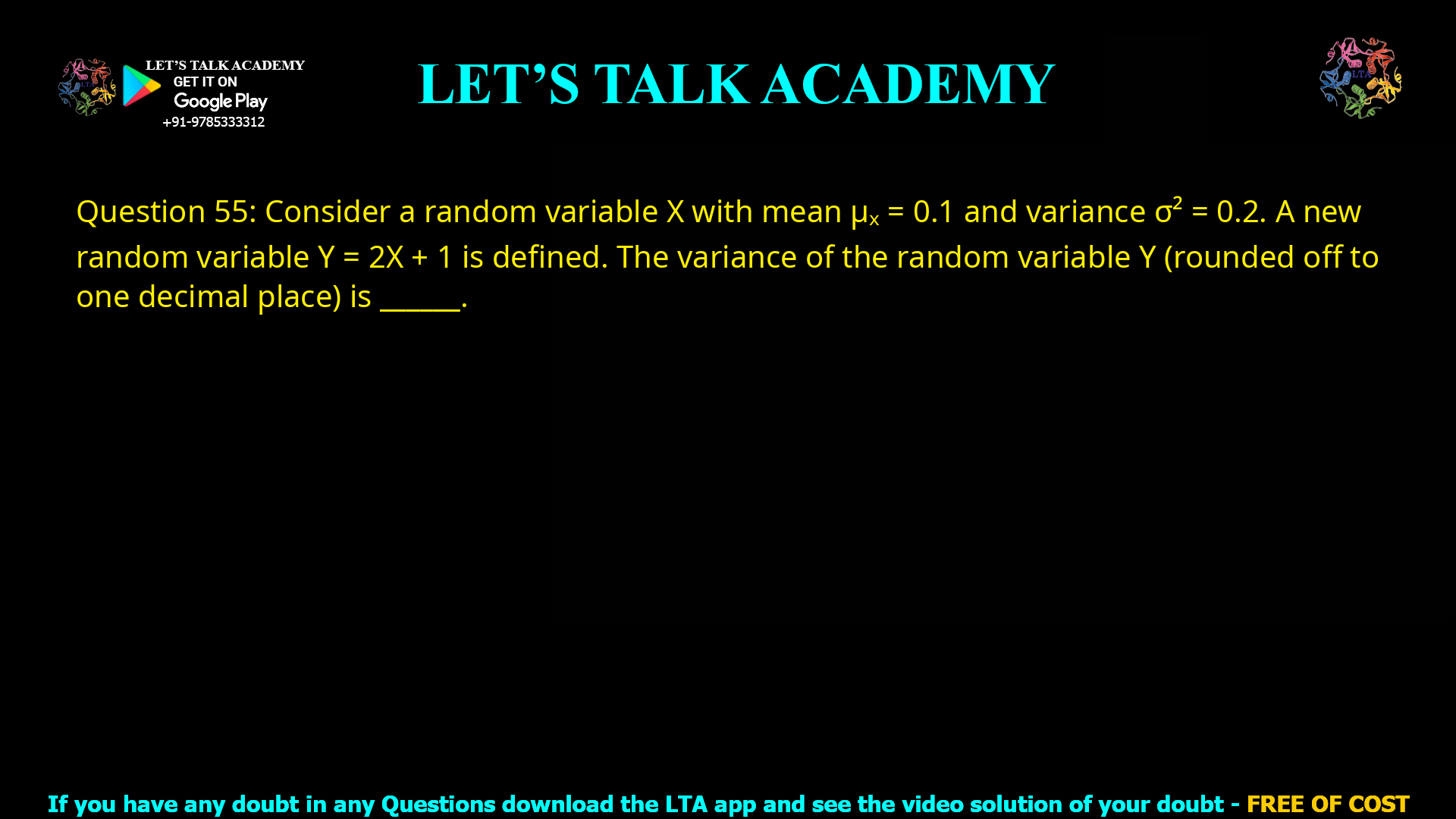
Consider a random variable X with mean μX = 0.1 and variance σX² = 0.2.
A new random variable Y = 2X + 1 is defined.
The variance of the random variable Y (rounded off to one decimal place) is __________________.
For a random variable X with mean μX = 0.1 and variance σX2 = 0.2, the variance of Y = 2X + 1 is 0.8 when rounded to one decimal place.
Core Concept
Linear transformations of random variables follow precise rules for mean and variance. When Y = aX + b, the mean shifts to E(Y) = a × μX + b, while variance scales solely by the multiplier: Var(Y) = a2 × σX2. Adding a constant like +1 affects only the mean, not the spread.
Step-by-Step Calculation
Given μX = 0.1, σX2 = 0.2, and Y = 2X + 1, apply the formula with a = 2 and b = 1. Var(Y) = (2)2 × 0.2 = 4 × 0.2 = 0.8. Rounded to one decimal place, this confirms 0.8 as the answer.
Common Misconceptions
Many confuse variance scaling, assuming addition impacts it—yet constants cancel in deviation calculations: Var(aX + b) ignores b entirely. Others might compute standard deviation wrongly or forget squaring the coefficient, yielding errors like 0.4 (using 2 × 0.2).
Why This Matters
Mastering variance transformations aids probability modeling in genetics, risk analysis, and data science—essential for your studies in biological sciences where random variables model traits or enzyme kinetics.


