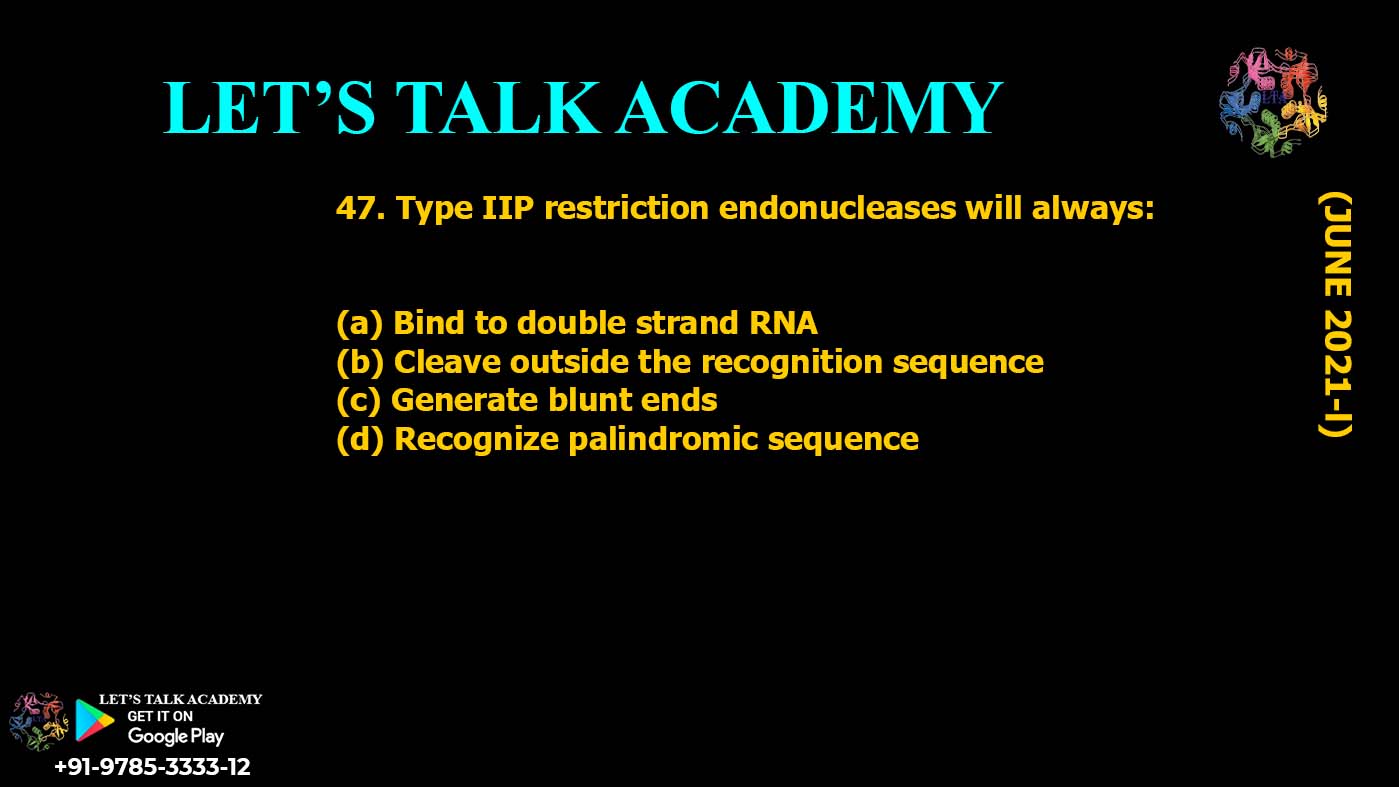
47. Type IIP restriction endonucleases will always:
(a) Bind to double strand RNA
(b) Cleave outside the recognition sequence
(c) Generate blunt ends
(d) Recognize palindromic sequence
What Are Type IIP Restriction Endonucleases?
Type IIP restriction endonucleases are enzymes widely used in molecular biology for DNA cleavage. They belong to a class of enzymes that recognize specific palindromic sequences within DNA and cut the DNA at precise locations. These enzymes are essential for genetic manipulation, cloning, and genomic studies.
Key Characteristics of Type IIP Restriction Endonucleases
1. Recognition of Palindromic Sequences
The most defining feature of Type IIP restriction endonucleases is their ability to recognize palindromic sequences. Palindromic sequences are DNA sequences that read the same in both directions when written in 5′ to 3′ direction. For example, an enzyme might recognize the sequence GAATTC, where both strands have the same sequence when read in opposite directions. This property is essential for the enzyme’s specificity and function.
2. Cleavage Pattern
Type IIP restriction endonucleases typically cleave within or near their recognition sequence. Unlike other types of restriction enzymes, Type IIP enzymes often generate sticky ends rather than blunt ends. Sticky ends are advantageous in recombinant DNA technology because they allow for more efficient ligation of DNA fragments.
3. Cleave DNA at Specific Sites
Unlike some other restriction enzymes that cleave outside of their recognition sequence, Type IIP restriction enzymes cleave directly at or near the recognition site. This precise cleavage is crucial for applications like genetic cloning or site-directed mutagenesis.
Why Type IIP Enzymes Do Not Bind to Double-Strand RNA or Generate Blunt Ends
-
(a) Bind to double-strand RNA:
Type IIP restriction enzymes do not typically interact with RNA, as they are specific to DNA. Their role is to cleave DNA molecules at specific palindromic sequences. -
(c) Generate blunt ends:
Most Type IIP enzymes produce sticky ends rather than blunt ends. Sticky ends are easier to ligate to other DNA fragments, which makes these enzymes ideal tools for cloning and other molecular biology techniques. -
(b) Cleave outside the recognition sequence:
Type IIP restriction enzymes cleave within or near their recognition sequence, not outside it, ensuring precise and targeted cleavage of DNA.
Conclusion
In conclusion, Type IIP restriction endonucleases are characterized by their ability to recognize palindromic sequences within DNA and cleave it precisely, often producing sticky ends for easier ligation. They are indispensable tools in molecular biology, especially for DNA cloning and genetic modification. Their palindromic sequence recognition sets them apart from other types of restriction enzymes and is key to their functionality in lab applications.


4 Comments
Vikram
April 19, 2025👍
Akshay mahawar
April 22, 2025Done 👍
yogesh sharma
May 8, 2025Done sir 😁✅
Neelam Sharma
September 9, 2025Type IIP restriction endonucleases are characterized by their ability to recognize palindromic sequences within DNA and cleave it precisely, often producing sticky ends for easier ligation. They are indispensable tools in molecular biology, especially for DNA cloning and genetic modification. Their palindromic sequence recognition sets them apart from other types of restriction enzymes and is key to their functionality in lab applications.