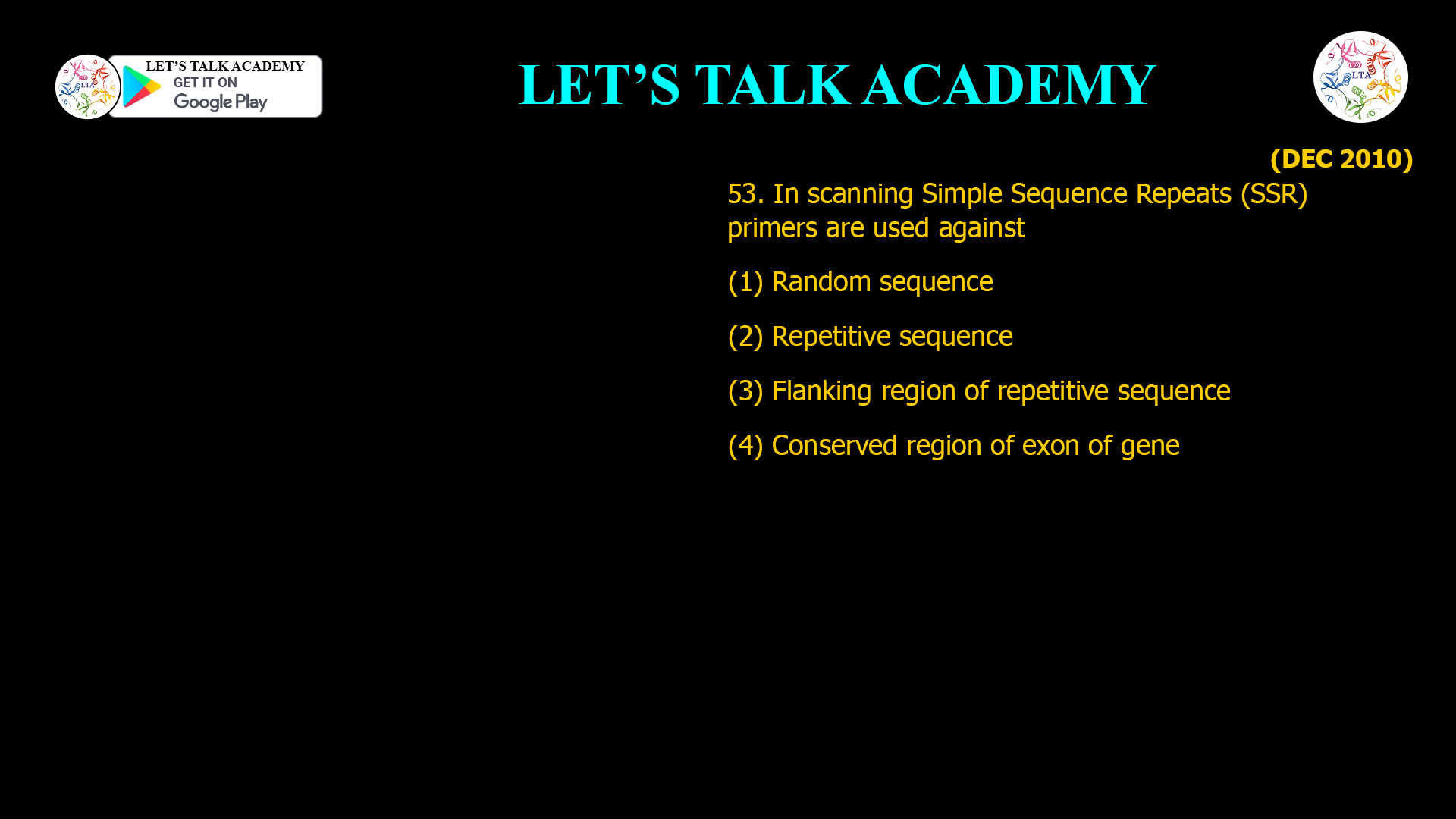
53. In scanning Simple Sequence Repeats (SSR) primers are used against
(1) Random sequence
(2) Repetitive sequence
(3) Flanking region of repetitive sequence
(4) Conserved region of exon of gene
Detailed explanation of options:
-
Random sequence: This refers to nonspecific DNA regions without any specific pattern or repeat; SSR primers are not designed to target random sequences as this would result in nonspecific amplification.
-
Repetitive sequence: SSRs themselves are repetitive DNA sequences (microsatellites) composed of short repeat motifs; although repetitive, SSR primers are not designed within these repeats because repeats often cause slippage and PCR artifacts.
-
Flanking region of repetitive sequence: SSR primers are designed specifically to anneal to the conserved flanking regions adjacent to the SSR motifs. These flanking regions are unique and stable, allowing specific and reproducible PCR amplification of the SSR locus.
-
Conserved region of exon of gene: Exons are coding regions of genes and may occasionally contain SSRs, but SSR primer design focuses on flanking non-repetitive sequences around SSRs, not specifically conserved exonic regions.
Correct answer: (3) Flanking region of repetitive sequence
Introduction:
Simple Sequence Repeats (SSRs), also called microsatellites, are short tandem repeats found in genomes that serve as valuable genetic markers. SSR primers are critical tools used for scanning these repeats in genetic mapping and diversity analysis. Importantly, SSR primers are designed to anneal to the flanking regions adjacent to these repetitive sequences rather than the repetitive sequences themselves. This design strategy ensures specificity and reproducibility in PCR amplification, making SSR analysis robust and reliable.
Detailed Explanation:
The design of SSR primers involves selecting sequences from the conserved flanking regions around the SSR motifs. These flanking regions are unique sequences present immediately next to the repetitive microsatellite motifs. Targeting these flanking regions avoids potential issues such as slippage or nonspecific binding that can happen when primers bind within repetitive sequences themselves. The PCR amplification using primers from flanking regions generates clear, specific DNA fragments corresponding to the SSR loci, which can then be analyzed for genetic variation.
Other options in SSR primer design include random sequences, which are too nonspecific and will result in nonspecific amplification, and conserved regions within exons which are not the typical targets unless they happen to flank an SSR. The repetitive sequence itself is not a suitable primer binding site because of its repetitive nature, which complicates primer binding and PCR efficiency.
Thus, in scanning SSRs, primers must be designed against the flanking region of repetitive sequences to enable accurate identification and genotyping of SSR loci in genetic studies.
This explanation clarifies the rationale behind SSR primer design and why the flanking regions are targeted for scanning SSRs.


