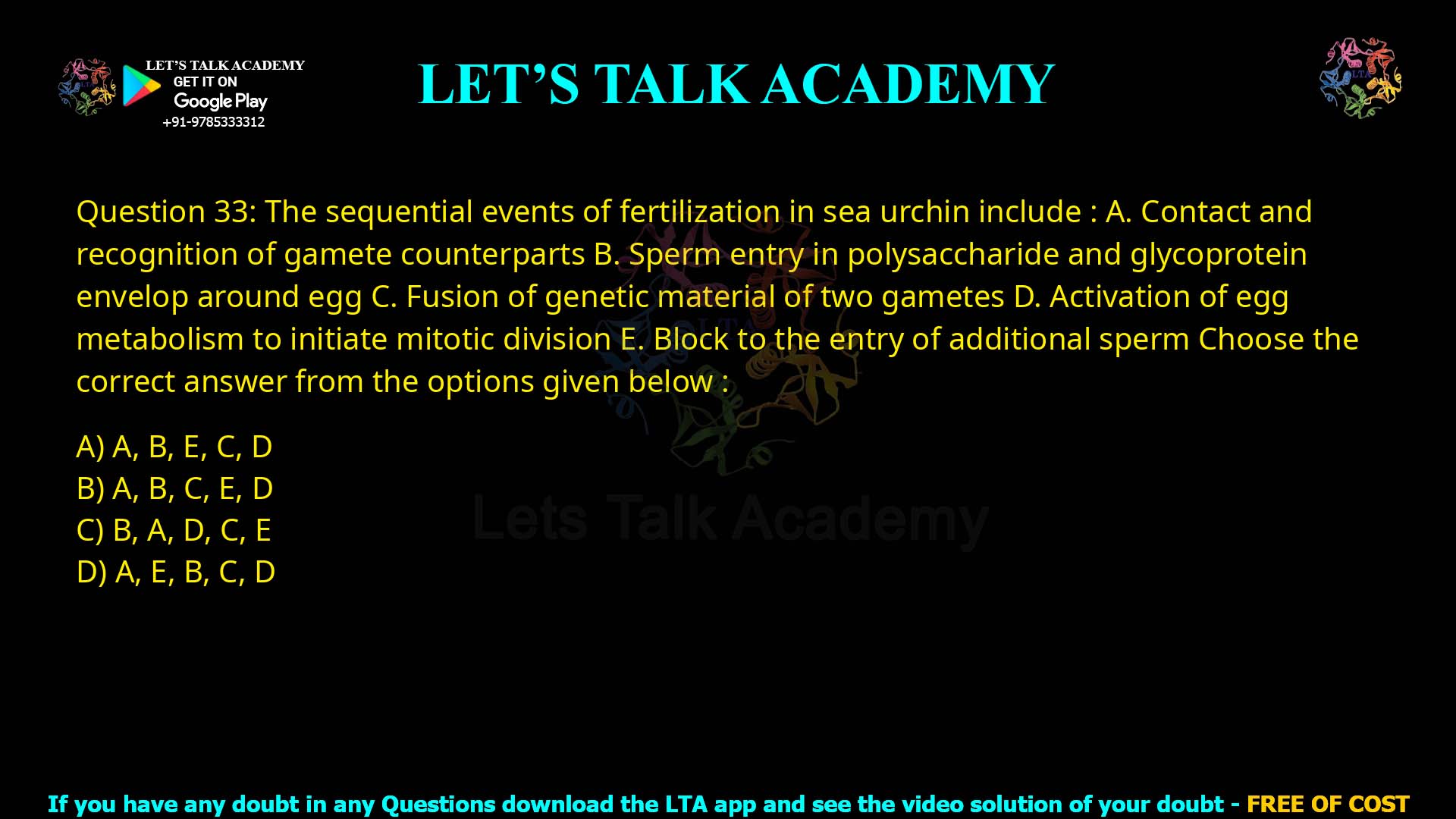
Q.33 The sequential events of fertilization in sea urchin include :
- Contact and recognition of gamete counterparts
- Sperm entry in polysaccharide and glycoprotein envelope around egg
- Fusion of genetic material of two gametes
- Activation of egg metabolism to initiate mitotic division
- Block to the entry of additional sperm
Choose the correct answer from the options given below :
- A, B, E, C, D
- A, B, C, E, D
- B, A, D, C, E
- A, E, B, C, D
A, B, E, C, D is the correct sequence for fertilization events in sea urchin, following the standard model where sperm-egg recognition precedes penetration, polyspermy block, genetic fusion, and egg activation.
Sequence Breakdown
Sea urchin fertilization is a model for studying external fertilization, involving precise steps to ensure monospermy and zygote formation. The chronological order matches option 1:
-
A: Contact and recognition – Sperm binds to egg jelly via species-specific molecules like resact.
-
B: Sperm entry – Acrosome reaction releases enzymes to penetrate vitelline envelope.
-
E: Block to additional sperm – Fast (Na+ depolarization) and slow (Ca2+ wave) blocks prevent polyspermy.
-
C: Fusion of genetic material – Sperm and egg pronuclei fuse post-entry.
-
D: Activation of egg metabolism – Cortical granule exocytosis triggers mitosis.
Option Analysis
Each option fails except the first by violating temporal logic:
Option Order Issue 1: A, B, E, C, D Contact → Entry → Block → Fusion → Activation Correct: Polyspermy block immediate post-fusion, before pronuclei . 2: A, B, C, E, D Contact → Entry → Fusion → Block → Activation Wrong; block precedes pronuclear fusion . 3: B, A, D, C, E Entry → Contact → Activation → Fusion → Block Illogical; contact/recognition first . 4: A, E, B, C, D Contact → Block → Entry → Fusion → Activation Impossible; block after entry . Introduction to Sequential Events of Fertilization in Sea Urchin
The sequential events of fertilization in sea urchin represent a classic external fertilization process, studied since Frank Lillie’s work. Key steps include contact and recognition of gamete counterparts, sperm entry in polysaccharide and glycoprotein envelope, block to the entry of additional sperm, fusion of genetic material, and activation of egg metabolism. This sequence prevents polyspermy and initiates development, essential for exams like NEET, CSIR NET, and GATE Life Sciences.
Contact and Recognition: Gamete Specificity
Sperm detects egg via chemoattractants (resact) diffusing from the polysaccharide and glycoprotein envelope (jelly coat). Bindin proteins ensure species-specific contact and recognition of gamete counterparts (A), preventing cross-fertilization.
Sperm Entry: Acrosome Reaction and Penetration
Post-recognition, acrosome reaction releases hydrolytic enzymes. Sperm penetrates the vitelline membrane and zona pellucida-like envelope (sperm entry in polysaccharide and glycoprotein envelope – B), reaching the plasma membrane.
Polyspermy Block: Fast and Slow Mechanisms
Immediate block to the entry of additional sperm (E) via:
-
Fast block: Membrane depolarization (Na+ influx).
-
Slow block: Ca2+ wave triggers cortical granule fusion, hardening envelope.
Genetic Fusion: Pronuclei Unite
Sperm nucleus decondenses into male pronucleus; fuses with female pronucleus (fusion of genetic material of two gametes – C), forming diploid zygote nucleus.
Egg Activation: Cleavage Begins
Ca2+ signal activates metabolism (activation of egg metabolism to initiate mitotic division – D): protein synthesis rises, DNA replicates for first cleavage.
This sequential events of fertilization in sea urchin model highlights molecular controls, aiding exam preparation.
-


