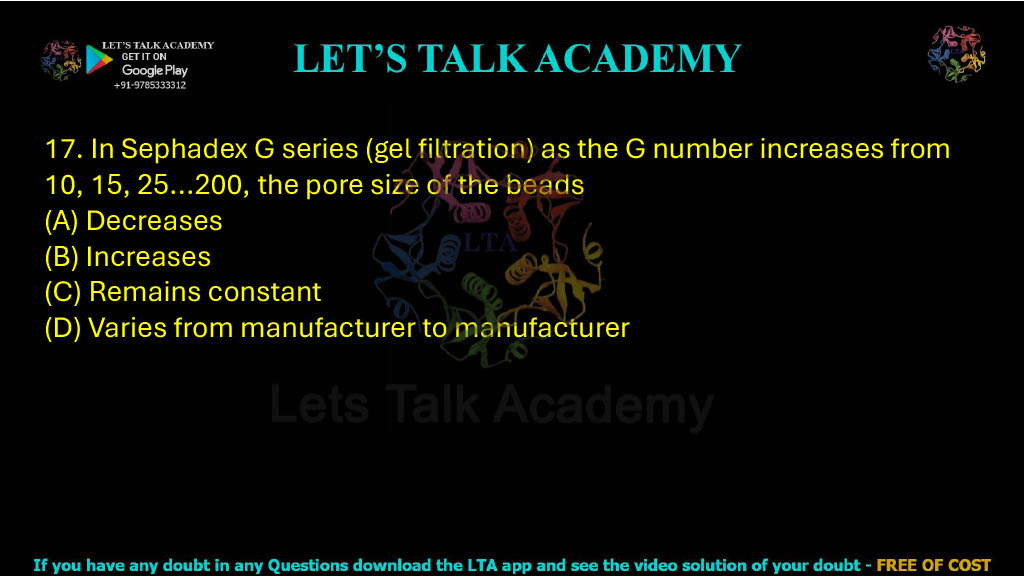
17. In Sephadex G series (gel filtration), as the G number increases from 10, 15, 25 … 200, the pore size of the beads:
A. Decreases
B. Increases
C. Remains constant
D. Varies from manufacturer to manufacturer
Correct answer: B. Increases
In the Sephadex G series (G‑10, G‑15, G‑25 … G‑200), a higher G number corresponds to a higher molecular weight exclusion limit, which in practice means larger internal pores in the gel beads. As the G number increases, the beads can accommodate and separate larger molecules, so the effective pore size increases.
Why option B is correct (pore size increases)
-
Sephadex is a cross‑linked dextran gel used for gel filtration (size exclusion) chromatography.
-
The G number (e.g., G‑10, G‑25, G‑100) is related to the exclusion limit of the gel in terms of molecular weight; higher G numbers can separate larger molecules.
-
To allow larger molecules into the beads, the internal pores must be larger, so as you go from G‑10 to G‑200, the pore size increases.
-
Therefore, as the G number increases, the pore size of the beads increases, making B the correct answer.
Why option A is incorrect (pore size decreases)
-
If pore size decreased, the gel would exclude larger and larger molecules and only allow very small molecules inside.
-
That would mean higher G numbers are suitable only for smaller molecules, which is the opposite of what is observed in Sephadex gels.
-
Hence, saying pore size decreases with increasing G number contradicts the basic design and labeling of the Sephadex G series.
Why option C is incorrect (pore size remains constant)
-
Different Sephadex G types are specifically manufactured to have different fractionation ranges, which depend directly on pore size.
-
If pore size were constant, G‑10, G‑25, G‑50, G‑100, G‑200 would all separate the same range of molecular weights, making the series meaningless.
-
Therefore, pore size cannot remain constant across the series.
Why option D is incorrect (varies from manufacturer to manufacturer)
-
Sephadex is a trademarked, standardized product line (originally from Pharmacia/GE/Cytiva), with well‑defined G numbers and corresponding fractionation ranges.
-
While minor batch-to-batch differences can exist in any material, the trend of increasing pore size with higher G number is fixed, not arbitrarily varying between manufacturers.
-
So the systematic relationship between G number and pore size is not manufacturer dependent in the way option D suggests.
Introduction (SEO‑Optimized)
Sephadex G series pore size is a fundamental concept in gel filtration chromatography for separating biomolecules by size. Understanding how pore size changes with G number, from G‑10 up to G‑200, helps you choose the right Sephadex grade for protein and polysaccharide purification as well as solve competitive exam questions accurately.
What Is the Sephadex G Series?
Sephadex is a cross‑linked dextran gel commonly used in size exclusion chromatography. Different G types (G‑10, G‑15, G‑25, G‑50, G‑75, G‑100, G‑200) are designed to separate molecules over distinct molecular weight ranges.
Key points:
-
Each G number corresponds to an approximate molecular weight exclusion limit.
-
Lower G numbers (e.g., G‑10, G‑15) are for very small molecules.
-
Higher G numbers (e.g., G‑100, G‑200) are for larger molecules, such as bigger proteins and polysaccharides.
-
This behavior is directly linked to the pore size of the beads.
Relationship Between G Number and Pore Size
As you move from G‑10 → G‑15 → G‑25 → … → G‑200, the gels are designed with progressively larger pores.
-
Higher G number → higher exclusion limit → larger pores.
-
Larger pores allow entry of larger solute molecules into the bead interior.
-
This expands the fractionation range, enabling separation of higher molecular weight species.
A simple way to think of it:
-
G‑10: small pores, only very small molecules can enter.
-
G‑25 / G‑50: medium pores, suitable for many peptides and small proteins.
-
G‑100 / G‑200: large pores, suitable for larger proteins and polysaccharides.
Concept Check: MCQ Recap
To reinforce the concept:
As the G number increases from 10, 15, 25 … 200, the pore size of the beads:
-
A. Decreases
-
B. Increases ✅
-
C. Remains constant
-
D. Varies from manufacturer to manufacturer
Because higher G numbers are designed for higher molecular weight exclusion limits, the Sephadex G series pore size increases with G number, making option B correct.
Summary Table: G Number vs Pore Logic
| Sephadex Type (G) | Relative Pore Size | Relative MW Range | Conceptual Use Case |
|---|---|---|---|
| G‑10 | Small | Very low MW | Small solutes, salts |
| G‑25 | Small–medium | Low MW | Desalting, peptides |
| G‑50 | Medium | Moderate MW | Small proteins |
| G‑100 | Large | High MW | Larger proteins |
| G‑200 | Larger | Very high MW | Very large proteins/polymers |
(Exact numerical ranges vary by datasheet, but the trend of increasing pore size with increasing G number is fixed.)
This structure gives you both a clear conceptual understanding for exams and an SEO‑friendly article targeting the key phrase “Sephadex G series pore size.”


2 Comments
Vanshika Sharma
January 29, 2026As the G no. Increases the pore size is also increases
Kanica Sunwalka
June 25, 2026G no. icreases – > pore size increases