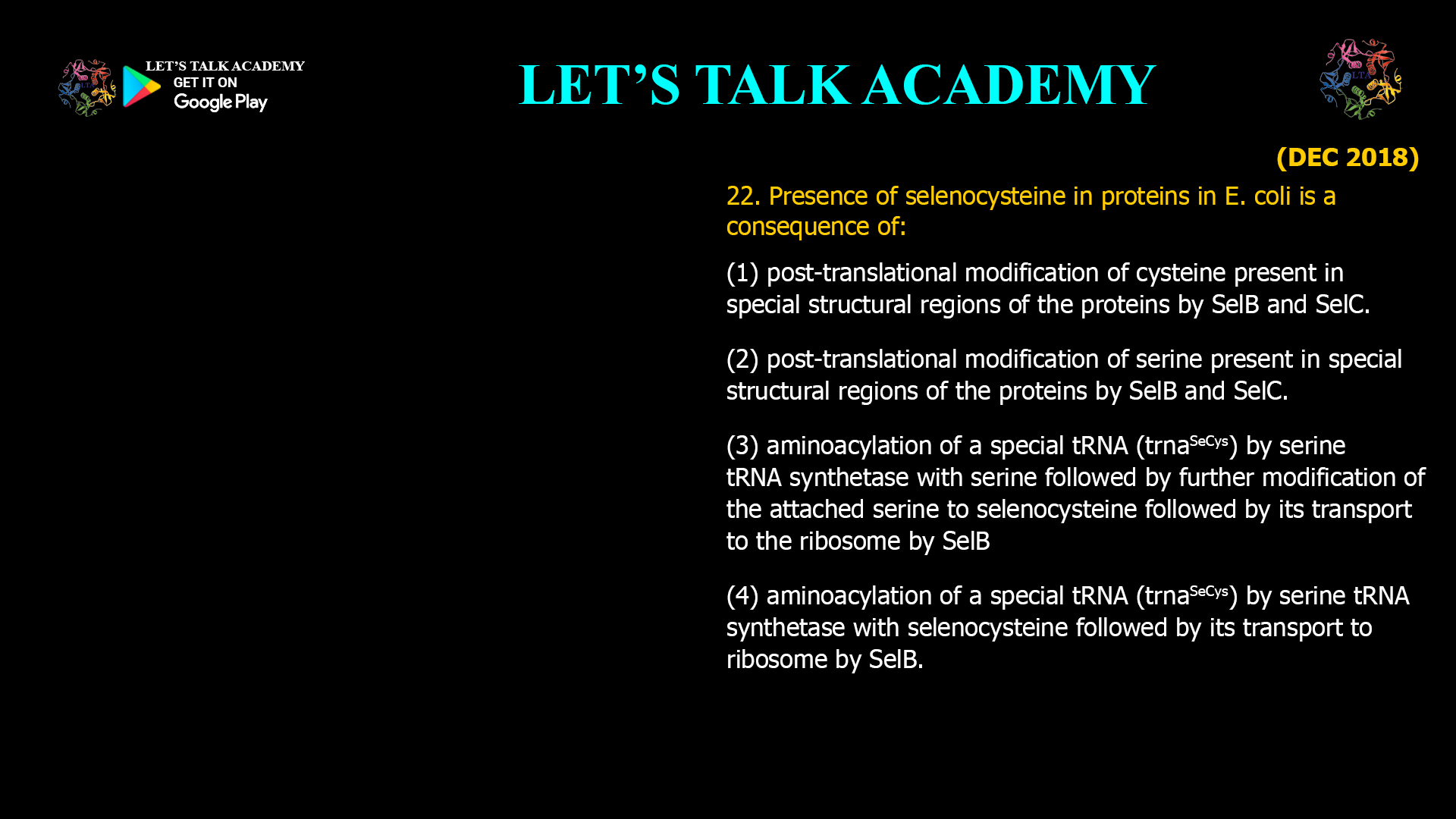
- Presence of selenocysteine in proteins in E. coli is a consequence of:
(1) post-translational modification of cysteine present in special structural regions of the proteins by SelBand SelC.
(2) post-translational modification of serine present in special structural regions of the proteins by SelBand SelC.
(3) aminoacylation of a special tRNA (TrnaSeCys) by serine tRNAsynthetase with serine followed by further modification of the attached serine toselenocysteinefollowed by its transport to the ribosome by SelB
(4) aminoacylation of a special tRNA (TrnaSeCys) by serine tRNAsynthetase with selenocysteinefollowed by its transport to ribosome by SelB.Incorporation of Selenocysteine into Proteins in Escherichia coli: The Role of Ser-tRNA^Sec and SelB
Selenocysteine (Sec) is known as the 21st amino acid and is uniquely incorporated into proteins during translation by a specialized mechanism distinct from the standard 20 amino acids. In Escherichia coli, this process involves a series of coordinated steps and specialized molecular components.
How E. coli Incorporates Selenocysteine into Proteins
-
Charging of tRNA^Sec with Serine:
The specialized tRNA for selenocysteine, called tRNA^Sec (encoded by the selC gene), is initially charged with serine by the seryl-tRNA synthetase. This step is crucial because there is no direct aminoacylation of tRNA^Sec with selenocysteine. -
Conversion of Serine to Selenocysteine:
The serine attached to tRNA^Sec is enzymatically converted into selenocysteine by the enzyme selenocysteine synthase (SelA). This conversion requires a selenium donor molecule, selenophosphate, synthesized by SelD. -
Transport to the Ribosome by SelB:
The selenocysteyl-tRNA^Sec complex is recognized and delivered to the ribosome by a specialized elongation factor called SelB. SelB specifically binds to the selenocysteine insertion sequence (SECIS) element in the mRNA, which is located immediately downstream of the UGA codon that codes for Sec. -
Recoding of the UGA Stop Codon:
Normally, UGA is a stop codon, but in the presence of the SECIS element and SelB, it is recoded to incorporate selenocysteine into the growing polypeptide chain.
Explanation of the Options
Option Description Correctness (1) Post-translational modification of cysteine by SelB and SelC Incorrect (2) Post-translational modification of serine in proteins by SelB and SelC Incorrect (3) Aminoacylation of tRNA^Sec by serine tRNA synthetase with serine, followed by conversion to selenocysteine and transport by SelB Correct (4) Aminoacylation of tRNA^Sec directly with selenocysteine and transport by SelB Incorrect
Summary
The correct mechanism in E. coli involves:
-
Charging of serine onto tRNA^Sec by seryl-tRNA synthetase
-
Conversion of the attached serine to selenocysteine by SelA
-
Delivery of Sec-tRNA^Sec to the ribosome by the elongation factor SelB
-
Recognition of the SECIS element in mRNA for UGA codon recoding
This intricate process ensures precise incorporation of selenocysteine at specific UGA codons during translation.
Keywords for SEO Optimization
-
Selenocysteine incorporation in E. coli
-
tRNA^Sec charging and modification
-
SelA, SelB, SelC, SelD functions
-
SECIS element and UGA recoding
-
Selenoprotein biosynthesis
-
Translation of selenocysteine
-
Specialized elongation factors in bacteria
-
Molecular mechanism of Sec insertion
-
Selenophosphate synthetase role
-
Protein synthesis with selenocysteine
Conclusion
The presence of selenocysteine in Escherichia coli proteins results from the aminoacylation of a specialized tRNA^Sec with serine by seryl-tRNA synthetase, followed by enzymatic conversion of serine to selenocysteine. The selenocysteyl-tRNA^Sec is then transported to the ribosome by the elongation factor SelB, which recognizes the SECIS element in the mRNA, enabling the recoding of the UGA stop codon for Sec incorporation.
Correct answer: (3) aminoacylation of a special tRNA (tRNA^Sec) by serine tRNA synthetase with serine followed by further modification of the attached serine to selenocysteine followed by its transport to the ribosome by SelB
-


4 Comments
Divya rani
November 3, 20253 is correct Selenocystein is the modification of serine so t RNA of serine is used in this modification then selB in prokaryotes transport it on ribosome.
Heena Mahlawat
November 5, 2025Option 3
Santosh Saini
November 7, 2025Option 3rd is correct
Sakshi Kanwar
November 8, 20253 rd