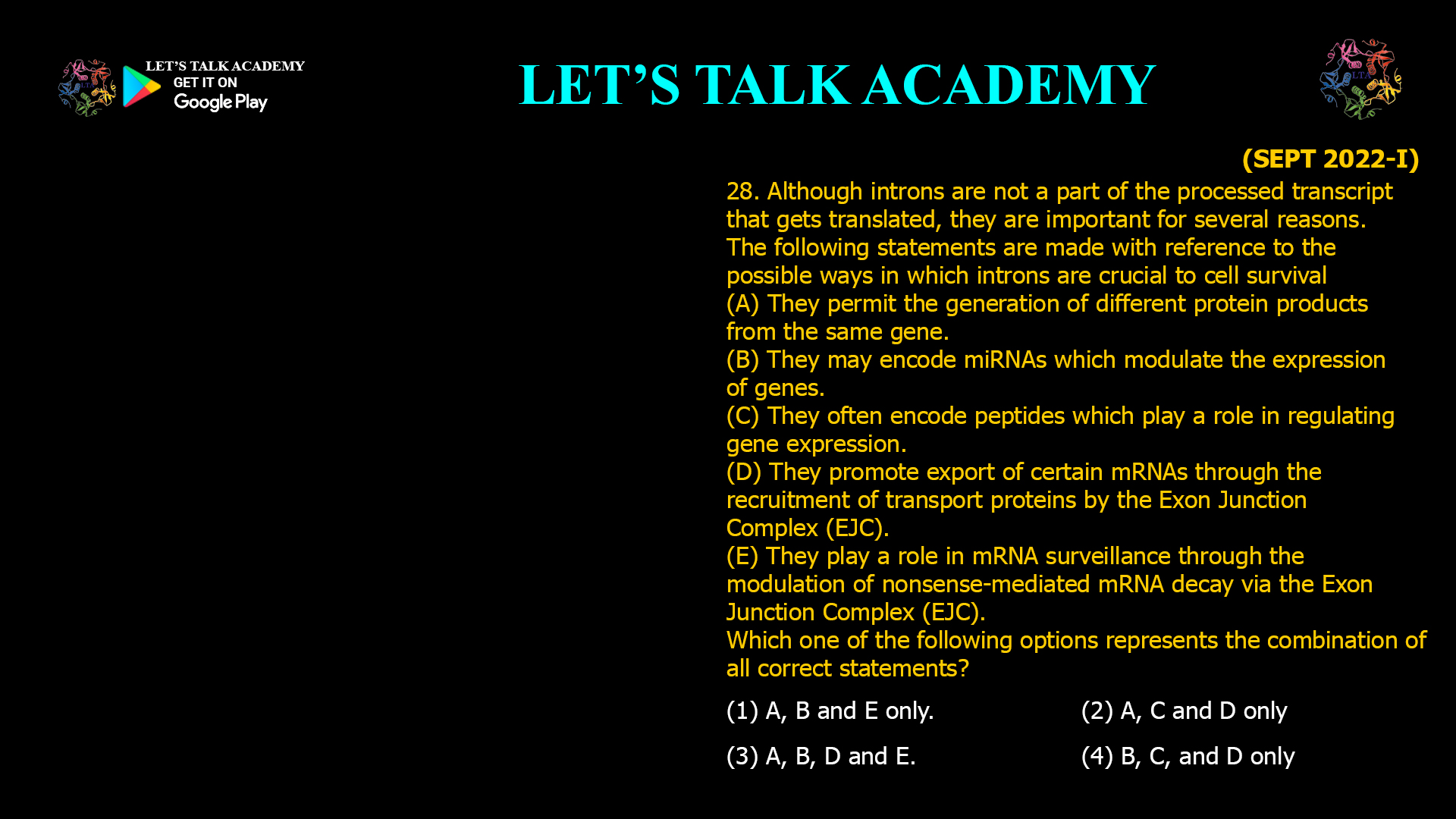
28. Although introns are not a part of the processed transcript that gets translated, they are important for several reasons. The following statements are made with reference to the possible ways in which introns are crucial to cell survival
(A) They permit the generation of different protein products from the same gene.
(B) They may encode miRNAs which modulate the expression of genes.
(C) They often encode peptides which play a role in regulating gene expression.
(D) They promote export of certain mRNAs through the recruitment of transport proteins by the Exon Junction Complex (EJC).
(E) They play a role in mRNA surveillance through the modulation of nonsense-mediated mRNA decay via the Exon Junction Complex (EJC).
Which one of the following options represents the combination of all correct statements?
(1) A, B and E only.
(2) A, C and D only
(3) A, B, D and E.
(4) B, C, and D only
The correct combination of all the true statements about the importance of introns in cell survival and RNA processing is:
(3) A, B, D and E
Explanation of Each Statement:
(A) They permit the generation of different protein products from the same gene.
True. Introns enable alternative splicing, allowing a single gene to produce multiple protein isoforms, greatly expanding proteomic diversity.
(B) They may encode miRNAs which modulate the expression of genes.
True. Some introns contain sequences that are processed into microRNAs (miRNAs), which regulate gene expression post-transcriptionally.
(C) They often encode peptides which play a role in regulating gene expression.
False. Introns are generally non-coding and do not typically encode peptides. Their regulatory roles are mostly through RNA sequences or structures, not direct peptide coding.
(D) They promote export of certain mRNAs through the recruitment of transport proteins by the Exon Junction Complex (EJC).
True. The Exon Junction Complex (EJC), deposited on mRNAs after splicing, facilitates mRNA export by recruiting transport proteins, enhancing nuclear export efficiency.
(E) They play a role in mRNA surveillance through the modulation of nonsense-mediated mRNA decay via the Exon Junction Complex (EJC).
True. The EJC also marks exon-exon junctions and is essential for nonsense-mediated decay (NMD), a quality control mechanism that degrades mRNAs with premature stop codons.
Summary Table
| Statement | True/False | Notes |
|---|---|---|
| A | True | Alternative splicing increases protein diversity. |
| B | True | Introns can encode miRNAs regulating gene expression. |
| C | False | Introns generally do not encode peptides. |
| D | True | EJC promotes mRNA export by recruiting transport proteins. |
| E | True | EJC involved in mRNA surveillance via nonsense-mediated decay (NMD). |
Conclusion
Introns are crucial for generating protein diversity, encoding regulatory miRNAs, promoting mRNA export via the EJC, and participating in mRNA quality control through NMD. They do not typically encode peptides. Therefore, the correct answer is:
(3) A, B, D and E


5 Comments
Komal Sharma
June 6, 2025Done
Lokesh kumawat
June 7, 2025Done
Prami Masih
June 8, 2025👍👍👍👍
Santosh Saini
November 3, 2025Statement A , B, D, and E are correct
Heena Mahlawat
November 5, 2025A,B,D,E