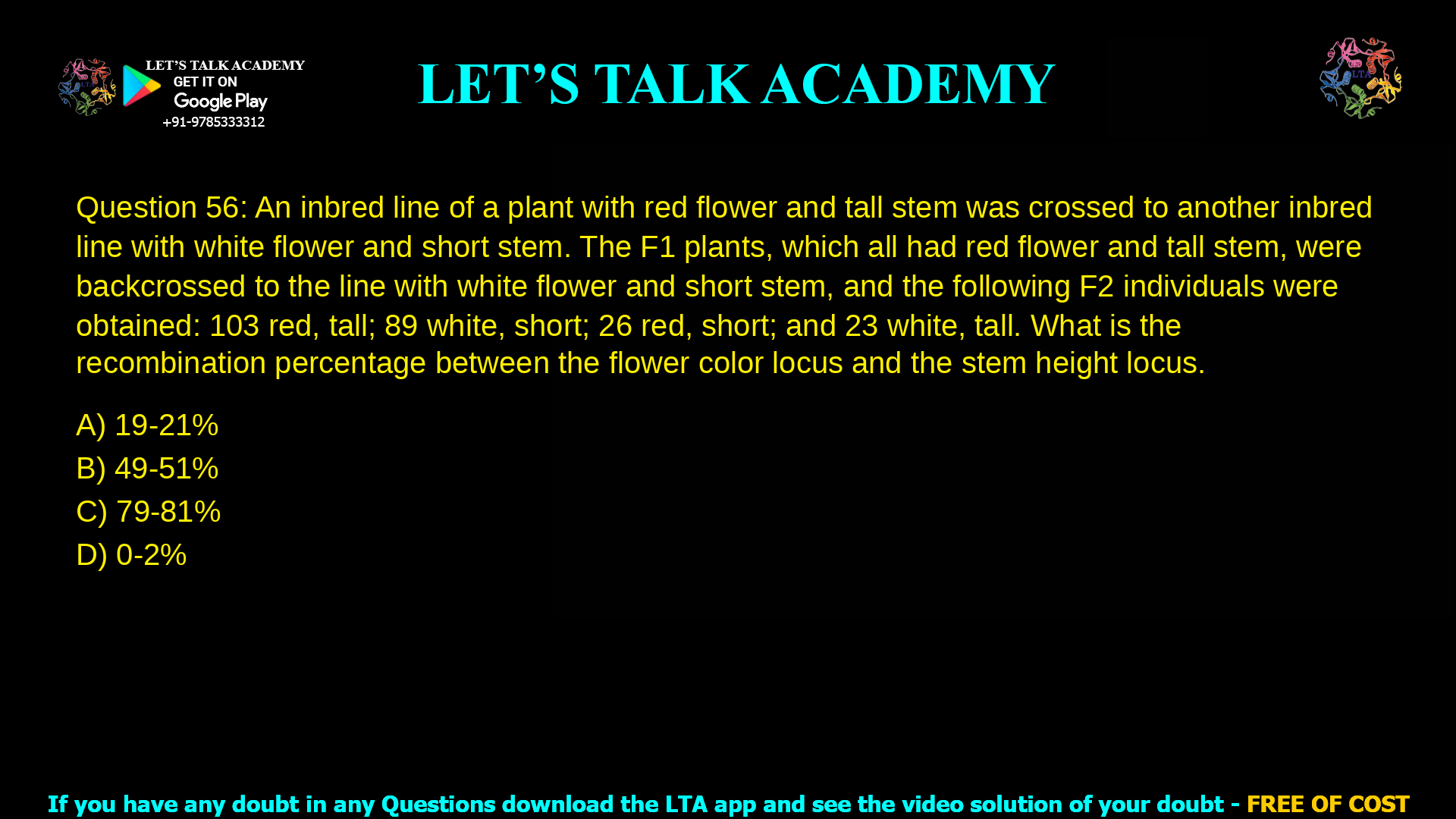
Q.56 An inbred line of a plant with red flower and tall stem was crossed to another inbred line with white
flower and short stem. The 𝐅𝟏 plants, which all had red flower and tall stem, were backcrossed to the line
with white flower and short stem, and the following 𝐅𝟐 individuals were obtained: 103 red, tall; 89 white,
short; 26 red, short; and 23 white, tall. What is the recombination percentage between the flower color
locus and the stem height locus.
(A) 19− 21%
(B) 49 −51%
(C) 79 −81%
(D) 0− 2%
Calculating Recombination Frequency in Plant Genetics Backcross
Recombination percentage measures genetic linkage between flower color and stem height loci in this backcross. The correct answer is (A) 19–21%, based on recombinant progeny proportions.
Problem Setup
Inbred red, tall (RR TT) crossed with white, short (rr tt) yields F1 red, tall (Rr Tt). Backcross to recessive rr tt produces 241 total progeny: 103 parental red tall, 89 parental white short, 26 recombinant red short, 23 recombinant white short.
Recombination Calculation
Recombination frequency equals recombinants divided by total progeny. Here, recombinants (26 + 23 = 49) over 241 total yields 49/241≈0.203 or 20.3%, fitting 19–21%.
Option Explanations
-
(A) 19–21%: Matches calculated 20.3% from 49/241 recombinants, indicating moderate linkage.
-
(B) 49–51%: Approximates independent assortment (50%), but parental types dominate (192/241 ≈ 80%), rejecting this.
-
(C) 79–81%: Reverses parental/recombinant roles; data shows opposite pattern.
-
(D) 0–2%: Suggests complete linkage, but 20% recombinants disprove tight coupling.
| Option | % Range | Basis | Correct? |
|---|---|---|---|
| A | 19–21 | Recombinants/total (49/241) | Yes |
| B | 49–51 | Independent assortment | No |
| C | 79–81 | Swapped parental/recombinant | No |
| D | 0–2 | No recombination | No |


