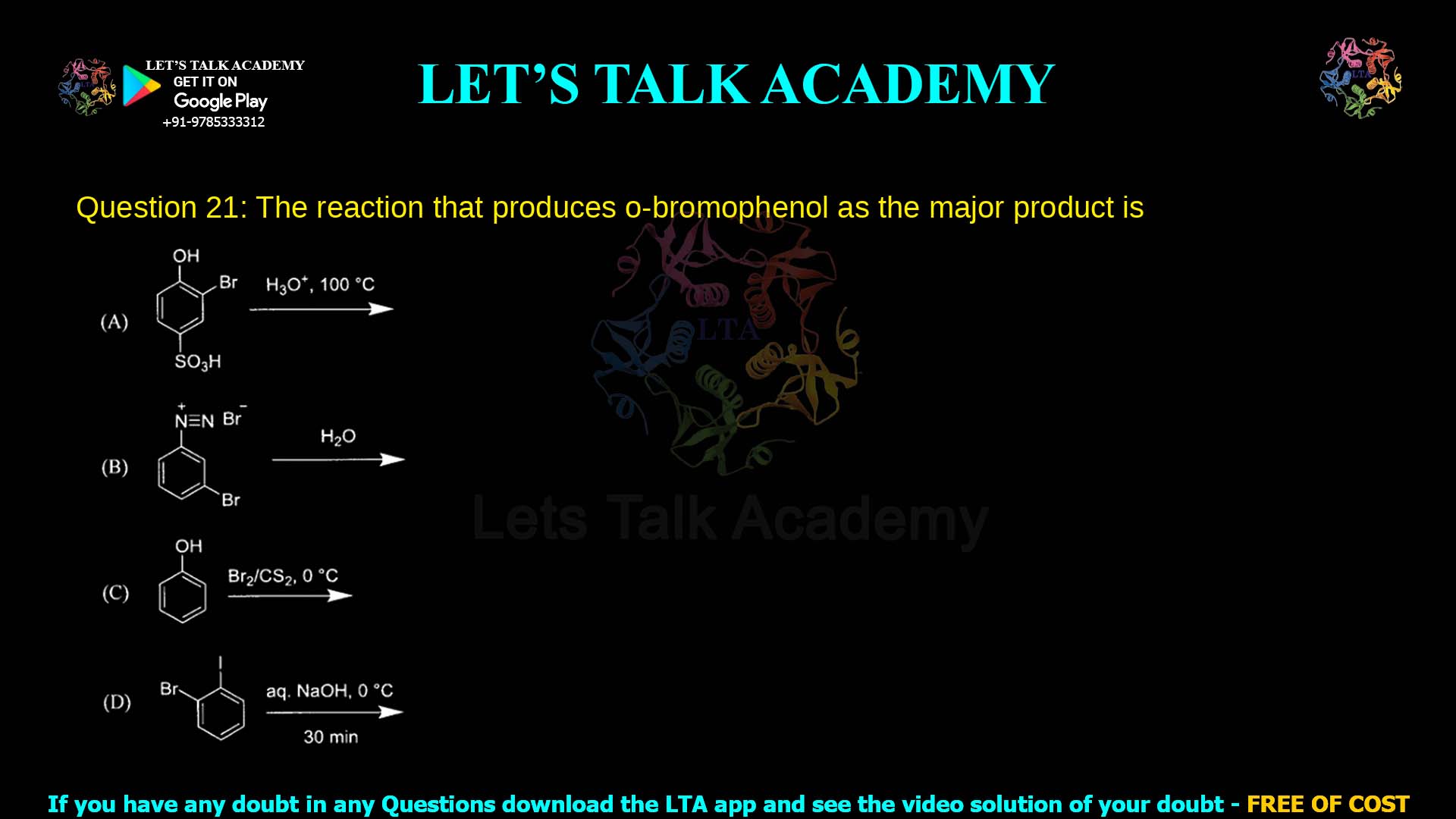
Q21. The reaction that produces o-bromophenol as the major product is
The reaction that produces o‑bromophenol as the major product is option (A).
Introduction
Understanding which reaction produces o‑bromophenol as the major product requires clear knowledge of electrophilic aromatic substitution, activating and deactivating groups, and their ortho/para or meta directing effects. In this question, each option represents a different transformation on a substituted benzene or its derivative, and only one pathway leads predominantly to o‑bromophenol. This type of problem is common in competitive exams where detailed reasoning about orientation and reaction conditions is essential.
Option (A): Correct reaction to o‑bromophenol
Option (A) shows a benzene ring bearing three groups: an OH group, a Br atom, and an \ceSO3H group (sulfonic acid), heated with aqueous acid at about 100 °C. Under such conditions, the sulfonic acid group is removed from the ring in a reversible desulfonation reaction, while the bromo and hydroxy substituents remain in their original relative positions, giving o‑bromophenol as the major product. This works because sulfonation–desulfonation of benzene is reversible: sulfonation introduces \ceSO3H mainly at a position controlled by directing groups, and subsequent heating with dilute acid removes it selectively, leaving behind the desired ortho‑substituted product.
Key points for this option:
-
\ceSO3H is a strongly deactivating, meta‑directing group but it is used here only as a temporary blocking group that can be removed under acidic, high‑temperature conditions.
-
o‑Bromophenol cannot be obtained selectively by simple bromination of phenol because phenol is strongly activating and gives a mixture of ortho and para bromo derivatives; therefore, the sulfonation–desulfonation strategy is used to control orientation and isolate the ortho isomer.
Thus, option (A) correctly yields o‑bromophenol as the major product.
Option (B): Reduction of diazonium salt
Option (B) shows an aromatic diazonium salt bearing a bromine substituent on the ring, treated with \ceH2. Under such conditions, a typical outcome is reduction of the diazonium group to hydrogen, producing a bromo‑substituted benzene, not a phenol. The diazonium group \ce–N2+ is a good leaving group and can be replaced by various nucleophiles in Sandmeyer‑type reactions, but plain \ceH2 acts as a reductant to give deaminated products rather than introducing an OH group.
Therefore, option (B) yields a bromobenzene derivative (with no OH group on the ring) and cannot produce o‑bromophenol as the major product.
Option (C): Bromination of phenol at low temperature
Option (C) shows phenol reacting with \ceBr2/CCl4 or similar halogenation conditions at 0 °C. Phenol is strongly activating and ortho/para‑directing because the lone pair on oxygen donates electron density into the ring by resonance. In the presence of bromine, phenol typically undergoes rapid bromination to give a mixture of ortho‑ and para‑bromophenol, and in many conditions, especially aqueous bromine, it further reacts to form 2,4,6‑tribromophenol.
Even though orthobromophenol is one of the products here, it is not the exclusive or major isolated product: the reaction gives a mixture of ortho and para products, and often the para product or further polysubstituted product dominates under typical exam‑level conditions. Thus, option (C) does not answer the question, which asks for a reaction that produces o‑bromophenol as the major product.
Option (D): Nucleophilic substitution on bromobenzene
Option (D) starts from bromobenzene (a benzene ring with a single Br substituent) treated with aqueous \ceNaOH at 0 °C for 30 min. Aryl bromides like bromobenzene are highly resistant to nucleophilic substitution because the aromatic ring does not stabilize the \ceSN2 or \ceSN1 transition states efficiently. Formation of phenol from bromobenzene generally requires much harsher conditions, such as fusion with solid \ceNaOH at high temperature and pressure, and even then it produces phenol (no ortho relationship) rather than o‑bromophenol.
Therefore, under the mild conditions given in option (D), no significant formation of phenol or o‑bromophenol occurs, and this option is incorrect.
Summary Table of Options
| Option | Starting substrate (conceptual) | Reagent/conditions | Main outcome | Produces o‑bromophenol as major product? |
|---|---|---|---|---|
| (A) | o‑Bromophenol sulfonic acid derivative | \ceH3O+,100°C | Desulfonation to o‑bromophenol | Yes |
| (B) | Aryl diazonium bromide | \ceH2 | Reduction to bromoarene (no OH) | No |
| (C) | Phenol | \ceBr2, 0 °C | Mixture of ortho‑ and para‑bromophenol or further bromination | No (not major, mixture) |
| (D) | Bromobenzene | aq. \ceNaOH, 0 °C | Essentially no substitution; bromobenzene remains | No |
Key Takeaways for Exam Preparation
-
To selectively obtain o‑bromophenol, a common synthetic route is: phenol → sulfonation (to block para or ortho position) → bromination at the available ortho position → desulfonation, as represented by option (A).
-
Direct bromination of phenol gives mixtures and often polysubstitution, while diazonium reductions or mild nucleophilic substitutions on aryl halides do not introduce an OH group at the required position.


