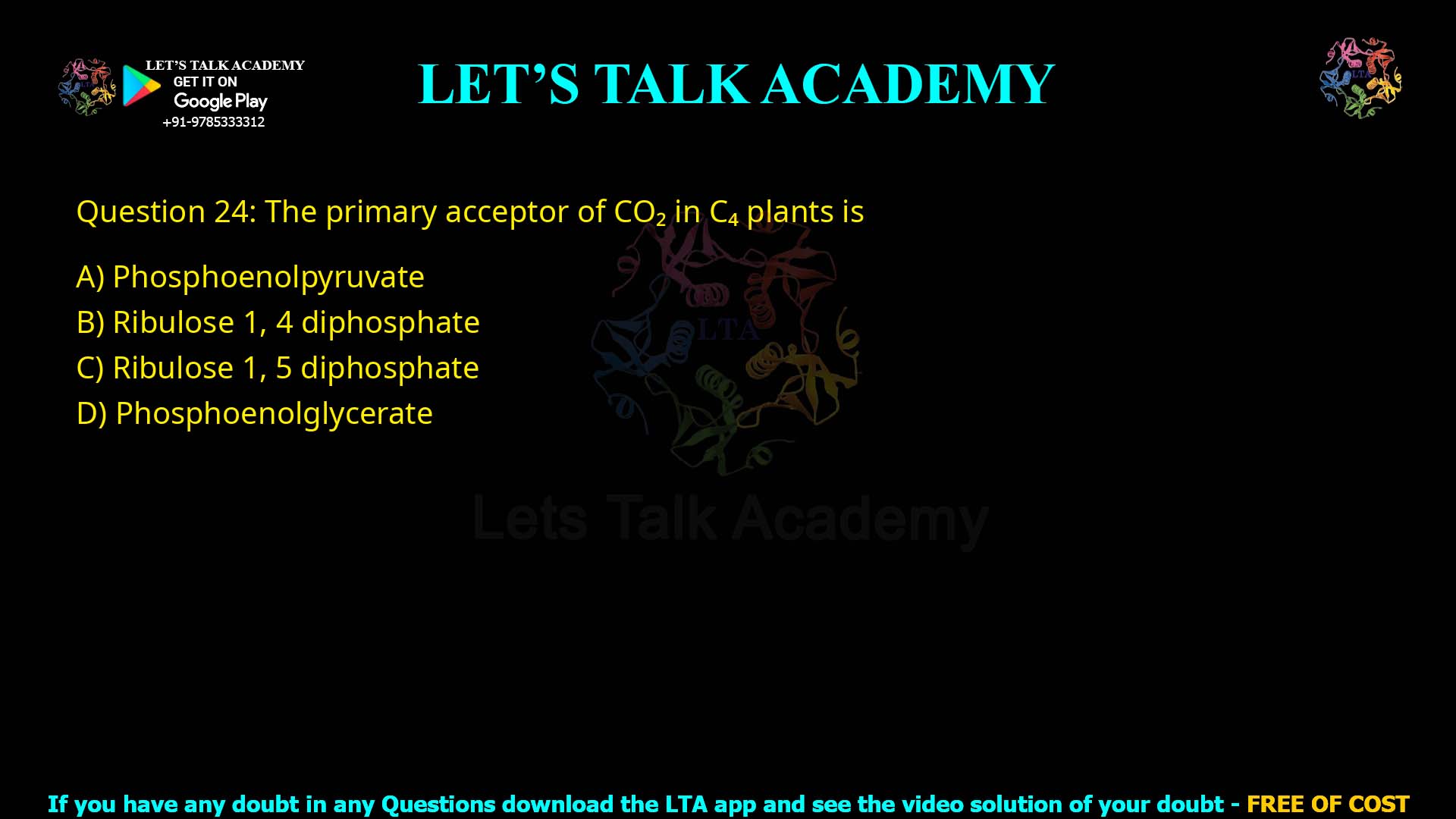
Q24.The primary acceptor of CO₂ in C₄ plants is
(A) Phosphoenolpyruvate
(B) Ribulose 1, 4 diphosphate
(C) Ribulose 1, 5 diphosphate
(D) Phosphoenolglycerate
The correct answer is (A) Phosphoenolpyruvate. In C₄ plants, PEP serves as the primary CO₂ acceptor in mesophyll cells, where PEP carboxylase fixes CO₂ into a 4-carbon compound (oxaloacetate), enabling efficient photosynthesis in hot, dry conditions.
This spatial separation from the Calvin cycle in bundle sheath cells minimizes photorespiration.
Option Analysis
Phosphoenolpyruvate (A): The 3-carbon molecule PEP reacts with CO₂ via PEP carboxylase in mesophyll cells, forming oxaloacetate (first stable C4 product). This high-affinity enzyme concentrates CO₂ for Rubisco.
Ribulose 1,4 diphosphate (B): Not a biological molecule; this is an incorrect or distractor option with no role in photosynthesis.
Ribulose 1,5 diphosphate (C): RuBP (RuBP) is the primary CO₂ acceptor in C3 plants’ Calvin cycle, catalyzed by Rubisco to form 3-PGA. In C4 plants, it’s secondary in bundle sheath cells.
Phosphoenolglycerate (D): Likely refers to 3-phosphoglycerate (3-PGA), the first product of CO₂ fixation in C3 plants, not the acceptor.
Phosphoenolpyruvate acts as the primary acceptor of CO₂ in C₄ plants, enabling initial fixation in mesophyll cells before Calvin cycle entry. This adaptation boosts efficiency in tropical crops like maize and sugarcane.
Pathway Comparison
C₄ plants use PEP carboxylase for CO₂ capture, avoiding Rubisco’s oxygenase activity. RuBP handles C3 fixation. Non-existent Ru 1,4-diphosphate misleads, while 3-PGA is a product.
Key Differences Table
| Option | Role in C₄ Plants | Enzyme |
|---|---|---|
| Phosphoenolpyruvate | Primary CO₂ acceptor | PEP carboxylase |
| Ru 1,4 diphosphate | None (invalid) | N/A |
| Ru 1,5 diphosphate | Secondary (Calvin) | Rubisco |
| Phosphoglycerate | C3 product only | N/A as acceptor |


