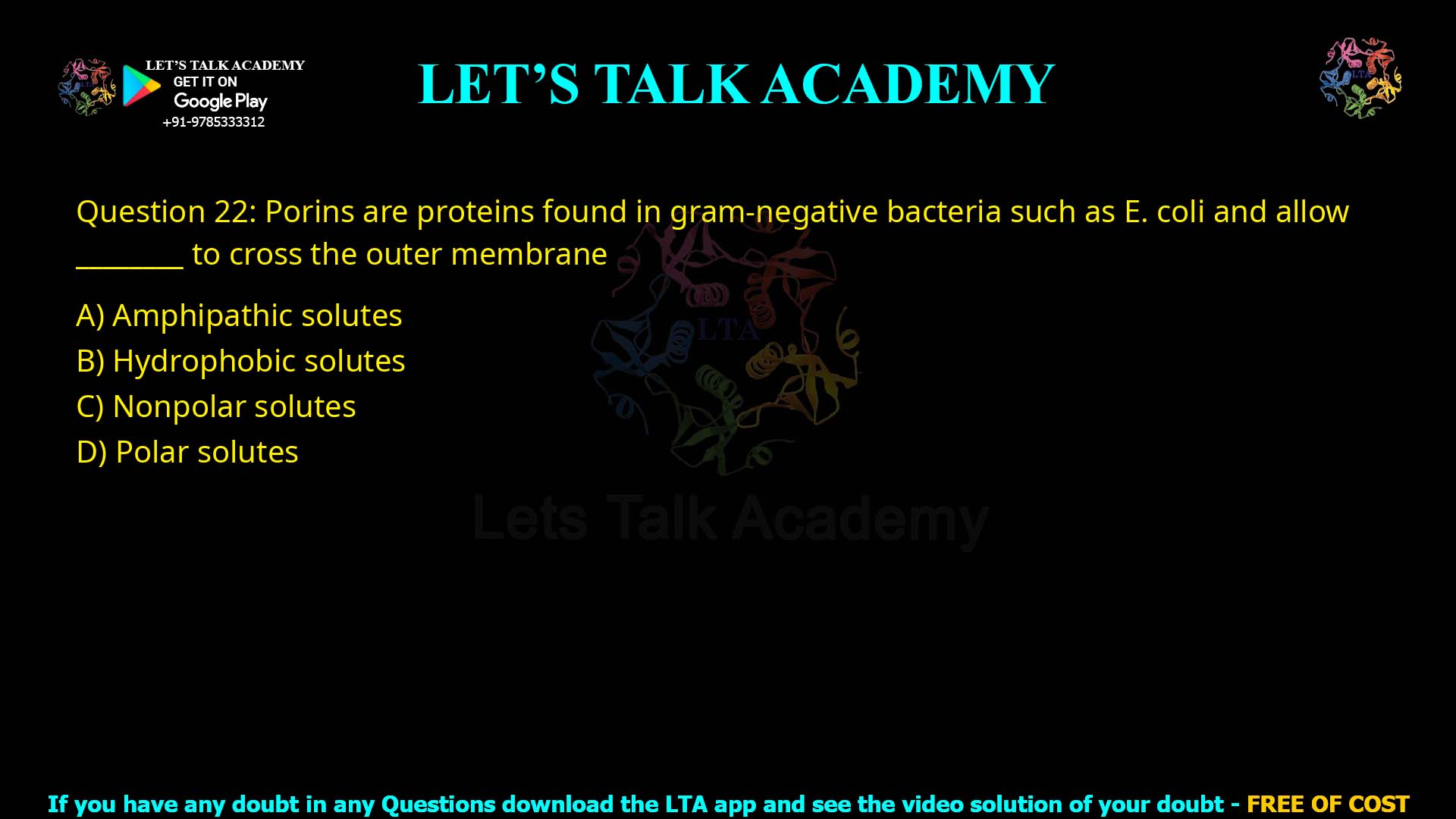
Q.22 Porins are proteins found in gram-negative bacteria such as
E. coli and allow ______ to cross the outer membrane.
Porins in gram-negative bacteria like E. coli allow polar solutes to cross the outer membrane. These β-barrel trimeric proteins form water-filled channels (~6-10 Å diameter) selective for small hydrophilic molecules (<600 Da), excluding hydrophobic solutes blocked by lipopolysaccharide (LPS).
Option Analysis
-
(1) Amphipathic solutes: Partially polar/hydrophobic (e.g., detergents); porins exclude these due to narrow aqueous pores—lipid bilayer handles them.
-
(2) Hydrophobic solutes: Lipids, fatty acids diffuse through LPS bilayer; porins impermeable to nonpolar molecules lacking H-bonding groups.
-
(3) Nonpolar solutes: Similar to hydrophobic; porins specifically evolved for polar nutrient uptake (sugars, ions), not alkanes/benzene.
-
(4) Polar solutes: Correct—OmpF/C porins transport glucose, amino acids, ions via electrostatic steering (arginine ladder attracts anions).
Answer: (4) Polar solutes.
Introduction to Porin Function
Porins are proteins found in gram-negative bacteria such as E. coli and allow polar solutes to cross the outer membrane. These general diffusion channels (OmpF, OmpC) maintain selective permeability against hydrophobic antibiotics while permitting hydrophilic nutrients.
Porin Channel Characteristics
-
Structure: 16-stranded β-barrel trimer, 10 Å constriction zone
-
Selectivity: Polar/charged molecules <600 Da; arginine cluster attracts anions
-
Exclusion: Hydrophobic solutes partition into LPS bilayer instead
Solute Permeability Comparison
| Solute Type | Porin Access | Pathway |
|---|---|---|
| Polar | Yes (glucose, ions) | Channel |
| Amphipathic | Limited | Bilayer |
| Hydrophobic | No | LPS leaflet |
| Nonpolar | No | Diffusion |
GATE Microbiology Relevance
Tests OM permeability barrier: porins = polar gatekeepers. Critical for antibiotic resistance (porin loss), LPS barrier concepts.


