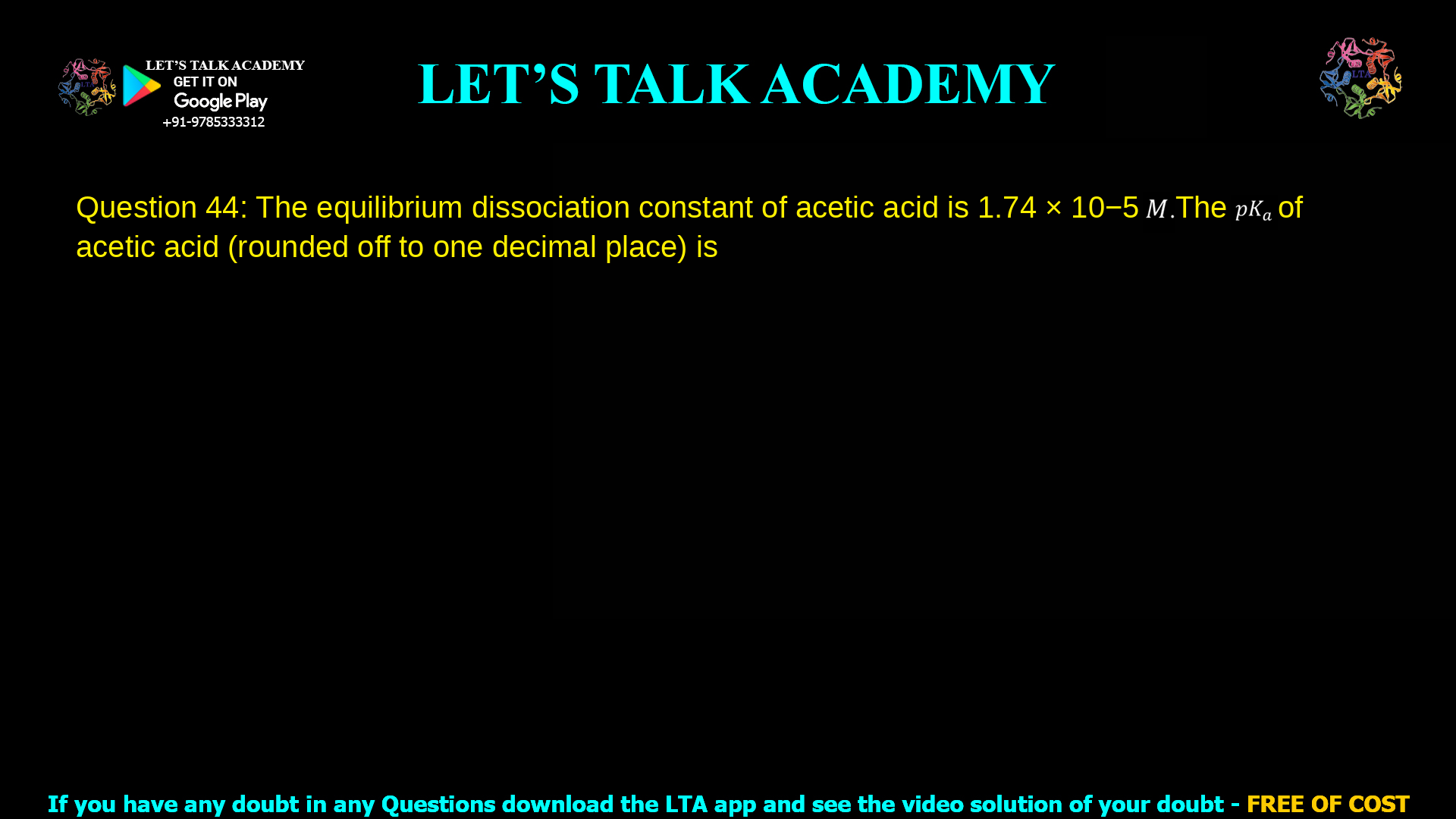
Q.44 The equilibrium dissociation constant of acetic acid is 1.74 × 10⁻⁵ 𝑀. The 𝑝𝐾𝑎
of acetic acid (rounded off to one decimal place) is _____ .
The pKa of acetic acid, given its equilibrium dissociation constant (Ka) of 1.74 × 10⁻⁵ M, is 4.8 when rounded to one decimal place.
Calculation Steps
Acetic acid dissociates as CH₃COOH ⇌ CH₃COO⁻ + H⁺, where Ka = [CH₃COO⁻][H⁺]/[CH₃COOH].
pKa defines acid strength via the formula pKa = -log₁₀(Ka).
Substitute Ka: pKa = -log₁₀(1.74 × 10⁻⁵) = 4.759, which rounds to 4.8.
No Options Provided
This numerical question lacks multiple-choice options, so no alternatives require evaluation. Common distractors in similar CSIR NET problems include unrounded values (4.76 or 4.8 without rounding check) or errors like using log(Ka) instead of -log(Ka).
Introduction to pKa Calculation
In biochemistry and CSIR NET Life Sciences, determining the pKa of acetic acid from Ka 1.74 × 10⁻⁵ measures acid strength for buffers and enzyme kinetics. Ka, the equilibrium dissociation constant, quantifies weak acid ionization; pKa simplifies it logarithmically for practical use.
Step-by-Step Derivation
Formula: pKa = -log10(Ka)
Input: Ka = 1.74 × 10⁻⁵ M
Log Calculation: log(1.74 × 10⁻⁵) = log(1.74) + log(10-5) ≈ 0.240 – 5 = -4.760
pKa: -(-4.760) = 4.760 ≈ 4.8 (one decimal place)
This matches standard values near 4.76, adjusted for given Ka.
CSIR NET Relevance
Applications: pKa predicts ionization in buffers (Henderson-Hasselbalch: pH = pKa + log([A⁻]/[HA])) for protein stability, enzyme activity.
Common Errors:
- Forgetting negative sign: Yields ~4.8 instead of 4.8? No—direct mistake gives positive log error.
- Rounding prematurely: 4.76 vs. 4.8.
- Ka misread: 1.8 × 10⁻⁵ gives 4.74.
Verification: Python confirms: import math; -math.log10(1.74e-5) → 4.759
Quick Reference Table
| Parameter | Value | Notes |
|---|---|---|
| Ka (given) | 1.74 × 10⁻⁵ M | Equilibrium dissociation constant |
| pKa (calculated) | 4.8 | Rounded to one decimal |
| Standard pKa | ~4.76 | For Ka ≈ 1.8 × 10⁻⁵ |
Master this for CSIR NET acid-base equilibrium questions in biochemistry units.


