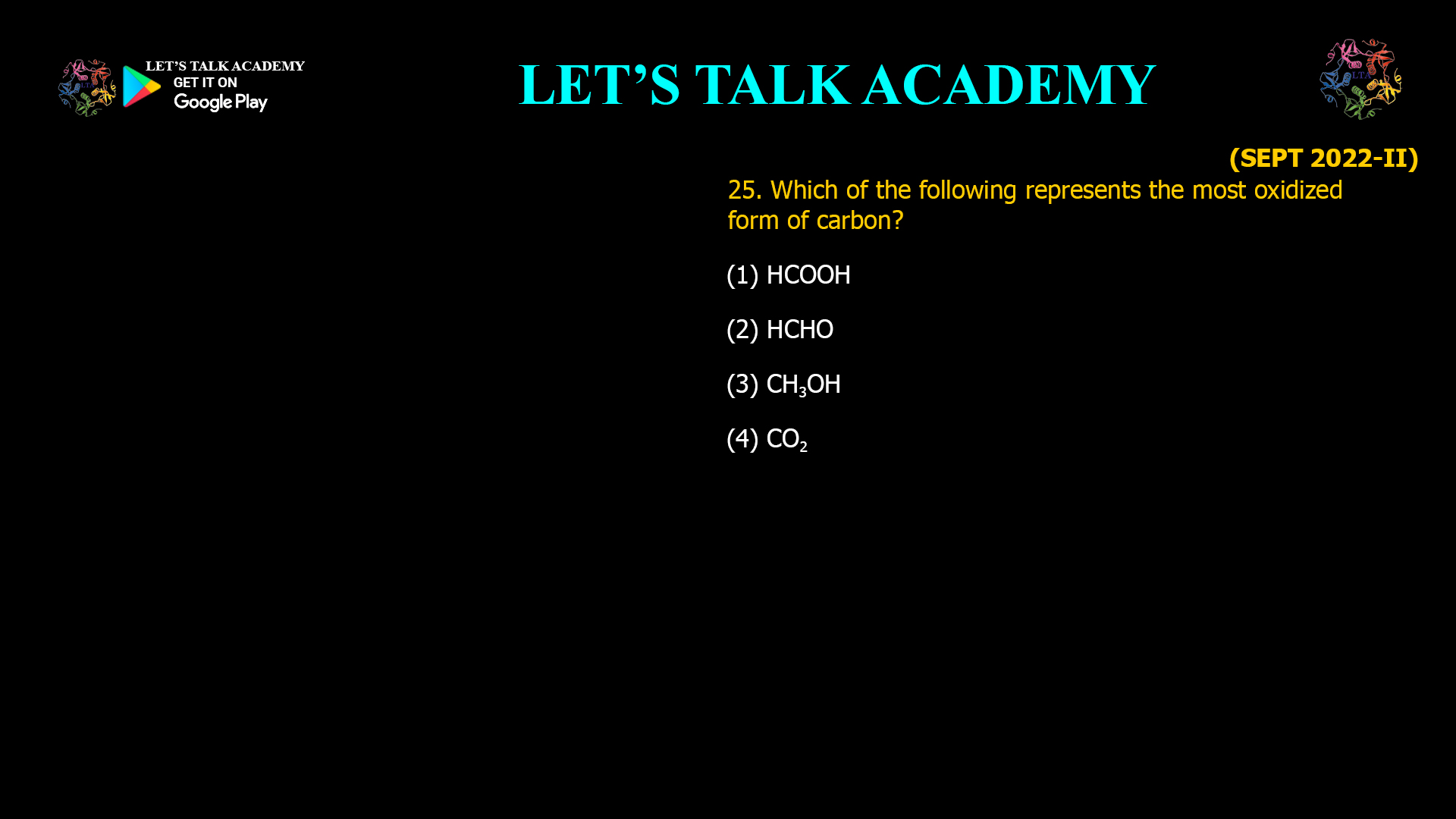
25. Which of the following represents the most oxidized form of carbon?
(1) HCOOH (2) HCHO
(3) CH3OH (4) CO2
Carbon exhibits a range of oxidation states depending on the chemical environment and the atoms it is bonded to. Determining the most oxidized form of carbon among compounds like formic acid (HCOOH), formaldehyde (HCHO), methanol (CH3OH), and carbon dioxide (CO2) involves understanding how oxidation states are assigned and how the presence of electronegative atoms influences these states.
What Is Oxidation State?
The oxidation state (or oxidation number) of an atom in a molecule is a formalism that represents the hypothetical charge an atom would have if all bonds to atoms of different elements were completely ionic. For carbon, oxidation states can vary widely, from -4 in methane (CH4) to +4 in carbon dioxide (CO2).
How to Calculate Oxidation States of Carbon
-
C–H bonds: Hydrogen is less electronegative than carbon, so each C–H bond decreases the oxidation state of carbon by 1.
-
C–O bonds: Oxygen is more electronegative than carbon, so each C–O bond increases the oxidation state of carbon by 1.
-
C–C bonds: Bonds between carbons do not affect the oxidation state of carbon atoms involved.
Using these rules, we can analyze the oxidation state of carbon in each compound.
Oxidation States in the Given Compounds
1. Methanol (CH3OH)
-
Carbon is bonded to three hydrogens (each lowers oxidation state by 1) and one oxygen (raises oxidation state by 1).
-
Calculation: Starting from 0, three C–H bonds lower oxidation state by 3, one C–O bond raises it by 1.
-
Oxidation state of carbon = 0 – 3 + 1 = -2.
2. Formaldehyde (HCHO)
-
Carbon is bonded to two hydrogens (each lowers oxidation state by 1) and one oxygen (raises oxidation state by 2 because of a double bond).
-
Calculation: 0 – 2 + 2 = 0.
-
Carbon oxidation state is 0.
3. Formic Acid (HCOOH)
-
Carbon is bonded to one hydrogen (lowers oxidation state by 1) and two oxygens (each raises oxidation state by 1, total +2).
-
Calculation: 0 – 1 + 2 = +1.
-
Carbon oxidation state is +1.
4. Carbon Dioxide (CO2)
-
Carbon is bonded to two oxygens (each raises oxidation state by 2 because of double bonds), total +4.
-
Calculation: 0 + 4 = +4.
-
Carbon oxidation state is +4.
Which Is the Most Oxidized Form?
Among these compounds, carbon dioxide (CO2) has the highest oxidation state of carbon at +4, making it the most oxidized form of carbon. This is consistent with the understanding that CO2 is the final oxidation product of carbon in aerobic respiration and combustion.
Summary Table
| Compound | Oxidation State of Carbon | Description |
|---|---|---|
| CH3OH | -2 | Least oxidized (methanol) |
| HCHO | 0 | Formaldehyde |
| HCOOH | +1 | Formic acid |
| CO2 | +4 | Most oxidized form of carbon |
Conclusion
The most oxidized form of carbon among the given options is carbon dioxide (CO2), where carbon attains an oxidation state of +4. This reflects the maximum oxidation state carbon can achieve in common compounds, highlighting CO2’s role as the end product of carbon oxidation in biological and chemical processes.
Final Answer:
(4) CO2


6 Comments
Pallavi Ghangas
September 23, 2025CO2
Kirti Agarwal
September 24, 2025Co2
Roopal Sharma
September 25, 2025Co2
Manisha choudhary
September 27, 2025CO2
Kajal
October 4, 2025Co2
Rishu
November 25, 2025Co2 is the most oxidized form