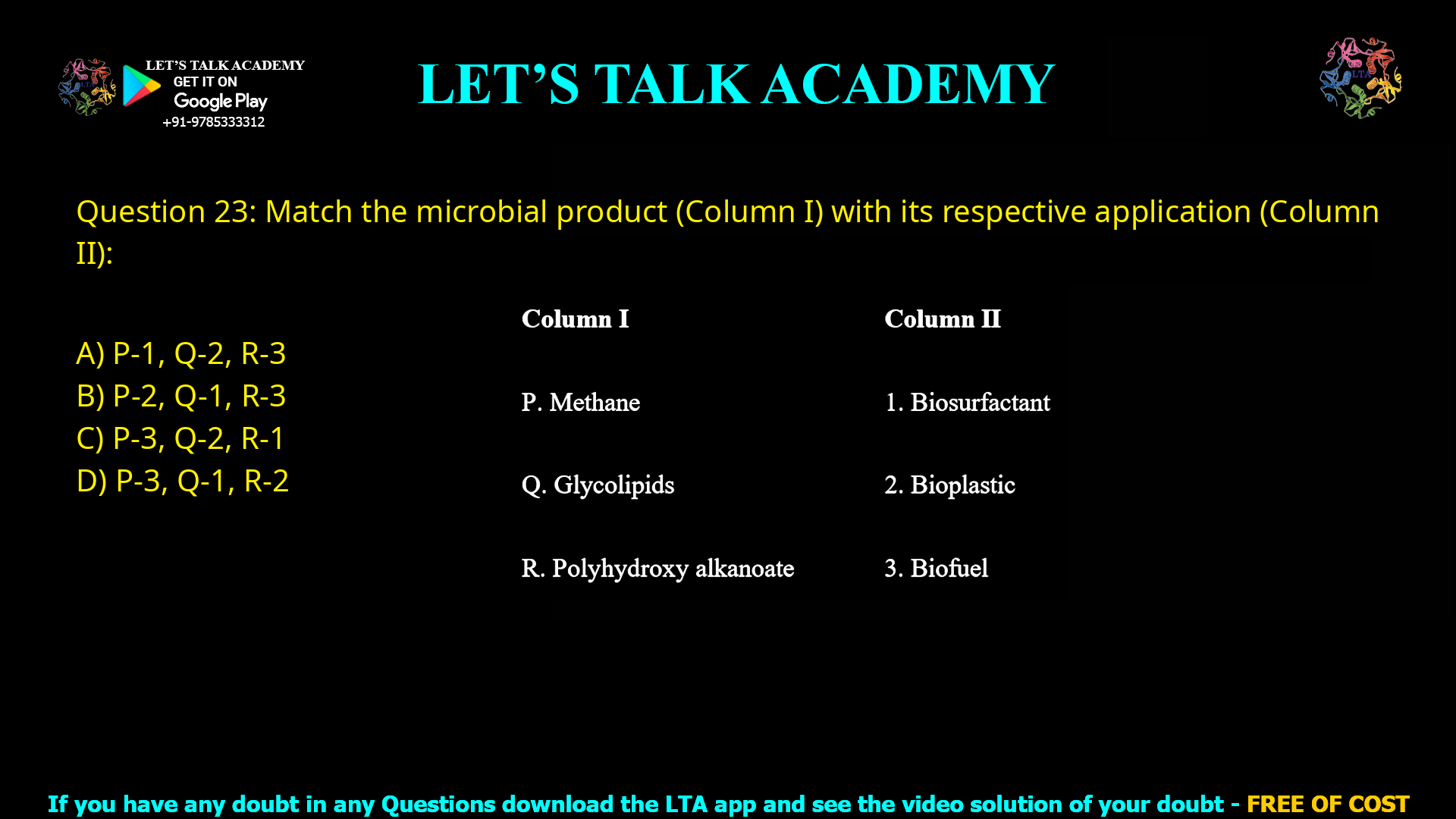
Q.23 Match the microbial product (Column I) with its respective application
(Column II).
Column I Column II
P. Methane 1. Biosurfactant
Q. Glycolipids 2. Bioplastic
R. Polyhydroxy alkanoate 3. Biofuel
(A) P-1, Q-2, R-3
(B) P-2, Q-1, R-3
(C) P-3, Q-2, R-1
(D) P-3, Q-1, R-2
Methane serves as a biofuel, glycolipids act as biosurfactants, and polyhydroxy alkanoates function as bioplastics in microbial applications. The correct answer is option (D) P-3, Q-1, R-2.
Correct Matching
-
P. Methane → 3. Biofuel: Methane, produced by methanogenic archaea via anaerobic digestion, powers renewable energy as biogas, reducing fossil fuel reliance.
-
Q. Glycolipids → 1. Biosurfactant: Microbially derived glycolipids like rhamnolipids lower surface tension for bioremediation, cleaning, and oil recovery.
-
R. Polyhydroxy alkanoate → 2. Bioplastic: Bacteria such as Cupriavidus necator synthesize PHA polymers, offering biodegradable alternatives to petroleum plastics.
Option Analysis
| Option | P-Methane | Q-Glycolipids | R-PHA | Correct? | Reason |
|---|---|---|---|---|---|
| (A) P-1, Q-2, R-3 | Biosurfactant | Bioplastic | Biofuel | No | Methane fuels energy, not surfactants; glycolipids emulsify, PHA biodegrades. |
| (B) P-2, Q-1, R-3 | Bioplastic | Biosurfactant | Biofuel | No | Methane combusts for fuel; PHA forms plastics, not methane. |
| (C) P-3, Q-2, R-1 | Biofuel | Bioplastic | Biosurfactant | No | Glycolipids surfactant via amphiphilic nature; PHA stores carbon as plastic. |
| (D) P-3, Q-1, R-2 | Biofuel | Biosurfactant | Bioplastic | Yes | Matches primary microbial biotech uses precisely. |


