
An enzyme is governed by Michaelis-Menten Kinetics. The apparent 𝐾𝑀 increases four fold due to the addition of inhibitor but the reaction rate declines by 50%. The substrate concentration in the reaction is:
A. 𝑆 = 𝐾𝑀
B. 𝑆 = 2 𝐾𝑀
C. 𝑆 = 3 𝐾𝑀
D. 𝑆 = 4 𝐾
Title: Understanding Michaelis-Menten Kinetics with Inhibitor Impact on KMK_M and Reaction Rate
Slug: michaelis-menten-kinetics-inhibitor-effect
Meta Description: Explore how inhibitors affect enzyme kinetics. Learn how a fourfold increase in KMK_M with 50% rate reduction reveals the substrate concentration in Michaelis-Menten reactions.
Michaelis-Menten Kinetics and Inhibitor Influence
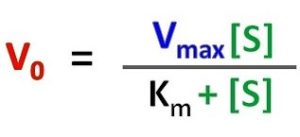
Enzyme kinetics is a cornerstone of biochemistry, with the Michaelis-Menten model being one of the most widely used frameworks to describe the rate of enzymatic reactions. In this model, the reaction rate depends on the substrate concentration [S][S], the maximum velocity
V = Vmax/Km +Km
Problem Statement:
An enzyme follows Michaelis-Menten kinetics. Upon adding an inhibitor:
- The apparent Km increases 4-fold
- The reaction rate drops by 50%
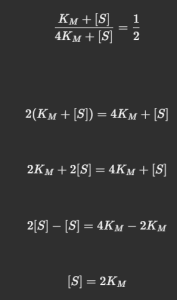
1/2 V=Vmax[S]\ 4KM+[S]
We are to determine the substrate concentration [S][S] relative to the original Km
✅ Correct Answer: B. S=2Km = 2Km
Step-by-Step Explanation
Michaelis-Menten Equation:
Why the Other Options Are Incorrect
- A. S=Km S = Km → Would not result in a 50% reduction with 4x Km
- C. S=3Km S = 3Km and
- D. S=4Km = 4Km → Would give lesser effect than 50% drop
Key Takeaways
- A fourfold increase in Km with 50% rate drop points to competitive inhibition.
- Substrate concentration at this point is twice the original Km


6 Comments
Suman bhakar
April 6, 2025Okay sir
Khushi yadav
April 17, 2025Done
Yashika Rajoriya
April 17, 2025Done
Vikram
April 17, 2025Done
Prami Masih
April 28, 2025✅✅
yogesh sharma
May 3, 2025Done sir ji 👍👍